Showing posts with label Mid Wmtte Hless Initiative Task Force. Show all posts

Saturday, June 3, 2017

Transition to MWVCOG

Revised: December 2018

By Sarah Owens and Michael Livingston


[Material originally posted under, "MWHI Transition Team Mulls Next Steps", and "News from the Continuum" (28 April 2017) and (24 June 2017)]
At the Task Force's last and final meeting in February, co-chairs Cathy Clark and Janet Carlson, having tried unsuccessfully to persuade anyone in the non-profit community to take on the role of a "backbone" organization for purposes of implementing the Task Force's strategic plan, proposed "housing" a strategic plan "project manager" in the MWVCOG or "COG", details to be worked out later by a transition team.

On April 20, the "Transition Team" met for the first time in an unannounced meeting at the Mid Willamette Council of Governments (COG)'s High Street offices.  Attendees included Marion County staffer Hitesh Parekh, Mayor Cathy Clark, Marion County Commissioner Janet Carlson (on the phone), Karen Ray (on the phone), John Reeves, Shaney Starr, COG executive director Nancy Boyer and Salem City Manager Steve Powers.  They discussed mainly costs and potential funding sources.  The upshot of the meeting was that COG wants a formal proposal, with a commitment of around $120K for salary/benefits (FTE), rent, incidental expenses and a telephone, less if the position is part time.

On May 30, the Transition Team held a public meeting at COG to go over the draft description of the Homeless Initiatives Coordinator position (see City of Salem staff report), and discuss next steps.

Marion County has "set aside" $45,000 for the position.  The Keizer and Salem budget advisory committees declined to recommend funding during their regular budget processes, with City of Salem staff opining that there should be "further organizational development before considering this expense", which they characterized as "ongoing."

However, Powers said during the May meeting that "Keizer is supporting the position" ($5,000), and he will be "going back to Council" to recommend that Salem also support the position ($65,000, up from the $40,000 mentioned at the February Task Force meeting).  The position is listed in Powers' budget as an "enhancement" and described as being "for a position focused on working the affordable housing initiatives and opportunities identified in the Mid-Willamette Homelessness Initiative." 

As for the "further organizational development" that City staff felt was needed, "We still have work to do for other jurisdictions who might be interested", said one participant at Tuesday's meeting, "we need a clear work plan for what the money will be buying", and "certainty from partners on their commitments."

The draft position description lists the following "distinguishing characteristics":

The position will be "responsible for the overall management of specialized efforts to develop a cohesive, collaborative and coordinated system of care that extends the reach of resources available to the homeless population.  Such efforts may include working closely with a network of local non-profit service providers, governmental agencies, and local businesses to provide case management, emergency housing, transitional housing, permanent supportive housing, mental health and substance abuse counseling, and domestic violence interventions.  Efforts may also include system development, organizational evaluation and other projects to improve the efficiency and effectiveness of the program.  The focus of this position is on initial program development and evaluation rather than ongoing managerial responsibility."

Powers told the group he expected that, when he returned to Council, he would be asked about other means and types of collaborations -- business, for example.  Would COG facilitate those collaborations, he wanted to know?  Or should the team consider, for example, United Way as a more suitable "home"?  (Several months previous, United Way of the Mid Willamette Valley had hired Ron Hays to replace outgoing Executive Director Randy Franke to deal with a sharp decline in revenues.  Hays reneged on Franke's FY 2017 grant agreements with local providers, citing budgetary concerns.)  Might the team want to talk to other potential partners, Powers wanted to know.   

"Phase One", Commissioner Carlson was quick to explain, "would be general agreement" between Salem, Keizer, Marion County and COG, with a "policy team giving guidance to the position."

The decision to house the position in COG had been made, Carlson seemed to be saying, because COG is "Switzerland", and anyway, she didn't trust United Way because it brings in so few funds ($2M) relative to Eugene's United Way ($6M), and it also allowed her Volunteer and Mentor Center to die.

Carlson continued for the next ten minutes, touching on a wide range of topics, including how a money map would show most homeless monies come from government, the conference call with HUD HQ about the ROCC, the problems with the Youth Homeless Demonstration Project planning grant application, and the possibility of adding a CoC administrator or HMIS lead to the project manager to be housed in COG.

When at last Carlson yielded the floor, Powers asked COG's new ED, Sean O'Day, for his thoughts on the "expanded vision" for COG.  (COG currently has no programs coordinating housing or homeless services.)  O'Day said he would of course have to take it to the board, "who have been waiting for it to gel."  He said the proposal was "in the budget", but they still needed an IGA between COG and "the jurisdictions" that was "discrete to the position."  As for other potential partners, he thought MWVCAA "might explore housing the position." 

MWVCAA Director Jon Reeves opined somnambulantly that the problem with housing the position in a non-profit was conflicting priorities, which he characterized as "community vs. program."  He said the United Way option might be more viable to him if it wasn't at the very beginning of a new administration (Hays's).  He said he "struggles with [the] COG [option] because of the governments involved and the potential for non-participation", likely a veiled reference to Polk County.

About the conference call with HUD HQ, Reeves said that, "when HUD said you can't do this [separate from ROCC], it won't work, it really made me want to do it."  It was, as usual, not clear if he was joking.

Powers, looking right at Commissioner Carlson, said there was no question about "the City's commitment to making this plan actionable", but would it be helpful, he wondered to the group, to have a discussion with the "policy team", and determine what the level of interest was among non-profits and other private companies in affordable housing and homelessness?  The response to his question, to the extent there was any, suggested the others either didn't understand what he was asking, or, more likely, wished to avoid the question. 

In summing up, Powers noted that there was general agreement on the minor changes needed to position description, but that they were still considering the pros and cons of the COG plan, and whether it "could expand outside government."  Someone asked about the next meeting, which had the unintended consequence of re-raising his question of whether or not they should meet with NGO  "policy team" members, and also who would be on the policy team.  Commissioner Carlson began talking about her suggestions (she was the only one to have turned in a list of names).  Reeves wondered if the Coordinated Entry Workgroup wasn't "a place to talk about this", and someone asked about including Yamhill County.  Powers finally let everyone off the hook and concluded there was "no need to have a meeting with sectors of the policy committee." 

Someone announced that the next meeting of the COG board of directors was June 20.  O'Day said he would have a "placeholder" for an information report on the proposal, and would be "gauging their interest" in it.  He said he would ask for authority to negotiate an IGA, because he didn't have "enough to draft one" at present.  Commissioner Carlson asked if this might be the last meeting of the transition team, then?  No, said O'Day, "if the board says okay [to his negotiating an IGA], then this group would iron out the details."  Powers suggested that "the three funders meet" by themselves for that purpose, which was agreed to.  No date was set.

On June 20, the COG board voted unanimously to authorize O'Day to negotiate an intergovernmental agreement between it and Salem, Keizer and Marion County, whereby the latter will pay for, and the former will "house a Program Manager who will oversee implementation of the Mid-Willamette Valley [sic] Homeless Initiative Strategic Plan."  The decision appeared to rest on O'Day's recommendation to proceed, and his assurance that COG would not be responsible for any of the costs.  COG budgeted $54,935.73 for the position, which is just a half FTE, perhaps because Salem has yet to approve the $65,000 it's expected to put up.

The City of Salem's Affordable Housing, Social Services and Homelessness Strategic Planning Work Group met several times over the summer.  The COG agreement/position was barely mentioned.

On October 17th, the COG board authorized O'Day to execute the IGA with Salem, Keizer, Monmouth, Independence and Marion County to establish a Homeless Program Coordinator position within COG. Salary and benefits to be paid by the cities and County.  Salem and Marion County to put up $45K each, with the remainder cities each putting up $5K.  Details here.

On October 23, the Salem City Council adopted strategic plan goals for affordable housing, homelessness and social service coordination, which didn't include the COG agreement/position.

On November 27, the Salem City Council authorized execution of the IGA, including allocating $45,000 toward a coordinator.  See here.  Although the staff report asserted that "The program will not duplicate or dilute existing advisory boards or initiatives the City has started -- such as the Homeless Rental Assistance Program" -- the position's "scope of work" is sufficiently broad that overlap and duplication would seem to be unavoidable.  We asked Mayor Bennett if the City's participation was the price that Marion County (i.e., Janet Carlson) required for its support of his sobering station.  His answer, "Pretty much."  Statesman Journal article here.  
  

Thursday, June 1, 2017

MWHITF: Carlson Denies Wrongdoing

Revised: December 2018

By Sarah Owens and Michael Livingston


[Material originally posted under the titles, "Janet Carlson: Fact Check" (18 March 2017) and "Salem Weekly: Fact Check" (26 May 2017).]

For over a year, the Tuesday Willamette Wake Up team, then consisting of yours truly, Sara Cromwell and Sarah Rohrs, covered the Mid-Willamette Valley Homeless Initiative Task Force for KMUZ, 100.7 FM in Salem.  We also reported on the Task Force here in the CANDO Archive.   

However, it wasn't until January of 2017 that any of our reporting came to the attention of Marion County Commissioner Carlson, who took particular issue with the Willamette Wake Up report that aired January 17 (podcast here).  Melanie Zermer and Bill Smaldone (President of KMUZ's Board of Directors and member of the Salem Weekly Editorial Board) both reviewed the podcast, and concluded "the research was thorough and makes a compelling argument for public concern."  John Gear, legal counsel to the Board, also reviewed the podcast and approved the quality of the reporting as a "scoop."

About ten days after the report aired, the County asked KMUZ to "either remove the podcast from further distribution, or allow the county, and other task force conveners if they wish, the opportunity to respond in a follow up interview." 

KMUZ's President responded to the request saying that, of course, there would be an opportunity for a response.  Willamette Wake Up's Tuesday team arranged an interview date but had to cancel because of a power outage at the station.  The County did not follow through on the offer to reschedule.  The last communication from the County was a February 20 email saying they would "touch base with Michael next week", which they never did.        

On March 16, Salem Weekly ran a cover story about the January 17 Willamette Wake Up report.  The story said the County's PR person "looks forward for Commissioner Carlson and her having the opportunity to 'correct factually inaccurate information, and answer questions by the show hosts regarding the task force.'"  However, the County never attempted to reschedule an interview.     

The same day the Salem Weekly published its story, "Gator" Gaynor interviewed Commissioner Carlson on his show, Gator's Radio Experience, on KYKN, 1430 AM in Keizer.

The show has since been canceled, and the show's podcasts are no longer available.  However, three things about her interview are worth noting.

First, Carlson told "Gator" that she still wanted to do the interview with the Tuesday Willamette Wake Up team, she "just hasn't had the opportunity."  The show aired Tuesdays from 8 to 9, and the team was willing to schedule as far out as necessary to accommodate the Commissioner's schedule.  

The other two noteworthy bits were her comments about Polk County Commissioner Jennifer Wheeler's reasons for leaving the Task Force and her failure to respond directly to the report's very specific charges --  for example, the charge that she withheld Wheeler's October 18 memo from the Task Force and the public and that she was dishonest in telling the Task Force that Heidi Mackay and Sheriff Garton had not resigned.   

When asked during the interview, "from your mouth, what happened with Jennifer Wheeler?", Carlson responded:

Jennifer had some personal things going on in her life at that time, and she stepped away from the Task Force, uh, she, there was some confusion in how the letter was written, and so, when, when we got the letter, Anna, Cathy and myself, from Karen [sic], we needed to check in to find out whether it meant that Jennifer was stepping down, or whether Polk County was stepping away.  And that took us a little while to, uh, Anna talked to Mike Ainsworth, I talked to Craig Pope, uh, we also talked with our legal counsel, they had not rescinded their charter, so we thought it would be best to clarify at the next meeting, that while Jennifer had resigned, that Polk County was still at the table.  So it was the consensus of the co-chairs to come up with a statement, uh, to say that the four jurisdictions were still moving forward.  When I talked with Craig, they were really not interested in trying to, you know, the other two commissioners had a lot of commitments, didn't want to step in, and only three meetings left at that point, so, uh, that was where we went.  I sent you an email, I hope you got that, from Jennifer where, uh, she basically did not condone the, you know, kind of the blogs and the commentary that was going on about the Task Force and Polk County. 

After hearing the interview with "Gator", we asked Commissioner Wheeler whether she in fact "stepped away" from participating further on the Task Force because she "had some personal things going on in her life at that time."  This was her response, received March 23, 2017.


In closing the interview with "Gator", Carlson said,

The other point that we want to make is that in some of that innuendo or insinuations or speculations, there's a lot of discussion about transparency and whether we're being transparent or trying to mislead and all of that, you know everything was done appropriately under public meetings laws, you know, when a question came up, I contacted our county attorney, she sent me a statement, I sent that statement out, and I sent that statement to you [the interviewers], that, you know, what we were doing was within the bounds of the public meeting law.  I'm the one in Marion County that actually started the training in public meetings law.  It's a big deal to me, so it's interesting that somehow I'm getting tagged with the idea that I'm doing something inappropriate.   

On May 25, 2017, Salem Weekly ran yet another story about the January 17 Willamette Wake Up report.  In it, Carlson maintains that, contrary to the report, she was not a friend of Karen Ray, but a former colleague whose work she admired.  Carlson told Weekly she did her doctoral dissertation on one of Ray's books.  The report referred to Ray as "her friend, they had worked together in past years."

The Weekly incorrectly characterized the report as saying, "Ray's hiring...to do work a qualified volunteer could have done was contrary to the directive to co-chairs that they limit themselves to administrative actions."  What the Willamette Wake Up report actually said was,

Carlson was unable to persuade Co-Chair Polk County Commissioner Jennifer Wheeler of the need to go out of state, or to pay $20,000 for services that Wheeler suspected very well were available in the community, and probably for free.
and,

The County Counsel for Marion County, in responding to our request to attend and cover these co-chair meetings said they [the co-chairs] don't have any authority to make any substantive decisions, their authority is to schedule meetings...put items on the agenda, sort of ministerial, not to make any substantive decisions. 

Carlson admitted to the Weekly that Wheeler had left "over her unhappiness with the hiring of Ray, but Carlson adds that the departure was also due also to personal matters unrelated to the task force."  Wheeler has, as noted above, denied this.  

Carlson told the Weekly she rejected the report's suggestion that "she misled assembled task force members at the November 7, 2016 meeting...where she stated that several Polk County members 'just couldn’t be here.' It is not accurate, she maintains, to say that she made that statement 'knowing' that Polk County had actually departed."

Carlson's exact words to the Task Force at the November meeting were, "If I could clarify.  Jennifer resigned.  Steve Bobb sent in his resignation recently.  Heidi Mackay has not resigned.  Sheriff Garton has not resigned.  They just couldn't be here tonight."  The report did not allege Carlson's comments were made, "'knowing' that Polk County had actually departed", but that she made them after she had received and replied to, that very morning, an email from Heidi Mackay.  Mackay's email stated:

As already established by Commissioner Wheeler's letter dated October 18, 2016, Polk County is declining to participate in further meetings of the homeless task force.  Accordingly, as one of Polk County's appointed task force members, I also decline to participate in ongoing task force business. 

The Weekly stated that, "In fact, Carlson's documentation shows Polk County had not left the task force on November 7, and never did."  We haven't seen Carlson's "documentation", but the issue raised by the Willamette Wake Up Tuesday team was not whether Polk County "left" (i.e., whether its Task Force Charter remained intact), but why Carlson misrepresented the situation to the Task Force and the public.  The fact of Wheeler's memo is undisputed.  The fact that Carlson withheld it from the larger Task Force is undisputed.  The fact that Carlson received and replied to Heidi Mackay's email  prior to the meeting is undisputed. And, the fact that she told the Task Force that Jennifer Wheeler and Steve Bobb had resigned but Heidi Mackay and Sheriff Garton had "not resigned, "[t]hey just couldn't be here tonight," is undisputed

The Weekly had no basis for saying that, "The January 17 program...was part of an ongoing conflict between [the show's] co-host Michael Livingston and his wife, Sarah Owens, -- and the task force."  This is an ad hominem, circular argument that seeks to imply, but does not state, that the January report was somehow biased, and therefore lacking in credibility, because of critical CANDO Archive posts and emails linking to them that were sent to the Task Force once a week.  The claim of "ongoing conflict" was not raised in Carlson's interview with Gator Gaynor on KYKN in January, or anywhere else we know of, and it is not true.  Moreover, Carlson told her co-chairs in an email obtained through public records requests that "I don't read Sarah Owens' emails."              

Wednesday, February 15, 2017

Carlson Pitches Plan to Marion County

Revised: January 2019

By Sarah Owens and Michael Livingston


[Originally posted under the title, "Mayor Announces Ambitious Plan for Chronic Homeless."]

Laura Walker and Janet Carlson 2/15/17
On February 15, 2017, Marion County Commissioner Carlson pitched to the other two County Commissioners pretty much the same MWHI Task Force presentation she had pitched to the Salem City Council the night before.  However, Carlson told the County that the City of Salem was interested in implementing a "Real Change" (anti-panhandling) program, which she didn't mention at the the City Council meeting.

Speaking about the proposal to put a project manager in the MWV Council of Governments to oversee implementation of the Task Force's strategic plan, Carlson said Mayor Bennett "jumped on the idea and said he thought it was a great idea."  That also was not mentioned at the City Council presentation. 

Carlson said she and Mayor Clark had "talked to each of the jurisdictions...about setting aside some funds so we can jump start this project manager position over at the COG", but did not mention the $40,000 each from Salem and Marion County that she had referred to at the City Council meeting.

Carlson said the project manager would report to an executive team made up of the executive directors of various agencies and "jurisdictions who would help guide the process" and "oversee the implementation, for example, the housing authority directors, the Community Action director, the Union Gospel Mission director, those people would be key in helping guide that work because they're the ones that are providing those services."  (UGM's and MWVCAA's directors were on the Task Force, so they might have consented to this, but it's doubtful any other agencies or "jurisdictions" even know about this plan.)

Same Brentano and Kevin Cameron 2/15/17
When Carlson asked for questions, Commissioner Cameron wanted to know what to expect to receive in the way of "reports."  Carlson said she couldn't yet say.  In a typically rambling response, she said she suspected that Salem and Marion County combined provide "the lion's share" of resources for the homeless, and that "thousands of people are housed in the City of Salem every day in programs by the Housing Authority."

Commissioner Brentano said he sensed Commissioner Carlson's concern and didn't want to offend, but he didn't know "what we're signing on for.  We need a better picture of the real dollars and the commitment long term that you're looking for, so, there's a lot of vagueness...so that's what I'll be looking for."  He also said that he was "always concerned about setting up programs that attract others to come into the area...I don't want to become the Mecca for homelessness.  I want to take care of our own, but not expand it."  In another rambling response, Carlson talked about Eugene's camping programs and the Home Base Shelters of Salem  proposal for a camping program in Salem or Marion County and indicated her belief that neither owned a suitable parcel.  

Tuesday, February 14, 2017

Mayor Vows Not to Surrender as Plan Thuds

Revised: January 2019

By Sarah Owens and Michael Livingston


Cmr. Carlson presents certificate to frmr Mayor Peterson
Last night, the City Council received a 15-minute presentation on the work of the Mid-Willamette Homeless Initiative Task Force over the past year from Commissioner Janet Carlson, who concluded by presenting a certificate of appreciation to former Mayor and co-chair Anna Peterson, as former Councilor and Task Force member Warren Bednarz looked on.

During the presentation, Carlson commented on some of the many recommendations contained in the Task Force's 27-page strategic plan, and took credit for Mountain West's efforts to develop affordable housing. 
One of the things that we've already accomplished in this particular area is that Mountain West received a $5 million dollar grant from Oregon Housing and Community Services and is committed to developing several hundred units of affordable housing over the next several years.
Also mentioned were a transitional housing project of Marion County and the shelter relocation planned by Union Gospel Mission, both of which preexisted the Task Force.  Carlson even seemed to take credit for the City's having made shelter space available to UGM when its capacity was reduced and for the Marion County DA's embrace of harm reduction principles, although the Task Force was responsible for neither of those things.

Commissioner Carlson
"The Task Force spent a lot of time talking about what we call 'pivoting to implementation'", Carlson told the Council, "What we have talked about, and what we are working on, is hiring a project manager and creating a leadership team, which would consist of the people which represent the key partner organizations...we will also be convening people at the program manager level, and then the line staff, which are already convened through the Emergency Housing Network, so we are believing we could tag on to that."  And, according to Carlson:

Marion County has set aside $40,000 for this project.  Steve Powers and Chuck Bennett have told us they can identify another $40,000 to jump start this position.  City of Keizer is not committed yet; but is looking for another five.  And then we are working with the Council of Governments.  We are working with their board...ultimately this position would be folded in to their regular staff...The first step is to create a memorandum of collaboration among all the different entities...[and then] prioritizing strategies, looking for the low-hanging fruit, taking the ones that are more difficult and putting them into a project management plan and moving forward. 

Mayor Bennett
Following the certificate-of-appreciation presentation and another warm thank-you to Warren Bednarz, Carlson turned the floor back to the Mayor, who expressed his gratitude to everyone for their work, saying the City was already working "on aspects of this that we will talk about further with Council as time passes, but this is going to be a tremendous undertaking."  

"I will tell you, the one thing I like about this is, we're not going to surrender to this problem, and say, the only place to live is in a tent, in a park, in the mud.  We are not going there.  So, we are going to treat our neighbors without homes with dignity, and with real care", he said, and then  proceeded on with the evening's agenda.

The next morning, Commissioner Carlson gave pretty much the same presentation to her colleagues on the Marion County Board of Commissioners.  Then she attended the Mayor's State of the City Address down at the Convention Center.  Carlson was visibly displeased when the Mayor barely mentioned the Task Force's Strategic Plan, and focused instead on announcing an ambitious new program, designed to meet the needs of Salem's chronically homeless population and on his plans for a sobering center, in partnership with Salem Health and Marion County.  That afternoon, the sobering center plans began to unravel.  If Mayor Bennett wanted the County's tangible support for the sobering center, he was going to have to pony up tangible support for Carlson's project manager and leadership team.  Eventually, Salem would agree to the trade off, but it would take the better part of a year.

Thursday, February 9, 2017

MWHITF: Strategic Plan in Brief

Revised: December 2018

By Sarah Owens and Michael Livingston


Since adoption, the Strategic Plan of the Mid Willamette Homeless Initiative (MWHI) Task Force has been significantly reworked under the supervision of its principal author, Marion County Commissioner Janet Carlson and the rest of the MWHI Steering Committee.  The latest version can be found here. With Commissioner Carlson leaving office at the end of the year, this version might become the final version.

The original plan was much less impressive.  Below is a summary of the original, stripped of excess verbiage, with links/updates.  The plan objectives are grouped by the how hard, or easy, it should be to meet them. 

Summary of Original Task Force Recommendations


Will be completed/moot by the Task Force's last meeting
Community engagement/outreach (5).

Self-executing (requires no TF action)
"Support" MWIC's affordable housing projects
"Endorse" Salem/Keizer's implementation of the HNA
"Support" YHDP grant to expand RHY services (not successful)
"Endorse" UGM's relocation/expansion plan
"Endorse" [Westcare] veteran housing project
"Support" any and all DV and family housing projects
"Endorse" the local LEAD effort
"Support" Salem's non-existent anti-panhandling programs (see "Toilets and Panhandling")
"Endorse" the local CCO's efforts to get more people into supported housing (allowed)
"Endorse" MC Re-entry Initiative's transitional housing project
"Support" PHA DV and homeless preferences
"Support" Dream Ctr, HOME expansion & similar neighborhood-based services
"Support" SKATS' travel training program
"Develop" landlord assessment tool (deleted 1/7/17
"Determine" desirability of "temporary support-coordinated camping" program
"Support" Marion County, Salem Health, etc., in creating a Salem-area sobering station
"Support" community partners in creating a one-stop resource center

Not self-executing (requires action)
Inventory land/buildings suitable for housing, change zoning as needed
Explore CDL as "regional tool" (P18) and adopt statewide resource network
Create "Development Team" to implement plan
Develop senior shelter, housing, supportive services, and supportive housing
Develop medical street-outreach team
Develop veteran housing and services

"Advocacy" only 
for coordinating and facilitating grant applications
for more money from the state housing agency
for a home-buyer tax credit
for DV/homeless preference in new housing
for greater HMIS coverage and a plan to secede from ROCC
for collaboration between providers and WorkSource Oregon
for policy changes in SK 24J .
for continued transit service up the canyon  

"Assistance" only
to expand finlit training in schools 
to bring finlit classes to the poor (vs. making them go to a class somewhere)
to offer training about requirements related to service assistance animals 

Wednesday, February 8, 2017

MWHITF: Last Meeting

Revised: December 2018

By Sarah Owens and Michael Livingston


Salem and Marion County are talking about putting up  $40,000 each toward hiring someone to oversee implementation of the Mid Willamette Homeless Initiative Task Force's Strategic Plan.

Characterizing the Plan as "a tremendous platform for our communities to build on", Salem Mayor Chuck Bennett said the City Manager was already working on several items in the plan. "We're very excited about it", he said. 

Mayor Bennett opened the final meeting of the Mid Willamette Homeless Initiative Task Force promptly at 4pm with 10 Task Force members in attendance, enough for a quorum, and about 17 in the audience.  Also present was former Councilor Bednarz, who took a seat on the dais, seconded every motion, and voted, even though he's no longer a member, having been replaced by Councilor Andersen.  Absent were the Polk County reps, along with Verena Wessel and Kim Freeman of Keizer, and Gladys Blum of Salem.  Chief Moore and Sheriff Myers arrived late. 

During the public comment period that began about 4:10, Charles Fong talked about ADUs.  TJ Putman of Salem Interfaith Hospitality Network, who also runs the City's tenant-based rental assistance (TBRA) program, asked the Task Force to recommend funding TBRA programs for families.  Tina Hansen, who's attended most Task Force meetings, expressed her approval of the Task Force's work.

Next up was Jon Reeves to talk about the results of his committee's community engagement efforts.  Reeves mused about the process they'd used, read some survey comments, and received murmurs of appreciation for his hard work.

At 5:35 precisely, Commissioner Carlson began introducing the two recommendations, which had  not adopted at the last meeting because they needed to be reworked, and one new recommendation to offer training on service/assistance animals to landlords and "other agencies."  See here. The Task Force adopted those and voted to delete the landlord-assessment-tool recommendation made by the Health and Housing Committee, as they'd decided it wasn't useful.  Commissioner Carlson then moved adoption of the Strategic Plan, which motion passed.

At that point, Karen Ray was called on to help the Task Force "pivot to implementation", a process she and the Task Force had been working on since the November 2016 meeting. 

Ray began by telling the Task Force that they'd put together a "high quality plan" that would require "changes in organizational policies and procedures."  She asked them whether they voted for it because it's a quality plan, or just to "go along."  Bruce Bailey copped to going along.  Carlson said it put "meat on the bones" of the 10-Year Plan just as she talked about doing last year, thanks to the high-quality work of the committees.  Councilor Andersen said something about its needing a project manager.  Ray changed the subject.

Ray's "map" of Marion-Polk Homeless Services
She said the Task Force had "dissect[ed] what's currently going on in the community" and found that services for the homeless were not well coordinated.  (Illustration at left.)  She went on to talk about  the need for systems change generally, eventually arriving at  issue facing the Task Force, which was that, so far, no one on the Task Force or in the community had volunteered to be the "backbone organization" that would oversee or staff the Plan's implementation.

According to Ray, this was likely because they'd "not yet seen what their self-interest is in solving the persistent problems of homelessness."

Or, as the Statesman Journal put it, maybe it's because, "[m]ore than a year [after the Task Force began its work], it's hard to see what's been accomplished", despite more than 1,300 hours spent in meetings and the completion of a 20-page strategic plan.  (By our calculations, Task Force members, staff and technical advisors spent a total of 538 hours in Task Force meetings.  Members of the provider community, media and general public spent another 642.  That's a total of 1,008 hours in Task Force meetings, to which may be added another 330 hours in committee meetings, for a total of 1,338 hours in meetings, at a value of at least $31,523 ($23.56/hr volunteer rate for 2015) -- first and last month's rent and security deposit for 9 homeless families.)    

Prior to its last meeting, the Task Force had had very little discussion about plan implementation.  They'd had the one meeting with Karen Ray where nothing was decided, a five-minute discussion at the end of the December meeting and a few minutes at the very end of the the January meeting, which they spent listening to Commissioner Carlson talk about about her Implementation Structure Concept memo (p 41).

Some Task Force members were visibly taken aback to hear, half an hour before the meeting and the Task Force were to end, Mayor Clark propose putting a staff person in the MWV Council of Governments (COG) to "make sure the strategic plan happens."

COG has no history or experience with homeless housing and services.  As Mayor Clark put it,

When we [Carlson and Clark] talked to the [COG Board of Directors'] executive committee, they were really not all that interested in being the ones that understand homelessness, so that's where this group of leaders [sic] would be an advisory group to the COG Board.  So we would construct an implementation team that would have leadership from the participating organizations, and then a middle management team, and then there would be networking amongst the line staff.  So that all has to be developed. 

Although it was not entirely clear, Carlson and Clark appeared to be proposing that someone (probably Carlson and Clark) choose a leadership team and hire a staff person who, under the direction and control of COG, as advised by the leadership team, would convene a 3-layer implementation team that would be responsible for "making sure the strategic plan happens." If everything worked out, implementation would begin June 1, 2017, and the COG would adjust dues payments to pick up the cost of the staff person.     

About 6:15, with everyone wanting to go home, and no one really understanding what they were voting on, the Task Force approved the proposal.  Then, Mayor Clark announced that the COG had given the Task Force some kind of award, reminiscent of the one Mayor Peterson received last year, and Commissioner Carlson handed out framed certificates of appreciation to all the Task Force members, and crystalline trinkets to each of the staff.

Sorry homeless people, maybe we'll have something for you next winter.

Tuesday, January 24, 2017

MWHITF: Meeting 10 - Still No Backbone

Revised: December 2018

By Sarah Owens and Michael Livingston


Of the eighteen members still listed on the letterhead, only nine were present for most of the Task Force's January meeting -- not even enough for a quorum.  

For the better part of two hours,  Commissioner Carlson and others went over 20 recommendations, which the Task Force dutifully adopted, except for three that went back to staff to be "reworked."

After directing the Task Force to her January 4 memo, "Implementation Structure Concept" (last two pages), Carlson said Karen Ray was coming back to facilitate the Task Force's final meeting in February.

We're starting to talk with some organizations about where this home might be for this new governance structure, so I'm just going to whet your appetite for what we'll be talking about next time, because Karen Ray will be back to actually facilitate our last meeting [on February 7].  We will be adopting our strategic plan, which Jan Calvin [Marion County Reentry Initiative Project Manager] is helping us put together.  It will include all the recommendations we've voted on so far, plus the few that we said we were going to bring back and work on next time, and any other 'at large' recommendations.  We have tasked the PACE Team to take a look at other communities' plans to end homelessness...and may have a few recommendations to add in, based on what their analysis tells us, and then we'll spend the balance of the meeting talking about pivoting to implementation.

Neither Carlson or Mayor Clark gave any hint who, among those they'd spoken to, had shown any willingness to have their organization play the role of "home" (or "backbone", as it was originally referred to) (or, "Switzerland", as Mayor Clark put it). 

"Implementation Structure Concept"
However, the "Implementation Structure Concept" calls on "participating jurisdictions" to create a "housing commission" and share the cost of a "project manager", which seems to suggest the search for a "home" in an existing institution may have been abandoned.

Salem currently has the Salem Housing Authority Board of Commissioners, which is advised by the Salem Housing Advisory Committee.  There is also the Marion County Board of Commissioners, which oversees the Marion County Housing Authority, the West Valley Housing Authority Board of Commissioners, the Grand Ronde Housing Department, and the Polk Community Development Corporation.  (Salem's Urban Development, Community Services and Housing Commission  (CSHC) was eliminated in January 2018.) 

The podcast of the Willamette Wake Up report on the meeting can be found here

Saturday, January 7, 2017

Does Salem Need a Homelessness Commission?

Revised: December 2019

By Sarah Owens and Michael Livingston


The Salem Breakfast on Bikes blog  reports that, according to a recent phone survey, homelessness ranks high in the list of concerns that Salem residents want the City to address.

The survey also said that, "When asked in an open-ended format what issue is most important for city leaders to address, 21% mentioned an issue relating to housing or homelessness.  This is a 13 percentage point increase since this question was asked in May 2016." 

SBOB was given a copy by "a reader", but were eventually posted to the City's website.

The increased concern between May and December is pretty predictable, being attributable at least in part to the onset of cold weather, charitable holiday activities, and media attention.   Happens every winter and dissipates every spring.

Statesman Journal
Salem has a new mayor.  According to a recent interview with him on KMUZ's Willamette Wake Up and the Statesman Journal, Bennett is thinking of creating a commission on homelessness.  Does Salem need another commission?  Can such a commission replace, enhance or coordinate any existing  organizations? 

SRC Chapter 20G
The Urban Development, Community Services and Housing Commission (CSHC) is charged under SRC Chapter 20G to execute certain duties that it does not currently fulfill.  Would those duties be given over to the new commission?  Why? 

Salem's Ward 1 has a new councilorCara Kaser also takes an interest in homelessness, but her interest, according to the Statesman Journal, is in "tackling homelessness in the downtown area", taking "action as opposed to planning for a silver bullet solution."  What "action" does she have in mindWhat did she mean by "silver bullet solution"?  Is she talking with the mayor about his homelessness commission idea?      

Statesman Journal
Governor Brown told the Statesman Journal that our new mayor "gets how government works" and has priorities that include affordable housing and the needs of the homeless in Salem.  

That's good to know.  

Whether the City should work through an existing board or commission or create a new one remains to be seen.  We just want to see the City do more to live up to its responsibilities to address the needs of its homeless residents by ensuring effective housing and homeless services delivery.     

Sunday, December 4, 2016

MWHITF: Meeting 9 - No Backbone

Revised: December 2018


By Sarah Owens and Michael Livingston


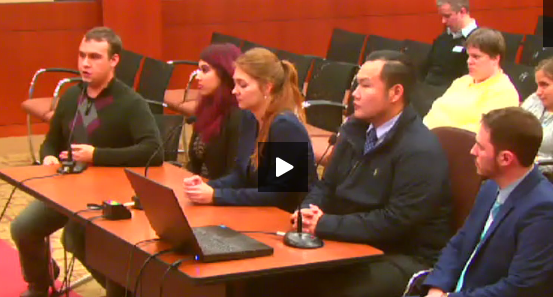
Ryan G., Nowshin A., Meghan M., Shanbo Z., Devon D.
Despite quite a few Task Force members being absent, the Task Force outnumbered the audience  at the December meeting.  There are two meetings left to go.

Salem Mayor-elect Chuck Bennett is now subbing for Mayor Petersen.  

After another of Commissioner Carlson's rambling introductions, five graduate students from Willamette University, enrolled in a course intended to offer "experiential learning as business consultants" and styling themselves as "PACE 2.1 Consulting", gave a 10-minute presentation broadly describing their project "scope" as "conduct primary and secondary research" and "analyze and evaluate strategic plans for each subcommittee", their research on "Veterans Support" (Polk County's efforts in this area), and their "Future Project Plans."  Data analyst Ryan Gail talked about the need for assessment tools to ensure the allocation of resources based on a person's unique needs.

The "PACE Project", first mentioned back in October, is apparently the result of conversations between Carlson and the course instructor.

Notably, the Task Force was not asked to take any action to approve or ratify the "project scope" or plan, and no time frame for completion, other than "the spring", was given.  As with the decision to contract with Karen Ray, the Task Force was simply informed that the students would be involved. 

Following the students' presentation, the Task Force was running about 10 minutes late.  The process of approving the second set of recommendations also ran over 10 minutes, leaving only 5 minutes to decide what the Task Force's successor organization should look like, based on Karen Ray's memo of options.

During the discussion of the recommendations, Mayor Clark asked to have the word "camping" taken out of the recommendation to look into some kind of sanctioned camping program (specifically, "Analyze the advisability of allowing, supporting or facilitating some form of temporary, support-coordinated camping.")  She was okay with the recommendation, just not the word "camping."  As someone in the audience put it, "They recommend not discussing the reality of people's lives."

On the form of the successor organization, there was a brief, unenthusiastic, very general discussion, but, no decision.  One member thought funding should precede a decision on form, but had no suggestions about funding.  Ultimately, it was the opinion of the Chair (Mayor Clark) that the Task Force was looking for a combination of options 2 (public-private) and 3 (collaboration), which preference she and Carlson would take back to Karen Ray for further development.

KMUZ's Sara Cromwell and Michael Livingston
There was public comment from KMUZ's Willamette Wake Up Tuesday hosts on all the things local providers could do with $20,000, which just happens to be the exact amount spent for Karen Ray consultation services to the Task Force.  The full text of their comment is below.
  

You've Just Been Given $20K!

I've been following and reporting on the work of the Task Force for KMUZ Community Radio. In preparation for a future program, we asked a number of local social service providers the following question: Pretend you've just been given $20,000 for your program.  The only requirement is that you spend it on something that is likely to have immediate impact, as opposed to a long-term project. Please list all the things you might use the money for. 

Sara Cromwell -- another KMUZ volunteer --and I are here today to share with you some of the responses. 

If HOME Youth and Resource Center -- a Community Action program -- had $20,000 to spend, they’d use it for
  • 16 hours training in mental and behavioral health and suicide prevention
  • 20 sets of new undergarments for girls
  • 20 sleeping bags
  • 20 pairs of boys' underwear
  • 20 sets of youth rain gear
  • 80 hours of case management and street outreach
  • 40 hours and mileage transporting youth in need of shelter, medical care and other basics
  • stabilize one family with a rent or utilities payment
  • make a needed repair to a youth's house or buy a needed household item
  • one laptop to use in the field or for street outreach
  • travel expenses to reunite youth with their families outside the area
  • 50 youth bus passes
  • help with 20 youths' phone bills
  • 40 birth certificates and IDs
  • 50 haircut vouchers
  • 50 pairs of new shoes
  • help with college tuition or youth internship stipend
  • AND 20 quality backpacks.

If the Salem Interfaith Hospitality Network had $20,000 to spend, they’d use it one of two ways
. They could pay the first and last month’s rent and a security deposit to put 6 families into transitional housing.  $20,000 would also allow them to hire one-half a full time staff person to develop the capacity of their Family Mentoring Program, which matches trained volunteers with vulnerable families in an effort to create a sustained and productive mentoring relationship. The volunteer mentors work with families on budgeting, parenting, and relationship-building.  The program was developed and is used by Interfaith Hospitality Network affiliates across the country, as well as other organizations working with low-income families.

If Congregations Helping People had $20,000 to spend, they’d use it in their Back-to-Work Program to pay for 

  • 10 certificates, re-certifications, or license renewals
  • 10 pairs of workboots and socks
  • 10 sets of flagger supplies
  • 10 sets of scrubs and shoes for CNA, CMA, dental hygiene assistants
  • 10 construction or maintenance belts with tools
  • 19 food handler permits
  • AND 45 bus passes or gas vouchers
Northwest Human Services’ Homeless Outreach Advocacy Program could, with $20,000, immediately put 6 families into permanent housing.  If they had any money left over, they’d use it to help people obtain their out-of-state birth certificates so they could then get their IDs.

Polk County could use $20,000
to buy a used van or truck to pick up donations of large household items for use by families exiting homelessness.  Currently, county employees pick up these items on their own time, using their own vehicles.  With a dedicated vehicle, this task could be picked up by local volunteers.  Any amount left over would be used to buy mattresses, sleeping bags, tents, socks, jackets, boots, tarps, camping gear for cooking, help with security deposits, pet food, pet care and pet supplies, waterproof backpacks, sleeping pads, air mattresses, head lice kits, and rain gear.

$20,000 could expand the number of beds covered by Servicepoint --
Oregon’s Homeless Management Information System -- and the Mid-Willamette Valley Community Action Agency’s coordinated entry system, by paying for 8 Servicepoint licenses and more than 100 hours of training and technical assistance for the eight organizations that don’t currently use Servicepoint or participate in the Mid-Willamette Valley Community Action Agency’s coordinated entry system.

Tuesday, November 8, 2016

MWHITF: Meeting 8 - Mendacity & Bluster

Revised: December 2018

By Sarah Owens and Michael Livingston


As at the October meeting, attendance at the November meeting was down.  Absent were Kathleen Ashley, Ron Hays, Sheriff Myers and, the Polk County contingent: Commissioner Wheeler, Steve Bobb, Sheriff Garton, and Heidi MacKay.  Irma Oliveros was present "as the representative for the [Salem-Keizer 24J] school district."  There were about 20 people in the audience.  

During the discussion of the "Update" memo, Commissioner Carlson told the Task Force that Heidi Mackay had not resigned, that she and Sheriff Garton "just couldn't be here."  She said nothing about having received and responded to Mackay's email earlier in the day.

Carlson's comments came in response to a question from MWVCAA Director Jon Reeves, who was aware that the Polk County team had resigned, and had asked to know the reason.    

Jon Reeves:  "I just wanted to say I appreciate the broad stroke coming from the co-chairs, and I don't necessarily have any concerns with the wording of the document that we're putting forward, but...seeing that we have only one...of our Polk County representatives here...I'm just curious how we intend to address that, because we've made a commitment to have both Marion and Polk Counties included...Partnership to me is about the people who are at the table...and it's very important to me that we ensure that those individuals are somehow brought back to the table in some capacity...they came to the table for a reason, and left the table for a reason, and it would be nice to make sure we understand what that is...I have not heard from any of these folks why they would walk away."

Janet Carlson: "If I could clarify.  Jennifer resigned.  Steve Bobb sent in his resignation recently.  Heidi Mackay has not resigned.  Sheriff Garton has not resigned.  They just couldn't be here tonight."

Reeves: "It's two meetings in a row, though, so it feels like it's related."

Carlson: "Right.  So, we have reached out.  Lisa has contacted all of the Polk County members.  We have talked with the Commissioners of Polk County, Craig and Mike Ainsworth, and their legal counsel, to affirm that they have not rescinded their charter, so we clarified all of that.  It's really up to their jurisdiction to determine if they're going to appoint replacements...we are pivoting to implementation, and there will be opportunities in the implementation process to move forward.  That would be my clarification.  So, do we have a motion on the floor?"

At which point, the ever-credulous Warren Bednarz, seemingly unaware of what had just happened, changed the subject.  The motion to adopt the memorandum passed unanimously, without further inquiry or discussion.  Carlson then gave a long, rambling introduction of Karen Ray.  See Ray's PowerPoint here,  the recommendations she had the Task Force review during their 90-minute session here, and a draft "asset map" that they did not go over here.  Ray's fee, which was paid by Marion County was $20,000. 

Karen Ray telling the Task Force they've planted a tree.
Karen Ray started out by telling the members present that, tonight, she wanted them to talk to one another, to step outside the planning role they'd been taking, and "think a little bit about how you're going to keep all your good ideas alive and healthy in the community."

She said, "if we are going to take ahold of the Task Force recommendations -- and they are multiple and complex -- and move to implementation, we need to understand some alternative structures that the Task Force can be thinking about as you complete your work."

There were three more meetings during which the Task Force could look at the recommendations in detail, she said, so she did not want to do that during this meeting.  She continued:

Instead, we're going to take a broad look.  If these are the kinds of...strategies that your subcommittees and your experts have suggested can impact homelessness effectively, what kind of structures are you going to need to implement those alternatives?

Ray put up a slide of all the people who had been "working behind the scenes for a year" to "generate the best ideas."  Then she put up a slide showing that four more committee meetings were scheduled, and read the schedule aloud to demonstrate that "the work continues."

The next slide was a graphic of a leaf.  She said the members should think about "all these good ideas...as if you've been exploring a tree piece by piece."

You have more than 75 people [FN] discussing the minutiae of homeless girls and the minutiae of helping vets, who may or may not understand that there's an alternative to their lifestyle.  You've had lots of interesting ideas about how to fund, how to negotiate with the federal government, how to advocate at the state level.  

Putting up a graphic of a branch, she explained, "So you've been looking at the...leaves on a big tree, and some of your committees have started to put these leaves together on a branch -- well this piece fits with this piece, and this piece fits with this piece" until, over the last nine months, "you've created a tree."  She put up a graphic of tree.

"And that tree" she said, "you're getting ready to plant." She continued,

Come February, someone's going to ceremoniously dig a large hole, and you're going to ceremoniously stand around this tree you've assembled, and plant it.  So, our charge tonight is not to look at the individual leaves -- you have 75+ people [FN] doing that.  But instead, look at this whole tree.  To look at what the whole tree is doing.  So, before we go any further, I would like to take a moment, and have you talk about your experience in the subcommittees, and your experience on this Task Force.  I'd like you to think about whether you believe the subcommittees have been doing quality work.   I'd like you to think about what you have gained in knowledge or experience as a result of being on this Task Force.  I'd like you to reflect on the quality of work that's been done.   

Ray then asked the members to share their thoughts privately with the person(s) next to them, which with some exceptions they did, for about two minutes, while the public watched. After apologizing for interrupting them, she asked if anyone would like to make a statement "publicly, about the quality of the subcommittee work as you've experienced it."  Bruce Bailey and Chief Moore spoke.  In summarizing, Ray said she was hearing that they'd learned about resources they didn't know existed, and also that resources were not adequate to meet the problem.  Councilor Bednarz responded, following which Ray said,

The Task Force agreed to meet for a year and plan.  We need to put a period on the planning, so we can pivot to implementation, so that planning doesn't become the only thing the group does.  And how will we ask the community to structure its implementation work?...What will the Task Force ask the community, and its organizations, to ensure that all the study that's been done by excellent thinkers in the subcommittees actually take fruition, that you actually plant the tree and it starts to bloom? 

Ray directed attention to a "chart of recommendations" (a paper document they had before them) and read aloud from a slide those that had been approved.  She then gave the members five minutes to read their paper charts, which included recommendations not yet approved, while the public watched and waited.  When they were done, she asked the members to turn to the person(s) next to them, and say whatever they wanted to about the proposed recommendations.

After a couple of minutes, she interrupted, invited the members to share their thoughts with staff later, after the meeting, and asked them to look at the three columns on the right side of the chart, labeled "Funding", "Coordination", and "Advocacy."  She spoke of the need to find funding and to coordinate.  She asked the members to turn to the person(s) next to them and share ideas on how to coordinate.

Ray and easel
Ray asked them to share their conversations publicly, while she kept notes on easel paper.  Commissioner Carlson, Mayor Clark, Councilor Bednarz, David Leith offered comments, following which Ray asked Jon Reeves and Bruce Bailey to share their thoughts on coordination.  Ray followed up with this observation:

Successful collaborations exist and do good work when they pay attention to the self-interest of each member organization.  So as you shape some kind of implementation team, we'd be interested in what it is that business people need, in order to engage the business community as a whole, [and so on, citing the Salvation Army, UGM, MWVCAA].  Now the payoff for that, then those organizations would need to go to their boards, and we would get board approval and board energy for adopting some kind of strategic framework...If we can get all of the boards of all of the major service providers to be looking at the same document, then we avoid the big problem of this becoming something that sits on the shelf.

Mayor Peterson then commented on Bruce Bailey's comment and expressed gratitude for Councilor Andersen's attendance at Task Force meetings.  After observing that Mayor Peterson would be leaving office in 2017, Ray asked if the Task Force recommendations could be discussed at a January meeting of the Salem City Council, to which the Mayor replied "Absolutely", adding that the Mayor-elect fully supported what the Task Force had been doing. 

Ray said, "So what I'm hearing so far is that we need some kind of backbone organization ... some kind of team of people ... who will hang on to the shovel and remember that you are planting a tree, and try to get that tree planted deeply in the proper ground."  She again asked for ideas on how to coordinate such a team.   Carlson said "There has to be some dedicated staff support."  Ray asked if anyone had any ideas how to make sure that there's paid staff?  Carlson suggested that someone in the community ("LT/Ron") might provide funds or a "project manager" for that purpose.

Ray said she wanted to turn to "a second piece, advocacy", and asked the members how they could make sure that, during the implementation phase, advocacy actually occurs.  Bednarz, Carlson, Peterson spoke.  Ray asked the members whether they wanted to ask the committees to continue in some way after February 2017. "Or -- I don't know the culture in this community -- is it important for you to release them and then invite them back in again?"  Peterson, Shaney Starr, Carlson commented.  Ray said she was hearing it was important to "release everyone", to "complete the charter" and then reassemble in a new, "more nimble" structure, and she asked the members what they thought that might look like.   Reeves, Bailey, Moore offered comments.  Ray responded,

Executive Director Reeves and Executive Director Bailey have spent 33 years putting together powerful collaborations that change the way business is done among -- in the non-profit community, in a given organization.  You know, down in Eugene-Springfield, they came together, non-profit organizations and safety-net clinics, and an insurance company came together, and they insured 25,000 men, women and children in a two-year period, and provided them with a medical home.  Now that took a big change in the way those non-profits decided to operate together.  Do you think there's a climate where, with specific help and direction, non-profit organizations in this community might use the homeless issue as an opportunity to overcome some of the turfism that Chief Moore is alleging--is allowing?

Following a comment by Reeves, Ray spoke of having met privately with Reeves and Bailey, and of their "great commitment to doing something, because what you're currently doing isn't working", and said she had heard "the same commitment from the three co-chairs."  Verena Wessel and Bednarz commented.  While Bednarz was speaking, Shaney Starr got up to leave.  Ray asked her if she was "leaving angry?", to which Starr replied she was not.  As Bednarz continued, he was interrupted by Carlson, followed by Clark, who invited comment from Irma Oliveros.  Ray attempted to take back the discussion at that point by saying, 

So I'm hearing a kind of multi-step plan already, and Step one is to find some kind of backbone organization to organize the ongoing effort.  Step two, is to ... develop this strategic plan that staff have showed me ... Step three would be to get organizations to officially engage that plan and say yes, this is our plan, and then the next step is to prioritize sets of projects for funding.  That solves several problems, including coordination and funding. 

She then asked the members if what she'd just said "does indeed summarize what we've said so far about implementation."  She then re-summarized what she'd heard, and asked the members to agree or disagree, and everyone nodded agreement.  Peterson and Carlson commented.  Ray then asked the members to be thinking about what organization could serve as the "backbone" and told them they could leave the questions of funding, coordination and advocacy to the new, more nimble implementation group that would convene March 1.

She then asked the members to "turn to the person next to you one last time and say how was this meeting for you? Was it a good use of your time?"  After a couple of minutes, during which the members conversed privately, she asked them to rate the meeting's usefulness by a show of fingers, 1 being the least positive, 5 being the most positive.  All fives.

She then asked them whether they believed they could find a backbone structure to implement the recommendations? Mostly fives, except for Chief Moore, who gave it a two.
 
Chief Moore rates the chances of finding a backbone
"I plan to be as involved in the future as I have been in the past?"  Mostly fives.

"Karen Ray's style matches my style?"  Mostly fives.  Ray then turned the meeting back to Commissioner Carlson, who wrapped things up.

~~~

On November 14, Councilor Bednarz gave the Salem City Council an update on the work of the Task Force:

We have a finite number of days that we're going to be holding these [Task Force] meetings...and we've got to come to -- I don't want another report, I want some action items to come out of this whole discussion, and I will just let you know that after this last meeting we had [with Karen Ray], I'm really glad to see that something's really coming out  -- there's wheels underneath this plan, there's some ideas that are happening, and there's a lot of cogs, a lot of things that are moving out there.  I do know one thing that came out of it is, the discussion about having a permanent, more of a permanent, overall, I mentioned something like SEDCOR, but it's the idea that there's somebody out there advocating for the homeless, who coordinates between all the multi-jurisdictional - jurisdictions - that are out there, and likely - I guess what I'm saying is that likely, I'm going to come to this [Council] - as well as the county, as well as the other communities around here, to help fund some of that, and I certainly hope I won't be on Council when that comes up to fruition.  But I certainly hope that this Council finds some resources, as we were mentioning earlier to help solve, resolve, a little bit of the homelessness problem that we have in our community.  I've noted very much that they're lining up on the sidewalks on Liberty Street next to Rite Aid, I saw them down on Court Street...down across from Busick Court, and boy, they're really coming out in droves.  It's getting colder and wetter out there and we need to take some action quickly about this matter.   

A podcast of the Willamette Wake Up report on the meeting can be found here.

FN - Ray didn't say how she arrived at the number 75.  It could be the total number of Task Force members (20) + the total number of Technical Advisors (50) + staff, however, there certainly were not 75 people immersed in committee work.  The average committee size was about six, including non-Task Force members, attendance was poor, and only staff appear to have been working outside the meetings.

~~~ Epilogue ~~~


After three more meetings, the Task Force disbanded on February 8, 2017 without having identified a backbone organization.  It was announced that Salem and Marion County were considering putting up $40,000 each toward the salary of someone to oversee the Strategic Plan's implementation.  Characterizing the Plan as "a tremendous platform for our communities to build on", Salem Mayor Chuck Bennett said the City Manager was already working on several items in the plan. "We're very excited about it", he said.  It would take another year to work out the details, set up a steering committee and hire a coordinator through the Mid-Willamette Valley Council of Governments.  The coordinator would quit after ten months of information gathering and analysis.  See "Homeless Coordinator Calls it Quits."  The coordinator position has been funded through 2019, and the search for a replacement is ongoing. 

As mentioned, Mayor Peterson and Councilor Bednarz had, by February 2017, left office.  By June, 2017, Bruce Bailey had resigned from UGM.  By June, 2018, Jon Reeves had resigned from MWVCAA.  Commissioner Carlson did not run for reelection in 2018 and will be moving to Idaho in early 2019.  Of the original Task Force members, only Mayor Clark remains actively engaged.