Showing posts with label follow the money. Show all posts

Tuesday, August 11, 2020

BLM/Pandemic Weaken CAPO's Grip on Hless Assist $$

By Sarah Owens and Michael Livingston

Joint Committee of the Second Special Session of 2020

Civil unrest and a pandemic have begun to change how Oregon delivers homeless assistance.

Oregon has long mandated through ORS 458 that federal "anti-poverty" funding be distributed by formula through long established community action agencies (CAAs), who could then "sub-grant" funds to eligible non-profit agencies -- if there was enough to go around, and if the CAAs felt like it, with almost no accountability for outcomes, due in large part to the effective advocacy of Community Action Partnership of Oregon (CAPO), the CAAs' trade organization.  See "State Seeks Accountability from Hless Service Providers." (24 February 2019.)

After decades under CAAs' monopoly control over resources, Oregon has "fallen far short in its goals associated with funding minority and culturally specific projects", particularly those serving BIPOC communities, according to the Oregon Commission on Black Affairs, a message resoundingly amplified by the voices of Black Lives Matter over the last couple of months.  But for the pandemic and the need to push massive amounts of federal CARES Act funding out to hard hit communities, who knows when or whether change would have come.

But change has come.  Last night, #orleg quietly passed HB 4304, which, among a lot of other things, "specifies that expenditures related to the Emergency Solutions Grant made available under the CARES Act can be awarded to various entities through a competitive or contract process."  (See Section 41.)  In other words, the change will allow the Oregon Housing and Community Services Department (OHCS) to depart from the requirement of ORS 458 to distribute more than $49M in federal CARES Act funding by formula. 

In a letter to Senate President Peter Courtney and House Speaker Tina Kotek, co-chairs of the Joint Committee of the Second Special Session of 2020, OHCS Director Margaret Salazar described the need for change this way:  

OHCS is seeking this change to address the unprecedented demands on our community services and homeless services systems.  OHCS is slated to pass through more than $200 million directly, exclusively and non-competitively to Community Action Agencies over the course of just a handful of months.  As context, for the 2019-21 biennium, base level of funding for homeless services is $50 million.  To successfully and thoughtfully steward these resources, OHCS needs more seats at the table to help program these dollars; an all hands on deck approach will help deploy funds and meet the immediate and mid-term needs of our friends and neighbors.  Our Community Action Agencies are working harder than ever to get funds out to Oregonians as fast as they can, but the existing statute and the existing program delivery system was not built for this.  OHCS needs flexibility to address the crisis.

This change will open the door to new strategies that will more intentionally serve communities of color, and build the capacity of organizations designed for and by people of color. The COVID-19 pandemic, recent uprising on the issue of systemic racism, and the inequitable impact of the health and economic crisis on communities of color, call for government to take intentional actions to undo systems that have, intentionally or not, led to barriers to access and disparate outcomes.

The first funds to be distributed with HB 4304's new flexibility will be $49.4M in Emergency Solution Grants (ESG).  ESG can be used for shelter and homeless services and homeless prevention, like rent and utility assistance.  OHCS plans to allocate $7M to local CAAs and the remaining $42.7M through "a competitive process that maintains regional distribution."  Salazar's letter states that "the competitive process developed will include regional allocations that take into account the needs of communities across the state and ensure geographic reach of ESG funds", and a "set aside" for culturally specific organizations that will allow them to build capacity, expand services, and create stability in staffing. 

A recent study by the Urban Institute found that, among existing federal rent assistance programs, the tenant-based Housing Choice Voucher and Emergency Solutions Grant programs were the best suited to deliver rent efficiently and equitably during the pandemic.

This blog may be updated with news of the community response to this major policy change.

Monday, June 29, 2020

'Progressive' Council Snuffs Affordable Hsg Project

By Sarah Owens and Michael Livingston


So much for Salem's commitment to affordable housing.

The plan was to purchase Evergreen Presbyterian Church and turn it into 14 units of low-income housing with on-site management and support.  Project description in the 2020-2021 Action Plan at 15.  Salem Breakfast on Bikes wrote about the plan back in May.

The property sits on D Street, right at CANDO's edge, just inside the Grant neighborhood.

The Church has outgrown the space and is looking to move.  It's not the first time Grant has felt one of its church's growing pains.  See, e.g., Loew, T.  "A mega church is buying up a Salem neighborhood.  Here's why." (19 August 2019, Statesman Journal.) ("Salem Alliance Church owns 31 properties, worth $22.7 million, comprising part or all of eight blocks in the Grant neighborhood, north of downtown.")  

Staff recommendation to Council was for the City to underwrite the purchase of the property using about $400K in federal HOME Investment Partnership Program (HOME) funds.  The developer, DevNW, is Salem's only Community Housing Development Organization (CHDO) (pronounced "choh-doh").  Federal regulations require that at least 15% of the City's HOME funds be set aside for eligible CHDO activities.  DevNW and the City spent many months looking for an appropriate project before deciding on the Evergreen Church location, and the project has been deemed eligible in all aspects.

With advice from City staff, DevNW is seeking to rezone the church property from RS (Single Family) to CO (Commercial Office), to allow it to use the manse as office space.  DevNW currently rents an office in CANDO at 437 Union Street NE.  The rezoning application is currently scheduled to go before the Planning Commission on July 21, 2020, but Council recent actions may change that.  

Notwithstanding all the above, in a June 17, 2020 letter to Council, and in public comments on June 22, the Grant Land Use Committee chair asked Council to withhold funding for the project in order to prevent DevNW from attempting to rezone the property, which the Grant neighborhood believes would constitute a further "chipping away at [the neighborhood's] character", according to the letter. 

During the public hearing on the Consolidated Plan/2020-2021 Annual Action Plan, DevNW CEO Emily Reiman gave a brief overview of the project and offered to answer questions. 

DevNW CEO Emily Reiman offers comment on June 22 while Mayor Bennett is away from his chair.

Council Deliberates Rezoning

As Councilor Nanke would later comment, the Grant neighborhood's request that Council withhold funding for the DevNW project because of the rezoning issue was "kind of weird, in that it's throwing a land-use decision before it's been done into a Consolidated Plan."    
      
Councilor Hoy asked Reiman about the need to convert the manse into an office, saying  "seems like a real waste" given Salem's need for housing.  Reiman responded that the exterior of the manse and grounds would be preserved, and that communities generally see on-site services and management "as a positive" because "we have eyes on the project, and the people living there have ready access to services", adding "that's our preference because that's what we think will provide the best experience for low-income families."        

Mayor Bennett asked Reiman if she had been "informed of Council's long-term neighborhood and Council policy relative to bringing commercial office into that sort of historic older neighborhood." Reiman responded that her director of development could speak to that, but she was on vacation, however, the decision to seek the CO rezone "was made in partnership with City staff."  Bennett shot back, saying, "I'm talking about the neighborhood. City staff is City staff.  They do their own thing.  I'm talking about the neighborhood...Did you understand how profoundly concerned they are about the changing character of that neighborhood?"

Reiman said, basically, yes, that's why DevNW was committed to preserving the manse exterior, but Bennett was dismissive, saying "The interior is an office and lobby center or something like that?"  Reiman told him that DevNW offered a range of financial literacy classes and counseling, home-ownership classes and counseling, and credit-building services.  Bennett asked, "Would you be entertaining legislators there, as part of a lobby effort?"  Reiman replied that DevNW does engage in housing advocacy, is occasionally called to offer expert testimony at the legislature, and participates in meetings at the Oregon Department of Housing and Community Services, but those activities amount to <1% of what they do.

Bennett wanted to know if she had "researched alternative office locations nearby, in a commercial office area already."  Reiman replied that their office was about four blocks away, and reiterated that "most people feel more comfortable about an affordable housing development when the property management and the owner are on site."

Councilor Kaser also asked why DevNW wanted its office on site, "and not someplace else."  Reiman reiterated the importance of onsite management and services, and DevNW's commitment to encouraging property ownership, saying they'd been looking for several years for a housing project that would allow DevNW to own its own office, "and have deeper roots in the Salem community."

Kaser asked Reiman if DevNW had "pursued other zoning" like RM1 or RM2, and what the "long-term impacts" of a CO rezone "would be to the neighborhood, in terms of changing its character."  Kaser said she thought DevNW wasn't willing to compromise "because you need the office."  She said, "that's very concerning.  It's very concerning to be using this [HOME Investment Partnership] money to build a permanent office space for you."  (As noted above, the project was eligible in all aspects.) 

Council also heard from Eric Bradfield, who, along with Sam Skillern, co-chairs the Grant neighborhood association.  Bradfield said he lives at 934 Cottage Street NE, "just across the street from Evergreen Church and parsonage", and was "here to represent my household this evening."  "The most contentious part of the project is the need for a zone and Comprehensive Plan change", he said, before arguing that Council should withhold funding for the project in order to prevent the rezone. 

After a few more questions, Bennett moved to approve the Con Plan/2020-2021 Action Plan without the award to DevNW.  "This one needs to go back to the drawing board, clearly" because DevNW was "unwilling to walk away from having commercial office space and plans to proceed" with the rezoning.  "And I just don't want to start down that road, so I'm making the motion to just pull them out of this package.  Maybe they'll rethink it."  Kaser said she "completely agree[d]" with Bennett, and that DevNW needed to look for "an area that would be compatible." 

Councilor Ausec said he would not support removing the DevNW award because he thought the project was compatible with the neighborhood, comparable to the activities of the church, and noted that the Comprehensive plan had been amended numerous times.  See Comprehensive Plan  (adopted 1992, amended 1997, 2000, 2002, 2003, 2004, 2005, 2009, 2x in 2009, 2x in 2013, 2015) and Grant Neighborhood Plan (adopted by Grant 1979, revised 1983, adopted by City Council with exceptions 1983).

Bennett's motion passed 7-1, with Ausec voting no.  Councilor Leung did not vote or participate in the discussion, having declared a conflict because she participates in a DevNW savings program.

Why Council Got it Wrong

There's a great deal not to like about this decision, but let's start with the result.  This is what Jimmy Jones, Executive Director of the Mid-Willamette Valley Community Action Agency, had to say about Council's decision to eliminate the DevNW project from the 2020-2021 Action Plan:

It was unfortunate that DevNW’s project wasn’t approved.  The community is in desperate need of affordable housing.  Our limited rental stock and low vacancy rates, and high rental prices, are in large part the result of a lack of development in Salem and the surrounding communities going back to the recession of 2009.  We’ve struggled as a community to attract affordable housing development to this area, and we are close to $1 billion short in new development from meeting the affordable housing need.  So every single unit matters.  I hope that DevNW isn’t discouraged, and continues to pursue the project.  There’s a way to do this that makes sure the community gets the project, that the neighborhood wishes are respected, and the best practice model of having onsite property management in these low-income housing models is in place.  
More concerning was the apparent lack of understanding of the Urban Renewal federal housing programs. It appeared that the Council came to the conclusion that there was very little post-award public process and oversight by the City of Salem with any development project financed by federal dollars, which is simply not the case.  The City retains oversight over those dollars after they are awarded and has to sign off on project plans at critical junctures in the development process.  I have worked with the City very closely on these projects for several years, and they do a good job of making sure everyone is held to account.

Now let's turn to the process.  It wasn't just "kind of weird" for Council to decide a pending zoning (land-use) matter before it even went to the Planning Commission, it was wrong.

The issue before Council was whether or not to approve staff recommendation and adopt the Consolidated and 2020-2021 Action Plan.  Any decisions to withhold a federal grant for an eligible project for which there is adequate funding must be demonstrably unbiased and non-arbitrary.  This is especially true when the applicant is the area's only recognized CHDO and the award is within the federally mandated set-aside.  Council's decision fails this test.

First, at no point before, during, or after the public hearing did Councilor Kaser state for the record that she is married to Bradfield, and, with him, owns and occupies the house directly across from the property in question (see map below).


We asked her why she didn't disclose the information or declare a conflict.  This was her response:
Per City and State ethics rules, even though I own property across the street from this site, I don’t have an actual or potential conflict of interest for this specific legislative decision because a single pecuniary, or material, tangible “benefit” or “detriment” to myself or any family member is not known and speculative at best. 
But it's not at all clear that Council's decision was "legislative."  Decisions whether to grant or withhold HOME funds are governed by § 92.356 of the Code of Federal Regulations (among others).  Even if Kaser was correct that she wasn't bound to reveal her interests by Salem Revised Code, Title 1, Chapter 12 (City ethics rules), Oregon Revised Statutes, Chapter 244 (State ethics rules), she should have considered her obligations under the applicable Federal rules.  When she was asked whether she had, she declined to comment.  Bradfield, Kaser's husband, argued Council should not fund the DevNW project on behalf of "my household."  He did not declare Kaser to be a member of that household, and neither did Kaser.  At a minimum, there is the appearance of a conflict of interest. 

Second, Council's decision was in the nature of a land-use decision, rather than a legislative decision, as Councilor Kaser would have it.  Land-use decisions must be on the record in the land use proceeding, and untainted by ex parte contacts and conflicts of interest.  They also require that interested parties be afforded notice and an opportunity to be heard.  Council's decision fails all aspects of this test.

City Councilors knew DevNW's rezone request would be at the Planning Commission July 21,  because City Attorney Dan Atchison told them so during the public hearing.  Council deliberately withheld funding for an eligible project in order to prevent the developer from pursuing the rezone -- a process it was legally entitled to pursue -- because they disapproved of the zoning change and wanted to circumvent the land use proceeding.  In essence, Council's decision was a land-use decision, even though it was not properly before them, was not free from the taint of ex parte contacts and conflicts of interest, and violated DevNW's right to due process before an impartial tribunal.  

Given the obvious impropriety of Council's actions and the prejudice to DevNW, one has to ask where was the City Attorney?  Was he taking advantage of the virtual meeting format to play Minecraft, or catch up on other work?  It is a mystery the answer to which may never be known, but one thing we do know.  He should have stopped Council at the very outset and informed them they could not withhold HOME funds for an eligible project except for a legitimate reason, which they didn't have.  He also  should have told them that DevNW had every right to seek the rezone, and, as it was a land-use matter, Council should keep their views to themselves and not discuss it unless and until the matter came before Council in due course. 

Fortunately for Salem, DevNW plans to appeal Council's daft decision.  This is not the first time the City's been in hot water over conflicts of interest in how it makes federal funding decisions.  See Brynelson, T. "City commission derailed over potential conflicts of interest." Salem Reporter, 16 November 2018; Bach, J. "Salem development commission may disband after feds raise ethics concerns", Statesman Journal, 20 December 2018.  And it probably won't be the last, given the astounding ignorance displayed during the public hearing.

And then there's the hypocrisy.  None of those Black Lives Matter speeches (Andersen, Nordyke, Hoy, Kaser) decrying the "crushing weight that 400 years of institutional, systemic, and personal racism has [had] on people of color" mean a damn thing when the same so-called "progressive voices" aren't willing to do more than advocate for change.  The first opportunity they had to actually vote against their privileged class interests in favor of housing and services for low-income families, what did they do?  They voted with the NIMBYs to maintain the status quo.  So predictable.  And so Salem.

6/29/20 update:  the July 21 hearing has been postponed at DevNW's request.  They will now be seeking a zone change to RH (multifamily high rise residential) with proposed conditions and submit  Site Plan Review and Design Review applications, to be consolidated with the zone change request.  The new design eliminates the onside management/services, adds 7 units (for a total of 21), and will require additional HOME funds.  DevNW will present details of the new plan at CANDO's virtual meeting on July 21st.  There will also be a presentation on the YMCA's veteran housing project.

7/8/20 update: see Harrell, S. "Why Salem City Council nixed an affordable housing development over an office space." (8 July 2020, Salem Reporter.)  In other developments, the City has agreed to reserve the funds set aside for the Evergreen Project pending approval of the new design plan or new project plan, obviating the need for an appeal.

8/6/20 update: the minutes of the May meeting of the Grant neighborhood association -- just published -- state with reference to the Evergreen Church project, "Cara [Kaser] stated that she will recuse herself from any involvement by City Council in this process and will assist the neighborhood in its response to the land use process."
 
9/15/20 update: Staff Report recommended approval of zoning change and new plans.  The September 21 hearing was postponed at DevNW's request.  "Grant NA Still Opposes Affordable Housing in Church Project" (14 September 2020, Salem Breakfast on Bikes) ("On the whole the Neighborhood's opposition to the proposal, framed as an "existential threat to the existing neighborhood," is exaggerated, and the result is a NIMBY move to preserve incumbency privilege.")  See also "Incumbency Privilege in the Historic Preservation Plan at Council Monday" (10 July 2020, Salem Breakfast on Bikes).

9/21/21 update:  Oregon Government Ethics Commission found probable cause to investigate Councilor Kaser's conduct in this matter as possible violation of ORS 244.120(2).
 
10/6/20 update:  Planning Commission unanimously approved staff recommendation as modified, except for condition 8 (trees).  See "Affordable Housing Project in 1928 German Baptist Church to Try Again at Postponed Hearing."  (4 October 2020, Salem Breakfast on Bikes.) 
 
10/23/20 update.  Councilor Kaser entered into a stipulated final order with the Oregon Government Ethics Commission in which she agreed she'd violated ORS 244.120(2).  See November 6, 2020 Meeting Materials at page 123.
 
10/26/20 update:  Grant neighborhood association appealed the Planning Commission's approval of the DevNW project.  City Council to conduct a hearing November 23.  See "City Council, October 26th - German Baptist Church Decision."   (25 October 2020, Salem Breakfast on Bikes.) 
 
11/2/20 update:  Councilor Kaser resigned two months before her term ended.
 
11/20/20 update:  Breakfast on Bikes slammed Kaser, City and Grant for their handling of the DevNW project.  See "City Council, November 23rd - Affordable Homes and German Baptist Church Project."   (20 November 2020, Salem Breakfast on Bikes.)   
 

Wednesday, May 13, 2020

DAB Says NIMBY to Nav Center

By Sarah Owens and Michael Livingston


Excerpt from Downtown Advisory Board's meeting minutes for 12 March 2020

The Downtown Advisory Board does not want a navigation center downtown, and it's made its position known through a recommendation to the Urban Renewal Agency Board not to spend Riverfront Downtown Urban Renewal Area funds to acquire and rehab a building for that purpose, suggesting doing so would be "reactionary."  See Memo from DAB to the Urban Renewal Agency Board dated May 2020 (at p. 4 of the document).

This issue first arose at DAB's February meeting where consideration of the Draft 2020-21 RDURA Budget led to concerns about using RDURA funds "to address the challenge of homelessness and concerns regarding the financial burden and concentration of services within the RDURA" See Memo from Shari Wahrgren to DAB dated 12 March 2020 re RDURA Draft FY 2020-21 Budget, (at p. 4 of the document).  See RDRUA Draft FY 2020-21 Budget (at p. 7 of the document)..

Part of DAB's problem with the proposal was not being allowed to know precisely in which building downtown the City's planning to site the nav center (this is standard practice to avoid driving up the purchase price before a contract's been signed).  But, while DAB's memo classified its concerns as having to do with "location", "equity" and "strategic planning", its main concern was "location", as in, not in our back yard ("Will this negatively impact adjacent neighbors, businesses?" "What measures would be taken to ensure that neighbor concerns are being addressed?" "Is this part of a homelessness ‘strategic plan’ and/or will it drive additional services to this area?" "A downtown location will further concentrate those with housing challenges into a small area of the city, which could be detrimental to their recovery and further intensify the density of high needs populations and make it worse.")  

In case DAB's memo didn't drive the point home, DAB member Linda Nishioka wrote a letter of her own, claiming, without evidence, that "placing a navigation center within the downtown area could have dire consequences.  A navigation center would not support the objectives of sustaining and improving the economic vitality of downtown."  (Emphasis in original.)  Her letter closed with "No one wants to see downtown decay."

Memo from DAB to the Urban Renewal Agency Board dated May 2020 (at p. 9 of the document)

Other members of DAB as of March 2020: Aaron Terpening, Vincenzo Meduri, Dana Vugteveen, Joshua Kay, Tyson Giza; Brad Compton, Hilary Holman-Kidd, Laurie Miller, and Scott McLeod.

Staff brought DAB's concerns to the attention of the Citizens Budget Comittee in the form of written comment, presented at its May 6 Meeting. The Committee consists of all the members of the City Council, plus a rep from each of the wards, plus one "at-large."  Former City Councilor Steve McCoid, who's also a member of the MWVCAA Board, represents Ward 4.  City Councilors all know the location of the proposed site, having been told in executive session.  It's likely McCoid also knows the location. 

RDURA, lower dot = MWVCAA, upper dot = New UGM
Committee member Kaser asked Urban Development Director Kristin Retherford to explain to the Committee that it was a "typical City process" not to disclose the location of potential real estate purchases, which opened the door for McCoid to ask why, given that constraint, the City would seek DAB's approval?  Retherford then had to explain that DAB advises City Council on the RDURA budget, and that DAB had been told that there had been an appraisal and "discussions" with the owner, but no agreement has been reached.

As to whether and when the public might weigh in on the location of the nav center, Retherford told the Committee that siting depended on "operational needs", "proximity to other services and to those who would be managing the navigation center" (i.e. the Mid-Willamette Community Action Agency), with emphasis on proximity to the latter.  Other siting considerations included the size of the building, its suitability for the intended use, and compatibility with building (fire, safety) and zoning codes, "so there are a lot of constraints about where such a building could be located."

As previously observed, the City cannot realistically count on the state to fund its low-barrier shelter/nav center, at least not in the near future.  See "Has Council Moved the Needle on Homelessness?"  But, the City will need to be prepared when and if state funding does come through, which preparation includes making substantial investments of its own, aka having "skin in the game."  Everyone knows the City lacks sufficient General Fund flexibility for such an undertaking, which is how the City wound up inserting the recommendations of the Downtown Homeless Solutions Task Force into the plan for the RDURA so that RDURA funds could be used instead.  See "Urban Renewal to the Rescue."  This was a very creative move, and one that DAB approved, by the way, in the full knowledge that RDURA funds must be spent on properties within the RDURA.  So it's more than a little disingenuous for DAB to get all huffy at the prospect of a nav center downtown.

Thursday, April 25, 2019

Urban Development's 2019 Award Recs

By Sarah Owens and Michael Livingston


Training materials on UDD's new process for federal programs
The Urban Development Department (UDD) recently completed its review of applications for the City's 2019 allocation of CDBG, HOME and General Fund public service dollars using a new process developed by Urban Renewal Department staff.

The new process was established in response to advice last fall from the U.S. Department of Housing and Urban Development.  See "Conflict at the CSHC."  It relies on an ad hoc committee for citizen input, instead of the City boards/commissions used since inception (SSAB, HUDAC, CSHC).

The ad hoc committee members for 2019 are listed here, at the very bottom.

The old process had other problems beside conflicts of interest, the biggest being that it was very subjective.  Unwritten and lacking objective standards, it was basically arbitrary.  The new process is, at least, written.  Asked whether it worked satisfactorily in the latest round of applications, or whether more adjustments were needed, UDD Director Kristin Retherford responded "Yes, I do think the new process worked well. I also think that as we focus more on things like project readiness, more systemic approaches, etc., that the future could see additional refinements to the process."  Providers we talked to were, unsurprisingly, more focused on results than the process (results in their favor = good process, results not in their favor = bad process).

The recommenda-tions were announced last Friday, April 19.

Under the old process, applicants were permitted to witness the deliberations of  the citizen board or commission, but not any more.

Under the new process, applicants submit their materials and wait several weeks for an announcement.

There were fewer applications this year than last.  There was also less money available. It is concerning that there were not more applications for housing construction and rehab projects.

According to the 
Draft Annual Action Plan (AAP), the City set aside an additional $223,354 for housing development or rehab by an unidentified Community Housing Development Organization (CHDO).  That amount was not included in the awards announcement, it only appears in the draft AAP.

If the 2019 recommendations are approved, which they usually are, Salem Housing Authority (SHA) will receive $425K plus another $100K in CDBG funds for the Yaquina Hall project, to reimburse SHA for the $425K used to acquire the multi-family housing complex and additional land located at 4107 Fisher Road (project has since been named Redwood Crossings).  See staff report here.  WestCare will receive $70K to make ADA improvements to its 30-bed facility for homeless veterans (located off Center Street, where the former Salem Outreach Shelter used to be before it closed in 2013).  Integrated Supports for living will receive $81K to rehab "Fisher/Sizemore Apartments", and Polk CDC will receive $180K for owner-occupied housing rehab somewhere in West Salem (?).  Because there weren't more applications for housing grants, $106K in CDBG funds will likely go to Merit for "microenterprise."

2019 HOME funds are all going to tenant-based rental assistance and security deposits -- no housing rehab, preservation or new construction.  The City definitely needs to find ways to leverage its federal dollars more effectively.

The only substantive change in 2019 social (or "public", as it's referred to in this anti-social age) services recommendations is Salem Interfaith Hospitality Network (dba Family Promise)'s case management grant is recommended to go to Mid-Willamette Community Action Agency to staff Salem's cold-weather shelter(s).  See very brief project descriptions in the awards announcement.

Not surprisingly, Jayne Downing managed to avoid having the Center for Hope and Safety disqualified from receiving CDBG funds by HUD conflict of interest rules.  See "Conflict at the CSHC."

The City is not required to spend CDBG funds on social services, and could decide to spend the $400K of General Fund dollars on something more than maintaining the same projects.  What's missing, however, is a diversified applicant pool and a shared strategy to guide funding decisions.     

6/9/19 Update:  the staff report to the City Council for the May 28 public hearing showed a change in the recommended CDBG grant to the Salem Housing Authority for housing (Yaquina Hall).  Instead of $525,000, the recommended grant was $451,960 (a difference of $73,040).  No explanation was given for the change.  See staff report here.    

Thursday, April 11, 2019

ODE: MWVCAA's "Serious Deficiency" Deferred

By Sarah Owens and Michael Livingston


Last September, we reported that the Oregon Department of Education, Childhood Nutrition Program (ODE CNP), had notified the Mid Willamette Valley Community Action Agency (MWVCAA) at the end of June 2018 that it was seriously deficient in its operation of the Child and Adult Care Food Program (CACFP), based on its review of the agency's FY 2017 audit.  The notice stated that "the serious deficiencies require long-term revision of financial management systems." See "ODE to MWVCAA: 'Seriously Deficient.'" MWVCAA took corrective action.  Yesterday, ODE CNP notified MWVCAA that its corrective action was "successful" and that the serious deficiency finding was temporarily deferred, despite the fact that there were findings in the most recent audit.  The notice (below) is self-explanatory.


Sunday, February 24, 2019

State Seeks Accountability from Hless Svces Providers

By Sarah Owens and Michael Livingston


Before 2016, the state allocation toward statewide homeless housing and services was a mere $5M per biennium.  Most of it was spent on motel vouchers.

Then, in 2016, the Oregon State Legislature allocated an additional $15M, for a total of $20M over the 2015-2017 biennium.

In 2017, they allocated another $20M, for a total of $40M over the 2017-2019 biennium.  They also established a program to provide homeless Oregonians replacement birth certificates without charge.

In 2018, after public outcry over the sheltering system during the winter of 2017-2018 left lawmakers wondering what the heck all those millions had been spent on, they directed the Housing Stability Council (HSC) to figure out how to prioritize the funding to ensure funds are spent "as efficiently and effectively as possible."  (Ensuring funds are spent "as efficiently and effectively as possible is the HSC's job per ORS 458.525.)  They also allocated another $5M, to go to specific areas.  See here at 31-32.

The lawmakers' directiive to OHCS to get the state's homeless assistance act together came in the form of what's known as a "Budget Note."

The Housing Stability Council, in alignment with preliminary findings from the Statewide Housing Plan, shall make recommendations to the Director of Oregon Housing and Community Services [OHCS] about how to prioritize funding for the Emergency Housing Account and the State Homeless Assistance Program to ensure that funds are being spent as efficiently and effectively as possible.
At a minimum, the Council shall consider how the use of funding incentivizes regionally and nationally recognized best practices, and outcome oriented strategies, to create a more effective system to prevent and reduce homelessness.
The Director shall present recommendations to the Legislature by February 28, 2019.

(Emphasis added.)  Clearly, the legislature doesn't think OHCS has been doing its job, and we agree.  However, as discussed in "Is Your State Hless Assist Plan Working?  How Can You Tell?", the problem lies not just with OHCS, but with Oregon's private community action agencies and their lobby/trade association, Community Action Partnership of Oregon (CAPO).  As the Governor's Housing Policy Advisor told us a year ago:

We know the system [in Oregon that disburses state and federal funds through community action agencies] is broken, but given a choice between fixing the system, and pushing the money out, now, through a broken system, Speaker Kotek and the [OHCS] Director [Margaret Salazar] felt very strongly that they needed to get the money out there now.  

See "State to Sink More Hless Assist $$ in MWVCAA Bldg."  In that context, the Budget Note can be seen to represent a legislative compromise that, in return for all those millions, OHCS would work to repair the broken system.  The problem is, the system's not "broken" so much as it's never been built.

And now, finally, after years of neglect, the legislature expects OHCS to do something about it? 
 
OHCS completed an 'historic' Statewide Housing Plan in January.  See "State Issues 'Historic' Housing Plan." In February, staff presented a memo on the Budget Note work, and an outline of the report to the Legislature, to the HSC at its February meeting.  See Memo re HB 5201 Budget Note (HCS Meeting Materials at page 27).   

The "best practices" recommendation is to take a Housing First approach, to maximize "coordinated entry" participation, to support access to low-barrier shelters, to incorporate lived experience in service delivery and to act intentionally to reduce racial disparities.  The "outcome oriented strategies" recommendation is to adopt the "EPIC Card approach" for prioritizing outcomes and tracking performance.


The recommendations are standard best practice across the U.S., Canada and U.K, but not in most of Oregon, including Salem, which continues to cling to Reaganesque, 1980s-era paradigms of homelessness and generally prefers to let religious institutions take care of "the indigent" while they focus on prevention.  But as far as OHCS being a change agent, heralding a new era of accountability in homeless services delivery?  One need go no farther than this sentence from the EPIC Card: "No action will be taken on the successes or challenges of these Outcomes and Performance Measures during this time [the 2019-2021 biennium]." 

One hardly need point out that OHCS is part of the problem.  Locally, OHCS colluded with the Mid Willamette Valley Community Action Agency (MWVCAA) to cover up OHCS's initial mismanagement of the Golden ARCHES Project, and, since then, OHSC has allowed MWVCAA to spend hundreds of thousands more homeless assistance funds on renovations and what amounts to debt service through a dubious accounting scheme.  See, "The Golden ARCHES Project", Part 1, Part 2, and Part 3, "State to Sink More Hless Assist $$ in MWVCAA Bldg", "MWVCAA Bldg Sucks Up More Gov't $$", and "MWVCAA Pays Mortgage Debt with Hless Assist $$." 

Clearly, if the legislature is relying on OHCS to "ensure that funds are being spent as efficiently and effectively as possible", they are leaning on a weak reed.  OHCS can't even manage to follow its own rules and regulations.  (See the above links.)

If the legislature wanted to do one simple thing to promote Oregon's policy on homelessness, it would require OHCS to make public what funds are going to which community action agencies for which programs, how the money was spent and leveraged, what the return on investment was and what kind of outcomes resulted.  The relevant data is being collected and shared -- just not with the public.

Public officials are very fond of saying that homelessness is a community problem.  If that's true, then  they should treat the community as an equal partner by sharing all relevant and available information.

3/3/19 Update:  View the final HB 5201 Budget Note report here.
1/3/20 Update:  View a status report on the HB 5201 Budget Note here.

Thursday, February 21, 2019

MWVCAA Pays Mortgage Debt with Hless Assist $$

By Sarah Owens and Michael Livingston


Funds intended for homeless housing and services continue to be used to pay for the Mid Willamette Community Action Agency (MWVCAA)'s new building at 615 Commercial Street NE (aka the ARCHES building).

The building was purchased in June 2017 using $487K in Emergency Housing Assistance (EHA) and State Homeless Assistance Program (SHAP) funds.  See "The Golden ARCHES Project", Part 1, Part 2 and Part 3. Renovations have used, or will use, another $500K of EHA and SHAP funds. 

Mortgage payments in 2018 included last year's quarter mil balloon payment.

A condition of using the EHA and SHAP funds for the down payment was that the building be used as a day shelter for the homeless, beginning in June 2017.  The day shelter was not opened until July 2018.  See "New Adult Day Shelter Finally Opens Downtown."  The shelter still doesn't provide showers, laundry or hot meals.  Consequently, HOAP continues to carry the burden of providing these services to all those living on CANDO's streets.

The Oregon Housing and Community Services Department, which is responsible for ensuring program compliance, approved MWVCAA's mortgage-related payments last March 2018, even though OHCS Director Salazar stated in September 2017 that OHCS doesn't permit the use of homeless housing funds for debt service.  See memorandum below and "MWVCAA Bldg Sucks Up More Gov't $$."

To get around the "no debt service" limitation, the ARCHES Project was allowed to "pay" MWVCAA up to $25K/mo "rent", and MWVCAA was allowed to use the proceeds to cover the monthly mortgage and reserve the balance to pay the balloon.

All perfectly legal?  Maybe.  Agencies may use state homeless housing funds to cover reasonable rent, or "space cost" as it's referred to when, as here, the agency is the property owner.  The question here is whether MWVCAA can reasonably charge The ARCHES Project up to $25K/mo "for the use of the building."

At its Madison Street location, The ARCHES Project paid between $6,400 and $6,800/mo for about 6,900SF, the same amount of space that the new day shelter and related offices require.  Its new location is almost three times the size of the old.  MWVCAA neither needed or especially wanted, and could ill afford to purchase, a 16,000SF building, but more or less was forced into it by its former CEO's incompetence and poor planning.  See "The Golden ARCHES Project", Part 1, Part 2 and Part 3.   Charging The ARCHES Project for the additional space -- much of which is unusable until renovated -- hardly seems reasonable.  

The SF/Mo rent at the Madison Street location was about $1.01SF/Mo.  At Commercial Street NE, it's about $1.56SF/Mo.  By way of comparison, the Morgan Building (formerly occupied by the Department of Energy) at 625 Marion Street, rents for about $1.15/SF/Mo.  It seems highly unlikely that $1.56SF/Mo is fair market rate for a 70 year-old warehouse that was converted to offices in the 1980s and still requires $1.5M in renovations before it can be used for its intended purpose.

OHCS obviously thinks it's perfectly legal for MWVCAA to charge The ARCHES Project up to $25K/Mo "for the use of the building."  But if that's true, then OHCS must consider it perfectly legal for any community action agency to use homeless housing funds to pay debt service on new offices and building upgrades, as long as they're tangentially related to homeless services (and they get OHCS to sign off on it). 

This can't be what the Oregon legislature had in mind for the $40 million allocated to statewide homeless housing and services in the 2017-2019 biennium.  The Madison Street location at least had a shower.  


Wednesday, November 28, 2018

Urban Renewal to the Rescue

By Sarah Owens and Michael Livingston


Resolution to Spend URA $ on Homeless Assistance
Good old urban renewal.  When the post- WWII middle class moved to the suburbs, they left their inner cities to those with low- and no-income.  Eventually, however, the commute once again made city living desirable.  Enter urban renewal, the process whereby cities "clean up" downtown, displacing the poor, and making it great again for the middle class.

To be sure, urban renewal was just one of several factors that contributed to the rise of homelessness in the latter part of the last century, but it seems entirely appropriate that a portion of the money reserved for urban renewal should be spent alleviating the suffering it causes.

So, we can all be grateful that, Monday night, the City Council, sitting as the Urban Renewal Agency Board, adopted Resolution No. 18-12 URA, approving amendments to the Riverfront-Downtown Urban Renewal Plan to add, among other things, URA Project 1110 to "address homelessness and support of the [sic] Salem Strategic Plan", and then, sitting as itself, adopted the virtually identical Resolution 2018-83.  These actions will allow the City to use its urban renewal dollars to "build out" the sobering center -- and even buy the building, if it wants to.

Here are some reasons the City might want to buy the building and lease it back to the owner/occupant, the Mid Willamette Valley Community Action Agency (MWVCAA), at a favorable (substantially less than market) rate (see here, last page): 

  1. Protect its investment against possible foreclosure.  This is a real possibility, considering the financial difficulties of the owner, which purchased the building in 2017 for $2.1M using $500,000 in state homeless assistance funds with the balance seller-financed, including two balloon payments of $250,000 each, the first of which must be paid by the end of this year (see here and here).   
  2. Lower sobering center annual operating costs.  At the moment, the City-County-Salem Health partnership is short about $200,000.  Assuming those costs include some amount for rent, City ownership would eliminate that cost and reduce the shortfall. 
  3. Allow the City to fulfill several Downtown Homeless Task Force recommendations (the building has public restrooms, and, after renovations are complete, will have more restrooms, showers and laundry facilities, and could potentially provide space for storage of personal possessions).
  4. Ensure the City always has an emergency/inclement weather overnight shelter location available downtown.
  5. Free MWVCAA to use its resources for homeless assistance, instead of buying and maintaining a building.     

Councilor McCoid Ward 4 at URA Bd Mtg 11/26/18
Recognizing that it might make sense for the City to take ownership of the Commercial Street building is not to say that the sobering center project makes  sense overall.

Yes, sobering services make general sense, in that they're a less costly way to provide a needed emergency service, but what about  this project?

It would appear to make sense from a law enforcement perspective, by avoiding hospital admissions/incarceration costs.

It would appear to make sense from MWVCAA's perspective, by lowering MWVCAA's construction, maintenance and utilities costs, not to mention the monthly mortgage payments.

But what about the homeless?  The City claims the sobering center is one of several programs that will be "actively helping the homeless and working to reduce homelessness", but is that true?  You won't find sobering services listed anywhere with OHCS or HUD as a best, or even promising, practice.  Users tend to be repeat users, versus the service being some sort of gateway to treatment or stable housing.

What about downtown businesses?  Will having a sobering center allow the police to "clean up" downtown every morning, as some may hope?  Chief Moore told the Public Safety Coordinating Council that the police do not remove those in need of sobering services, except on a voluntary basis (unlike CHIERS in PDX).  Will people be as likely, or more so, to want to go to the sobering station than they are to the ER?  Does it matter to downtown businesses where people go to sober up?   
What about HRAP?  The City program that is *actually* moving chronically homeless residents off the streets and into stable housing, one by one.  Does it make sense to spend $200,000+ annually in General Fund dollars that might otherwise be available for HRAP on sobering services?  Can we not agree it makes more sense to use those funds to help move would-be sobering service clients off the streets and into stable housing through HRAP?  The practitioners we've talked to all said yes, emphatically.

The City's decision to use urban renewal funds to address homelessness is a creative means by which to address several longstanding needs downtown.  Serious doubts remain, however, as to the advisability of City's sobering center project, the fact that we're poised to invest hundreds of thousands of dollars in construction notwithstanding.  

Sadly, urban renewal won't save us from ourselves.  

Thursday, September 20, 2018

Conflict at the CSHC

By Sarah Owens and Michael Livingston


But, what if we form a committee, and take turns voting for each other?  Wala!  No conflict of interest.

After we reported on the initial federal (HUD) funding recommendations of the Urban Development, Community Services and Housing Commission (CSHC)  (see here), additional funds came in or were "found" (Chair Kohler's word) and allocated to area agencies, including a couple of agencies lucky enough to have representatives on the CSHC.

It's not been easy for us to "follow the money" as it moves around, even though we are on the CSHC!  Or we were.  Michael's partial term was up in June, and he wasn't reappointed, we were told, because he had a "conflict of interest" stemming from our partnership.  Now isn't that interesting?

It's even more interesting that Kim Lemman, Executive Director of St. Francis Shelter and CSHC vice chair, and Jayne Downing, Executive Director of the Center for Hope and Safety and longtime (looooooong time) member of the CSHC and its predecessor the SSAB  -- both of whom regularly declare conflicts of interest due to the fact that every year they apply for and receive CSHC funds -- have no trouble at all getting reappointed.  In fact, to hear them tell it, the Mayor practically begged them to serve.  It's also interesting that their conflicts somehow don't prevent either of them from from voting to fund each other's projects.  It's a good thing we have a City Attorney keeping everything on the up and up.

For those unfamiliar with Oregon's conflict of interest law, there are two kinds -- "actual" (ORS 244.020(1)) and "potential" (ORS 244.020(12)).  According to the Oregon Government Ethics Commission's guidance,

A public official is met with an actual conflict of interest when the public official participates in action that would affect the financial interest of the official, the official’s relative or a business with which the official or a relative of the official is associated. A public official is met with a potential conflict of interest when the public official participates in action that could affect the financial interest of the official, a relative of that official or a business with which the official or the relative of that official is associated.
Training materials put out by the Salem City Attorney's Office say that potential conflicts of interest have the "same requirements as an actual conflict, except the financial consequences are possible, not certain."  (Emphasis in original.)

A person with an "actual" conflict of interest can't discuss or vote on the matter at issue, but one with a "potential" conflict of interest may.  Although Kim and Jayne maintain that their conflict of interest is merely "potential", they choose to treat it as if it were an "actual" conflict by not publicly discussing or voting on matters that "could" affect the financial interest of their respective businesses.  They do discuss and vote on each other's matters, however. 

Now, we weren't there when the City Attorney explained why Kim and Jayne's conflict of interest was "potential", not actual, but it would definitely take a law degree to understand how the CSHC's decision on how to divvy up a pie that, say, St. Francis had asked for a piece of is not certain to affect St. Francis's interest in that pie.  Most non-lawyer people would assume the decision would be certain to affect anyone who'd asked for a piece.   

The situation used to bother the Mayor, but, according to Kim and Jayne, he got over it.  We think maybe it bothers Kim a little, but not enough to risk disappointing Jayne.           

The CSHC's initial funding recommendations (made in March, based on estimates of available funding), were incorporated into a Draft Annual Action Plan.  The Draft AAP was then put out for public comment, and subsequently removed from the City's website.  (Refer to chart, below, for the initial funding recommendation amounts.) 

On May 9, City staff emailed the CSHC to say HUD had announced the City would be receiving an additional $66,400 in CDBG funds and $190,000 in HOME funds.

On May 14, the City Council was presented a revised version of the AAP which, according to a   supplemental staff report, included all the additional HOME and CDBG funds, but allocated only $66,395 in CDBG funds.  (See chart below, where "amount" = requested amount.) 

On June 13, the CSHC was informed that $148,200 in CDBG funds and $270,000 in HOME funds  needed to be allocated.  There was no cogent/consistent explanation as to the source of the additional funds ($148,195 CDBG and $80,000 HOME) over what had been reported to the CSHC in the May email.  The CSHC recommended one small CDBG award (per staff recommendation that they could do so because the public service "cap" of 15% was really 20% and "flexible"), and reserved the balance.  They also made recommendations as to the $270,000 in HOME funds (see chart below).


On August 22, the CSHC was asked to recommend another 2018 CDBG award in the amount of $85,000 to St. Francis.  (See charts above and the last page of the meeting packet here.)  They were also asked to recommend amending the 2017 AAP to reallocate $90,000 to the Center for Hope and Safety (CHS). That's two awards to Kim (this year), and three to Jayne, if anyone's counting.


Also in August, the CSHC was asked to recommend that the City Council approve a "Substantial Amendment to the 2014-2019 Consolidated Plan" which bumps economic development to the bottom of the list of priorities (see chart above), and puts ending homelessness at the top, making more money available for projects and programs like Kim's and Jayne's.

Although it's not mentioned in the document, the re-prioritization was the product of a quiet little work group consisting of Councilors Hoy, Kaser, Lewis and McCoid, and the CSHC chair/vice chair (see June 13 minutes, Item 6).  The City maintains that such work groups are not subject to Oregon's public meetings laws.

In September, the City Council adopted the Con Plan amendment and approved the additional awards as amendments to the 2018 and 2017 AAPs.  The 2017 amendments/reallocations (totaling $500,000) have to be "reimbursed" from whatever the City gets in 2019.  It's pretty confusing how all this works. 

In a recent radio interview, the Mayor spoke about the Downtown Homeless Solutions Task Force recommendation that the City take more responsibility for coordinating the social service response to the needs of the downtown homeless.  But, he said, 

For the City to get involved, really directly in...providing the kind of support that services may need...we really need to get...a handle on...the budget implications of...these proposals, and what's the funding source...We have some money that comes in from the federal government, and some from the state government...We've used traditionally a kind of a grant system...That may not be the right answer any more.  We need to take a look at that.
What might "taking a look" mean for the CSHC?  On the one hand, the CSHC, like the Citizen Budget Committee and most of the City's other advisory bodies, is bit of a "rubber stamp."  But, unlike other advisory bodies, the CSHC has additional duties relating to oversight and coordination under SRC 20G.040 -- duties they do not perform, because that's the way staff and the CSHC have preferred it.  (This was also true of the Social Services Advisory Board, the CSHC's predecessor entity.)  Considering  the CSHC's minimal contribution and poor "optics", the Mayor's entirely correct in suggesting that the City's "grant system" is "not the right answer any more", if it ever was.  But, the City should do much more than just "take a look" at the current "grant system."  We should either insist that the CSHC live up to the full range of its responsibilities, or end the pretense, and replace the CSHC altogether with an efficient, staff-driven, process (with just enough citizen involvement to satisfy HUD requirements).

[11/16/18 Update:  Jayne and Kim, along with Chair Adam Kohler and the United Way representative resigned after HUD made it known in a letter dated October 29th that the CSHC as it was currently configured could not participated in the City's grant application review/ranking process.  Unclear when they resigned.  Brynelson, T. "City commission derailed over potential conflicts of interest." Salem Reporter, 16 November 2018.]

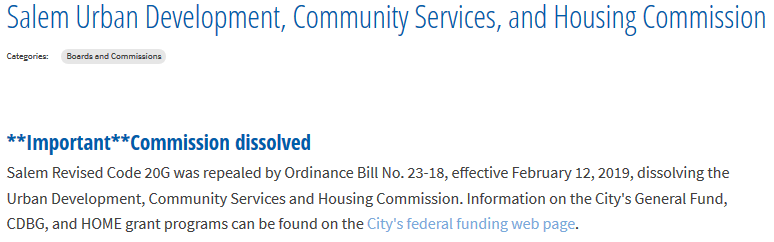
[12/8/18 Update:  UDD Director Kristin Retherford recommended killing the CSHC, having found that "many duties of the CSHC are now included in the position description for the Homeless Coordinator" and "community input in grant program awards and other matters can be achieved through limited duration ad hoc committees and work groups."  Note: The City has taken the position that work groups are not subject to Oregon's public meetings laws.]

12/20/18 Update:  Bach, J. "Salem development commission may disband after feds raise ethics concerns", Statesman Journal, 20 December 2018.

CSCH web page

City Manager's 3/13/19 Update