Showing posts with label ROCC: Leave or Remain?. Show all posts

Monday, January 20, 2020

Homeless Alliance Prepared for Lift Off

By Sarah Owens and Michael Livingston


CoC Development Councilors Lisa Leno, Jimmy Jones, Lyle Mordhorst
If you want to know how the collective effort to respond to area homelessness is going, all you have to do is look at Jimmy Jones's face during a Development Council meeting.

Jones is, of course, the Executive Director of the quasi-governmental Mid-Willamette Valley Community Action Agency (MWVCAA), and one of the generals in the war on poverty.     

The Development Council, an outgrowth of the Mid-Willamette Homeless Initiative, is about to launch the Mid-Willamette Valley Homeless Alliance (MWVHA or Alliance), which will bring the power and influence of local governments to bear on a problem that, for far too long, they've ignored and/or relegated to charitable and religious organizations.  Eugene/Springfield and Lane County, by contrast, recognized decades ago that they had important organizational roles and responsibilities to fulfill in responding to area homelessness.

The Development Council consists of the City of Salem, Marion and Polk counties, the Confederated Tribes of the Grand Ronde, Keizer, Monmouth, Independence and the Salem-Keizer School District, as well as the United Way of the Mid-Willamette Valley, the Union Gospel Mission and MWVCAA.  In a few weeks, the government entities on the Council will enter into an inter-governmental agreement under ORS 190 to form the Alliance, which will make it a separate public body.

In addition to being a public body, the Alliance will be Marion and Polk counties' "continuum of care" organization, once it registers as such with HUD (sometime in the next few weeks) and HUD accepts the submission.  At that point, Marion and Polk counties will no longer be part of the geographic area covered by the Rural Oregon Continuum of Care (ROCC).  Marion and Polk counties merged with ROCC in 2011.   

If getting the Alliance off the ground sounds complicated, it really isn't.  The bureaucratic requirements  are tedious, to be sure.  And, so is the wrangling over members' financial contributions.  However, the complicated bit will be walking the talk --  developing strategy based on sound public policy, versus each member voting ad hoc based on his or her personal bias.  Jones readily admits it won't be easy.  "This remains a very fragile process", he says.

Of course, by "process" Jones has more than homeless politics in mind.  "Most of the hard work will be done outside this room", he says.  He is wondering perhaps how he's going to persuade politicians and providers that homelessness can be solved and to make the shift from "my program" to "my community."  How to get them to think about "system performance" and commit to prioritizing housing and services based on objective vulnerability assessments, regardless funding source, and to collecting and sharing high quality data, and letting the data drive decisions.  Hard to believe this community doesn't know these things already, but that's the reality.      

The Development Council January 2020
Shifting from "my program" to "my community" will not be easy.  To quell fears that moving to local control over Continuum of Care (CoC) Program funding would result in a loss of funding, the Development Council promised "legacy" CoC Program grantees that they would continue to be funded for several years post-separation.  The move was characterized as ensuring program stability, but it was clearly a political trade-off.  

In any event, HUD always has the final say in such matters.  The 2019 CoC Program awards have been announced.  Only two agencies  serving Marion and Polk counties were awarded funds.  Total was  about $660K --  ~$323K to Shangri-La and ~$339K to Center for Hope and Safety.  The region should also receive some CoC Program funds to offset the cost to conduct vulnerability assessments and collect homeless information data.  By contrast, agencies serving Lane County were awarded more than $3.5M in 2019, and Clackamas County projects got more than $2.5M.  In addition, because these CoCs are high performers, they will probably receive additional funding on top of what's been announced.  Marion and Polk counties probably will not, because ROCC is a very low performer.

It's been known for a long time that continued participation in ROCC was bad for Marion and Polk counties' homeless.  In 2017, ROCC approved a poorly designed project developed by Salem Interfaith Hospitality Network (SIHN), dba Family Promise, and neglected to take corrective action despite SIHN's failing over a period of years to draw down any of its grant (a total of more than $300K in 2017 and 2018), ensuring SIHN's project would be de-funded in 2019.  In 2018, ROCC effectively eliminated MWVCAA's long-standing rapid rehousing project by giving it an undeserved low score in the review and ranking process (for more about that and 2018 awards, see "News from the Continuum.") (8 February 2019.)  The only good thing to be said about ROCC is that it's set the bar very low for the Alliance, at least for the first few years.  That fact probably will not give Jones much comfort.

Sunday, January 12, 2020

HUD Clears Salem MSA to Leave ROCC

By Sarah Owens and Michael Livingston


12/5/19 "Stakeholders" vote 'Yes' to leaving ROCC
Finally, HUD has given Salem, Marion and Polk counties (aka the Salem Metropolitan Statistical Area) the go-ahead to split off from the nightmare Rural Oregon Continuum of Care and re-form a regional continuum of care to coordinate delivery of homeless housing and services. 

Jimmy Jones, Director of the Mid-Willamette Community Action Agency, calls the decision a "generational change."  That's his way of trying to limit expectations, of letting people know that, although "actual" change will be slow in coming, there is reason to hope it will, eventually, turn out to have been significant.  Like getting elected or married, it's all about how one handles what comes next.

MWVHA Staff Jan Calvin arranges 'Yes' photo
As regular readers will be aware, the move is long overdue and brings much responsibility, but little risk, owing to the intolerable and ever-deteriorating conditions in ROCC.  See "ROCC: Leave or Remain?"  The new/old regional CoC will bear the name "Mid-Willamette Valley Homeless Alliance" and take its former HUD identifier "OR-504", relinquished in 2011 when Marion and Polk counties merged with ROCC.

The past ten years have cost the region's homeless housing and services so dearly that the region will probably never catch up.  But, we might at least stop falling further and further behind.  If nothing else, the re-formation effort has brought City, county and tribal  officials together in common cause, and means the region will finally have access to local homeless management information system and performance data, which is something it's never really had, even though the information existed.

You can find more information, including formation documents, at the Mid-Willamette Valley Homeless Alliance's website, here

Wednesday, September 4, 2019

Leave Decision Prompts ROCC Retribution

By Sarah Owens and Michael Livingston


MWHI Steering Committee August 2019 Meeting
This is the time of year that homeless assistance programs across the U.S. compete for limited funds from the U.S. Department of Housing and Urban Development's Continuum of Care Program.

As with any competitive grant process, to determine which programs to fund (and which not to fund), applications are scored and ranked in order of funding priority.  In the HUD CoC Program, this "review and ranking" is carried out by the local CoC, which is supposed to know best which programs are performing well, and which are not. 

As reported last week at the August meeting of  the Mid-Willamette Homeless Initiative Steering Committee, this year, the Rural Oregon Continuum of Care (ROCC) scored three homeless assistance projects serving Marion and Polk Counties well below scores received in previous years -- scores low enough to cause HUD not to fund them in 2020.  The move was seen by some on the Steering Committee as retaliation for the decision to leave ROCC and re-form a regional CoC (see "ROCC: Leave or Remain"), and an attempt to limit the funds that will be lost to ROCC as a result of the split.      

In a letter dated August 30, 2019 to the Community Action Partnership of Oregon, which staffs and is technically responsible for ROCC governance (ROCC is an unincorporated association), the Steering Committee expressed concerns about ROCC's structures and governance and asked that corrective action be taken: 

It is our understanding that conflicts of interest exist on the current Review and Ranking
Committee that scored the FY 2019 applications, as well as on the Executive Committee that approved the project priorities.

Given that these scorings and rankings were conducted by people representing organizations that have been or will be funded through HUD Continuum of Care dollars, contrary to HUD’s conflict of interest policies, we are encouraging and supporting agencies in Marion and Polk Counties to submit appeals of the scoring and ranking recently conducted. We further request that the Rural Oregon Continuum of Care have an independent, objective committee that has no conflicts of interest rescore the applications
for their final ranking.

The conflicts of interest complained of are, however, long-standing, and almost certainly have, from time to time, benefited local projects.  In other words, the situation is one that, over the years, local programs have not merely tolerated, but participated in, if not furthered.  This is but one of the many reasons we have long advocated re-forming the Salem, Marion and Polk Counties CoC with local government support and oversight.

In 2018, ROCC gave an allegedly undeserved low score to the Mid-Willamette Valley Community Action Agency (MWVCAA)'s rapid rehousing project, causing HUD to defund it, and the region to lose almost $400K in CoC homeless assistance.  See "ROCC Fissures Continue to Grow."  Unless ROCC 1) re-scores the applications and 2) local projects move up in the rankings as a result (which is not anticipated), MWVCAA predicts that local programs will receive only $681,848 in 2019 CoC funding, most of which will be for online domestic violence services, leaving only $138,581 or $120.40 per person for all other services.  These losses could hurt the Development Council's ability to negotiate a fair share of CoC funding in the split with ROCC.  Salem, Marion and Polk counties brought ROCC about $1M when they merged in 2011.

The August meeting was the MWHI Steering Committee's last before it reconvenes on September 24 as the regional CoC's Development Council.  See "Area Leaders Forming CoC Development Council."

Photo at top: around the "u" table, starting far right: Chris Hoy (Salem), Kristin Retherford (Salem), TJ Putman (Salem Interfaith Hospitality dba Family Promise), Lyle Mordhorst (Polk County), Jan Calvin (MWVCOG), Kathy Clark (Keizer), Colm Willis (Marion County), Dan Clem (Union Gospel Mission), Denise VanDyke (MWVCOG), Christy Perry (SKSD), Jimmy Jones (MWVCAA).  Not pictured: Sean O'Day (MWVCOG), Scott McClure (Independence), and Janet Carlson (MWVCOG and on phone).

Friday, July 5, 2019

Area Leaders Forming CoC Development Council

By Sarah Owens and Michael Livingston

Jan Calvin updates MWVCOG Board on CoC formation progress
The Yamhill County reps present at the June 24th meeting of the Mid-Willamette Council of Governments Board of Directors (Newberg Mayor Rick Rogers, Chehalem Parks & Rec Director Lisa Rogers and Amity Mayor Michael Cape) had to hear it from Yamhill County Commissioner Casey Kulla that another Yamhill County Commissioner (unnamed) was perhaps reconsidering his vote to keep Yamhill County in the Rural Oregon Continuum of Care (ROCC), and was planning to meet with Yamhill County mayors "in a few weeks" to discuss.

The other commissioner is, of course, Board of Commissioners Chair, Rick Olson, as reported here several weeks ago.  All four Yamhill County representatives seemed skeptical.  "We'll see if the promised meeting materializes", Rick Rogers later commented.  For now, however, the regional CoC formation efforts are focused on Marion and Polk counties.

Kulla's comments about Olson's possible change of heart followed a presentation to the MWVCOG board by Jan Calvin, who is under contract with MWVCOG to serve the Mid-Willamette Homeless Initiative Steering Committee, who is leading the effort to re-form the regional CoC.  Calvin's presentation was basically a repeat of the report she gave to local providers on June 17, 2019.  See "HUD Joins 2d Regional Providers Convo" (providers who'd seen Calvin's first presentation said of the second presentation that there was "nothing new").  It's expected that, at its next regular meeting on October 16, the MWVCOG board will be asked to house the regional CoC's Development Council and governing board and to act as the CoC's unified funding agency.  

MWHISC June 2019 Meeting
The next day, the MWHI Steering Committee met in the very same room with non-member "guests" to nail down the details of a "Memorandum of Agreement Relating to the Creation of a Development Council to Form a Continuum of Care Collaborative Governance Structure for the Marion and Polk County Region."  (Around the "u" table in the photo at right, starting far right: Jimmy Jones (MWVCAA), Colm Willis (Marion County), Sean O'Day (MWVCOG), Scott McClure (Independence), Kristin Retherford (Salem), Kathy Clark (Keizer), Jan Calvin (MWVCOG), Ron Hays (United Way), Christy Perry (SKSD), Chris Hoy (Salem), Tom Pessmier (Monmouth), Denise VanDyke (MWVCOG).)  Notably absent: anyone from Polk County.  Notably present in the audience: Robin Winkle (Shangri-La). 

Development Council members are expected to make a "substantial contribution" over two years, cash or in-kind, to the cause of reforming the regional CoC.  Cash contributions are needed to cover administrative costs until HUD funding comes available in 2021.  As of now, the members are expected to be Marion and Polk counties, the cities of Salem, Keizer, Silverton, Monmouth, Independence, the Confederated Tribes of the Grand Ronde Community of Oregon, the Salem-Keizer School District 24-J, the Mid Willamette Valley Community Action Agency, the United Way of the Mid-Willamette Valley, and the Union Gospel Mission (all voting members) and MWVCOG (non-voting member).  The chart below indicates what each entity is being asked/has agreed to contribute and, in most cases, how the contributions were calculated.  Christy Perry indicated that the school board had not yet approved the $23,000 contribution shown in the chart.  UGM's contribution has not been determined/defined.


CoC providers were told at their June 17, 2019 meeting that "there's no process" for getting a seat on the Development Council (see "HUD Joins 2d Regional Providers Convo").  Strictly speaking, that seems to be true.  However, as always in this town, a little cash in hand and a whisper in the right ear would seem to be a good place to start.

Page 1 of draft MOA re Development Council
A great deal of meeting time was spent discussing whether those contributing >$40K in a given year should have two votes during that year, with Colm Willis pressing in favor, and Ron Hays raising equity concerns (United Way has committed to contributing $20K this year and $40K next year).  Ultimately, the committee decided to give Salem and Marion County two votes/two people on the Development Council, irrespective of the amount of their contribution.    

The Development Council is expected to complete its work over the next six months.  That work includes developing a charter and bylaws for the regional CoC and its yet-to-be elected board of directors, a conflict of interest policy, some sort of electoral process, committee structures, a budget and funding strategy, position descriptions, and establishing a unified funding agency, all of which are subject to HUD's approval.

The MWHISC will not meet in July.  Its next meeting is scheduled for Thursday, August 29, 2019, from 3-5p at the MWVCOG offices. 

Tuesday, June 18, 2019

HUD Joins 2d Regional CoC Providers Convo

By Sarah Owens and Michael Livingston


HUD officials join providers, ROCC staff, in small group discussion
HUD representatives Todd Adkins and Toni Strutz with the Community Planning and Development (CPD)  Field Office in Portland joined local government and nonprofit homeless service providers Monday morning at the Kroc Center to discuss recent developments in the effort to form a regional Continuum of Care, the second such meeting called by the Mid-Willamette Homeless Initiative Steering Committee (MWHISC).  See "Kroc Center Hosts CoC Convo."

Forming a regional CoC would mean Marion and Polk counties leaving the Rural Oregon CoC (ROCC).

ROCC staffers Jessica Adams and Caleb Green were also present at the second meeting.

The meeting was also attended by twenty homeless housing and services providers, seven of whom had not attended the first meeting (listed at the end, with the newbies in bold.) 

Providers at the first meeting were told there was some possibility of Yamhill, Linn, Benton and Lincoln counties joining the regional CoC.  They asked that the next meeting be held after the geographical area had been determined.

At this second meeting, Jan Calvin, a consultant to the MWHISC, gave a 15-minute recap of HUD's CoC Program, the events leading to the regional CoC initiative, and a "macro timeline" of the CoC formation process (below).  She said "we are here", and pointed to the "Resolutions, Letters of Support" bubble.  She then asked if there were questions.


Robin Winkle asked if there was a process "to become part of the Development Council.  Calvin responded that the Council would consist of the "current jurisdictions) (Salem, Keizer, Marion County, Independence and Monmouth) plus Polk County, and said the Mid-Willamette Valley Community Action (MWVCAA) and United Way are being "looked at", but she also indicated that the MWHISC was "open to thoughts on how to do this."  Winkle said that she was just wanting to know if the Council would be a "closed group."  Calvin said, yes, it was "a closed group that's now looking for an MOU", but then said, "definitive, not closed -- public."  Winkle said, "if we're going to do this, I want to make sure we're involved."  Shelly Ehenger followed up, "So, is there a process [for getting on the Council]?"  To which Calvin responded, no, there's no process.

Ian Dixon-MacDonald asked, "Is the [Mid-Willamette Valley] Council of Governments interested [in hosting], and what about Yamhill County?"  Calvin said that COG (which hosts the MWHISC) had indicated it was open to being asked, and that she was giving a presentation to the COG Board on the 24th.  She said Salem, Marion and Polk counties, as well as Monmouth, Independence, Silverton and Keizer, had adopted resolutions supporting a regional CoC.  She said Yamhill County's Board of Commissioners had voted in May to remain in ROCC, but "one commissioner" (Rick Olson) was planning to hold a meeting with Yamhill County mayors to discuss the situation further.  Calvin said she would be there to answer questions, but the meeting had not been scheduled.  Later, when asked about Linn, Benton and Lincoln counties, Calvin indicated they would not be joining.

For the remaining hour, everyone was asked to break into small groups to discuss the components of an ideal CoC, and report back.  Calvin passed out a by-topic outline: geography, participation, purpose/function, organization, communications, data, output/accomplishments, other.  Todd Adkins and Toni Strutz, the HUD staffers, participated in the discussions.  Strutz was in a group with Carolyn Fry.  About halfway through the list, Fry asked Struz (who had been quiet) what she thought about one of the areas.  Strutz replied "There's no guarantee."  Fry asked what she meant.  Strutz said, "There's no guarantee there will be more resources."  

Participants appeared overall to be engaged throughout the exercise, even though most had little comprehension and much less experience of HUD expectations for CoCs.  For the most part, reports back were focused at a systems level versus on individual organizations or service sectors.  Calvin asked the groups for their outline notes, and promised to share the "notes of the meeting" by email.  The meeting ran over by about ten minutes.

Reviews of the meeting were vaguely positive, though most we talked to observed the absence of new information, and the absence of United Way and MWVCAA, as well as other, leadership.  In fact, the second meeting was down about a dozen director/executive director positions compared to the first meeting, a sign that "update/feedback" meetings are probably not the best way to continue to try and engage providers when there's no solid information to give them, and nothing of substance for them to discuss.  Calvin did say, however, that there would be another meeting in September.

Housing reps at the second meeting:  Candace Jamison, Marion County Housing Authority;  Pamala Garrick, Salem Housing Authority;  Kim Lyell, Polk Community Development Corporation;  Shelly Ehenger, City of Salem;  Kristin Keunz-Barber, Northwest Human Services;  Dan Williams, Salvation Army of Marion and Polk Counties' Kroc Center;  Robin Winkle, Shangri-La;  Josh Graves and Jim Seymour,  Catholic Community Services; Amy Hamilton, NEDCO; Dana Shultz, Mid-Willamette Valley Community Action Agency.

Supportive and preventative services reps at the second meeting: Melissa Baurer, Santiam Hospital; Cyndi Leinassar, Salem Health;  Ian Dixon-MacDonald, Marion Polk Food Share; Heather Wright, Polk County Homeless Connect;  Christina Korkow, Recovery Outreach Community Center;  Julie Conn-Johnson, Salem Keizer School District; Shaysee May, Northwest Senior and Disability Services;  Carolyn Fry, Marion County Health and Human Services;  Colleen Bradford, Oregon Department of Human Services.

Thursday, June 6, 2019

HUD admits ROCC "formed out of thin air"

By Sarah Owens and Michael Livingston


Nora Lally explains leave process at annual ROCC meeting
The admission was made this week in Salem, at ROCC's annual meeting, during a session intended to explain the elements needed for HUD to recognize a region as an independent Continuum of Care.  (For background, see "ROCC: Leave or Remain?")  Leading the session were Nora Lally and Matt Olsson with HomeBase, Todd Adkins and Doug Carlson with HUD's Community Planning and Development (CPD) Portland Field Office, Jessica Adams (CAPO staff assigned to ROCC), and Justina Fife (UCAN Community Action Partners and ROCC board chair).  Our notes on the session can be found at the end of this post.

In attendance were about 35 representatives from ROCC's  member agencies, almost all of which are CoC Program grantees, including the three from Marion and Polk counties that will receive CoC funding in 2019-2020Shangri-La ($311,185), Salem Interfaith Hospitality Network (dba Family Promise) ($160,764) and Center for Hope and Safety ($188,561).  Shangri-La's Robin Winkle was the only local rep who asked questions.  TJ Putman and Tiffany Ottis with Family Promise were present, as was Jayne Downing with Center for Hope and Safety.  Diane Merry and Scott Eastburn with the Mid-Willamette Valley Community Action Agency also were there.  MWVCAA lost its Rapid Rehousing project when ROCC gave it an undeserved low score in the most recent competition.  See "ROCC Fissures Continue to Grow."  Shelly Ehenger (Salem Urban Development Department) and Pamala Garrick (Salem Housing Authority) also attended.

Doug "heavy lift" Carlson, with Matt Olsson at left
After Lally, Doug Carlson  (Director of the CPD Portland Field Office) did most of the talking.  He did most of the talking a couple of years ago, too.  See "HUD Seeks to Ease Tensions Within the ROCC" (recounting the May 2017 conference call between Marion and Polk officials and HUD).

Carlson is concerned that Marion and Polk officials think, "If you do this [separation] the government will give you a bunch of money."  Echoing his comments from 2017, he said,

I do know what the realities are. We had a discussion with the group from Marion and Polk a few years ago, the theme was consistent:  we need more money.  I can't guarantee HUD is going to step up. If we need to explain that to commissioners or elected officials, because I don’t want there to be a mistaken belief.

Referring to Lane County, which receives about the same CoC Program funding that ROCC does, Carlson said, 

What Lane has is extraordinary support from local governments.  What really benefits their CoC program is knowledge and capacity, and all the public, private and government entities in the structure. It's an extremely heavy lift [to achieve that level of cooperation]. We know from our experience that its a heavily lift administratively.

Pegge McGuire, Community Services Consortium (CSC) of Linn, Benton and Lincoln counties, said Lane County understood much earlier than other Oregon communities what the CoC Program offered.  But, instead of pursuing those opportunities, "they just relied on OHCS" for direction.  That's when Carlson said,

ROCC was formed out of thin air.  It was put together by us [at HUD] and a consulting group out of necessity because OHCS wasn’t interested.  That is why we have the ROCC in its current form.

ROCC in its current form is an unincorporated coalition of service providers from 28 counties across Oregon.  It has two support staff housed at Community Action Partners of Oregon (CAPO).  Its  governing body is dominated by grantees with minimal CoC program knowledge and capacity and little interest in a systemic approach to the ending homelessness.  The organization itself is incapable of holding funds, is barely recognized by its local governments, has no institutional structures, and demonstrates only a nominal commitment to CoC Program goals.

We asked Carlson which he thought was the heavier lift, achieving CoC Program goals while a member of ROCC, or achieving them through a regional CoC that has substantial local government support and a unified funding agency, but did not receive a reply before this was posted.

To see all our posts on this subject, look for "ROCC: Leave or Remain?" under CANDO Archive Issues.


Panel: Jessica Adams, Justina Fife, Nora Lally, Matt Olsson, Todd Adkins, Doug Carlson

Notes on June 4, 2019 Session with HUD Officials at ROCC's Annual Meeting


We arrived at the Holiday Inn on Market Street at 10 to find start of the session with HUD had been moved up to 9:45, and Lally speaking in front of a series of slides.  "It's not really an approval process, more like acknowledging the necessary elements have been demonstrated", she said, referring to a slide headed "Basic Timeline."  The first element was a "transitional body" and their vote to support forming a new CoC.  Next came "consult" with the wider membership and their vote to approve moving forward.  Lally said such a vote would not need to be unanimous, but would need to be "more than 51%", a "preponderance."  If that element was satisfied, the next step was to notify the existing CoC.

Lally was just starting to explain that the new CoC would have to have a governance charter when Justina Fife, came over and told us we couldn't videotape the session.  Michael told her he was using an audio recorder.  She said we couldn't do that, either, and went away again.

The slide read "Potential Impacts of a Split on Balance of State CoC", first bullet point, "Reduction in Annual Renewal Demand tied to any projects that choose to go to the new CoC."  Doug Carlson was explaining how the process that Lally was describing was "normal practice."  He said explaining it was "not advocacy or non-advocacy", that this sort of thing happens in other communities, and that HUD doesn't take a position on how communities want to structure themselves.  But then he commented  that “splits are unique”, and that they generally "see more mergers."

Carlson said they were there to answer questions.  Lally said they wouldn't be able to answer all questions, but that William Snow (CPD's Office of Special Needs Assistance) was willing to schedule time for follow up questions.  

Robin Winkle (Shangri-La) referred to the slide that was up and asked, "Do projects really get to choose?"  She rose from her seat at the back of the room and went to sit at the front, near the speakers.  She complained that "none of this has really been brought to the grantees — it has once", she said.  She said "Shangri-La is actually in five counties."  Would they have to participate in both CoCs?

Lally explained that the choice referred to in the slide was whether or not to create a separate CoC, not which CoC to go with, and that participating in multiple CoCs "is not unheard of."

Winkle wanted to know how the restructuring was going to affect people in programs?  Olsson said that HUD would want to make sure that clients are "not affected" and that "HUD will work to restructure projects", but there could be an impact "on the administrative side."

At 10:15, it appeared that there were no more questions.  The group was told they had another 30 minutes, and there would likely not be another opportunity to speak with HUD reps in person like this. Someone asked how many projects do Marion and Polk Counties have?  The response was four.  "So three [grantees] have to agree to leave?"  "No", Lally explained, "the vote is not just grantees.  It's the stakeholder group as defined by HUD's interim rule."

"It sounds like the group who wants to separate, [if it has all the pieces together] that’s it?", someone asked.  Lally answered in the affirmative, but Carlson added several times that "It's a heavy lift", as if to suggest the separation might not occur.

Pegge McGuire (Deputy Director, Community Services Consortium, which covers Linn/Benton/Lincoln) said her organization was "under political pressure to pull out" of ROCC, but she wasn't interested in taking on governance responsibilities.  Winkle asked whether she would be looking at joining Marion and Polk, or forming another CoC.  McGuire said if she were to recommend leaving, she would recommend joining Marion and Polk.  Someone said that she had heard frequent comparisons between ROCC and Lane County in terms of CoC funding.  McGuire commented, "No one will catch up to Lane."

Carlson recounted his version of the decision to join the ROCC in 2011, then said,

What Lane has is extraordinary support from local governments.  What really benefits their CoC program is knowledge and capacity, and all the public, private and government entities in the structure.  It's an extremely heavy lift [to achieve that level of cooperation]. We know from our experience that its a heavily lift administratively.

McGuire said, "It wasn't until Scott Rich came to the State and said, 'You are walking away from all this money', but Lane knew that already.  Other [communities] didn’t grasp that, they just relied on OHCS.  I don’t know that [Marion and Polk] will ever reach what Lane has."

Carlson said "ROCC was formed out of thin air.  It was put together by us and a consulting group out of necessity because OHCS wasn’t interested.  That is why we have the ROCC in its current form."  Adkins said "Lane has had a lot of government support, but it’s not that easy.  There are built-in advantages for those who got in early.  The annual renewal demand for successful counties [like Lane] far exceeds their pro-rata need."  Carlson said that HUD today is "just basically renewing projects", and was not really funding many bonus projects.  He said it wasn't a matter of going to D.C. and lobbying HUD for more money.  He said the situation would continue without additional funds from Congress.

At 10:30, it again appeared there were no more questions.  Then someone asked about the impact on ROCC's HMIS grant, and "What are the next steps for ROCC to fill the gap?"  Lally responded that questions on the HMIS grant should be directed to William Snow.  Concerning the next steps, she said that HUD recognizes that splits should be coordinated between the legacy and new CoCs or the split will be much more difficult. 

Shelly Ehenger (City of Salem) asked whether field office staff would be same for both CoCs.  Carlson said he has very small staff, implying that they would be the same.  Winkle commented, "If we have the commitment of the providers [in Marion and Polk counties], great, but if it dwindles away, it will be like before. I just don’t want to see the people we are serving hurt."

McGuire said that providers in her community "don’t have a lot of interest in putting energy in governance", that she was "just trying to follow conversation and hear what the flavor is."  Fife asked rhetorically what will happen if Marion and Polk counties aren't successful, and want to rejoin the ROCC.  Carlson said he didn't "want there to be a misnomer", for people to think, "If you do this the government will give you a bunch of money."  He said,
I do know what the realities are. We had a discussion with the group from Marion and Polk a few years ago, the theme was consistent:  we need more money.  I can't guarantee HUD is going to step up. If we need to explain that to commissioners or elected officials, because I don’t want there to be a mistaken belief. 
McGuire said she thought that there was that mistaken belief and the belief that more control over projects would somehow translate to more money.  Someone else said that local control of the review and ranking process would not help, either.  McGuire said that the elephant in the room was ROCC's  governance.  Someone said what’s unfortunate is the timing, because things are better with CAPO taking on more of a role. 

Jan Calvin (consultant with Mid-Willamette Valley Council of Government) said she could speak to the question of political leaders' expectations regarding more money.  She said that, in presentations about the CoC, leaders were told its not about the money, but also that "It's always about the money."  She said "money" doesn't necessarily mean CoC money.  She said that only one tenth of the money coming into Marion and Polk Counties is CoC funding.  She said the issue for Marion and Polk was, "How do we do better work in our [geographic] footprint and in our organizations." 

Scott Eastburn (Mid-Willamette Valley Community Action Agency, The ARCHES Project) said that local control over the review and ranking process should make a difference.  He said he had heard the former ROCC coordinator (Jo Ann Zimmer) say CoC funds should be spread throughout region, not go just to the biggest agencies.  He said regional distribution wasn't one of the ranking criteria, and that  Marion and Polk had lost funds because of that instruction.  He said he was worried about his clients, too.  He said Marion and Polk counties have made a lot of changes for the good, but doesn’t feel like they have been fairly represented by ROCC.  

6/21/19 Update:  from CAPO's June newsletter


Wednesday, May 22, 2019

Yamhill County to Remain in ROCC


Yamhill County Commissioners Kulla, Olson and Starrett at May 21 work session

By Sarah Owens and Michael Livingston


The Yamhill County Board of Commissioners held a second work session yesterday to consider joining Marion and Polk counties in a regional Continuum of Care (see Yamhill Poised to Vote "Leave").  The session was scheduled for 1:30, but we arrived at 1:15 to find Commissioner Starrett explaining to Commissioner Kulla why leaving ROCC "isn't going to fix the problem."  She said,

It's going to cost $261,000 a year [gap funding until the HUD planning grant comes through], and that's somehow going to translate into all these social problems going away?  I don't see that money and staff [are] going to do that.

I think we need to look at the root causes of these problems, and that is not to say we enable the sub-populations that are creating perhaps the biggest concern in our community.  Take for example...the population that everyone seems to be talking about, which is the people who are taking up city streets and setting up residence there...If you throw more money at this, it's not necessarily going to fix the problem.  It's got to come from an initiative whereby the person says, I want to get clean, I don't want to live in the streets and I want to find a job.  Well, we don't even see that.  We have Stephen W[inaudible] from Express Professionals going around offering people jobs, transportation to those jobs, nobody's interested.    

There's one person on Dustin Court who wanted to get clean and sober.  HHS...sprang into action to get this person away from that environment so he could stay clean.  The majority of people are not interested, so more money is not going to fix that problem.     

Kulla asked Starrett what she considered the "root causes" of homelessness and the lack of affordable housing.  Starrett replied,

Let's just take the people who are camped on City streets.  Root causes are addiction -- the prevailing issue is addiction, and mental health issues, and a lot of it is drug-induced psychosis.  A lot of it is just ongoing addiction problems.  A lot of it is a lifestyle choice.

Starrett believes the problem is that you can't "force someone to seek sobriety."  Commissioner Olson weighed in at this point, saying,

To me, the answer is, and this is just me personally, you don't give a hand out, you give a hand up.  In order to give that hand up, some of those people have to want to take that hand up, and for those that don't want to take that hand up, which is several of them, you can't do anything to make them take that hand up.  Whereas...we have programs where we'll give you housing, we'll help you with subsidized housing, but in order to do that, you're going to have to [inaudible].  You're going to have to get a job, you'll have to stay clean, you'll have to work.  That's the only way you help people up... Most of the people on Dustin Court...you can offer them jobs, you can offer them anything...they don't want it.  They just don't want it.  So...I don't think the continuation [sic] of care, even though you make a lot more money for housing, I don't think it's going to address it, because they don't want to be there yet.             

Starrett asked Kulla how more money and more staff would increase housing supply.  Kulla started to talk about supportive housing, but Kulla cut him off.  "Let's talk about housing supply.  Supportive housing is next.  I'm just talking about increasing housing supply."  She said that Yamhill County had supportive housing "covered" by existing grants and programs.  Kulla said he wished he had area experts to speak to the issue, but it was his understanding that the County was seeking more supportive housing.  Starrett said, "We're not talking about supportive housing."  Kulla said he was returning to supportive housing because it was a good example of what more money and more staff could do.  He also said it was "one answer for the people on Dustin Court."  Starrett replied,  "That's not what I asked you...I asked you how spending $261,000 and adding three more staff people is going to 'increase housing supply?'...How do you spend more money and 'poof' -- housing supply increases?"

Starrett believes that housing supply "can't increase" because of state land use laws.  "It has to do with the political will of jurisdictions.  So, what I'm saying is, I don't know if we're going to get anything for spending all that money."  Olson said he'd asked Polk and Marion county commissioners if the McKinney-Vento funds they'd received had increased housing supply, and that "the majority of commissioners say it hasn't increased their housing supply."  He said low-income housing needed to be a business proposition for developers, and that SDCs were preventing that.  Kulla asked about SDC waivers and other ways the County might facilitate low-income housing development.  For Olson, though, the issue was that the reorganization into a regional CoC didn't guarantee additional housing.

Starrett said,

One of the points they make is that if we had a smaller geographic footprint, we would be able to address our own [community's needs].  They use the example, 'issues facing Salem are not the same as those facing McMinnville or Independence', and if we had a new continuum of care, we would be able to address our own specific issues.  But, I think, by and large, whether you go to Portland, Seattle, Honolulu, which has a really big problem, or anywhere, you have basically the same problem.  The basic problem is that you have significant addiction issues which are fueling a specific type of physical homelessness. 

We have the best economy we have had in half a century.  There is no shortage of jobs...the problem today is not a lack of employment.  We have a constriction in the housing supply, which is what you have when land use laws make it not hospitable to people building and expanding...I don't think we need another layer of government to facilitate [ways to accommodate workforce housing], and I don't think we have different problems.  Everybody's got the same issues, the same questions -- how do we deal with this?   

Kulla said he thought Starrett was going to say that housing in those communities is very expensive, unaffordable.  The three discussed whether housing affordability should be considered a "root cause" of homelessness, with Starrett and Olson arguing that housing was affordable for those willing to work.  To illustrate, Starrett said,

Kate Stokes [YCAP's Director of Youth and Adult Services] knocked on every door of every RV on Dustin Court, and she said, "We can get you into affordable housing."...She would get them first and last month's, all ready to go, and people would leave.  People would leave their RV completely empty, and someone else would move in.  So, despite offer after offer after offer for the housing, which is supposed to alleviate the problem that we see, it didn't happen.  It wasn't a question of the offer wasn't there, the apartment wasn't there, the option wasn't there.  It was a choice not to do that...Why would you choose to sleep in a freezing cold RV in your own filth?  Why would you, because addiction is a horrible disease that tells us that we would rather have the drug than to live clean and warm.  It's a horrible way to live.  We do everything we can to fight for these people, to bring them into recovery, but, as you know, you can't force recovery.  And that's the problem. 

Kulla said what he was hearing was his fellow commissioners equating the people living on Dustin Court and Marsh Lane with all Yamhill County's homeless, even though, "I know you both know differently than that."  Starrett agreed there were different sub-populations, and talked about county programs targeting those sub-populations.  Kulla noted that the county wasn't providing housing for every unaccompanied youth or woman fleeing domestic violence.  Starrett replied, "You could never, ever do that.  I mean, I don't know where you could get that amount of money, to be able to solve every social ill [with] the government and someone else's taxes."   

After several minutes discussing housing policy issues, Kulla pointed out "We're already in a Continuum of Care organization", and the discussion returned to whether or not Yamhill County should leave ROCC to join a regional CoC.  Olson said, "I just don't see a lot of benefits in joining a regional CoC."  Starrett said she was concerned that Yamhill County "might become less stable."  She said, and Olson agreed, that there were already differences with McMinnville, and "we don't necessarily lose anything by staying in the Balance of State."  Starrett said, "I'm looking at what they [the regional CoC] want to do, and I look at what we're doing, and then it's going to cost us more money, and we have to hire more people, so maybe what we should do at this point is say...this is not in our best interest."  There followed several minutes of discussion of the situation in McMinnville.  Finally, Olson said,

We've belonged to [ROCC] since...HUD put the rules in place.  I haven't heard any complaints.  I see it working.  Is there a potential we could get more money?  Probably.  Is there potential we could take on a lot more risk?  Certainly.  And [are] there a lot of things it's doing that the County isn't currently doing?  No.  I think the County is doing a lot better job than some of the Continuum of Care does.  So, benefit-wise, what would we benefit by changing?  I don't see a big benefit.     

Olson asked the county attorney if a formal action was needed, and it was agreed "an official vote" on the question of whether or not to join Marion and Polk counties in forming a regional CoC would be taken at the regular meeting on Thursday, May 23.  The question was ultimately placed on the agenda for May 30.  During the meeting on May 30, the question arose whether or not entities within Yamhill County such as McMinnville or YCAP could decide independently to join the regional CoC.  Based on the erroneous belief that they could, Olson and Starrett voted in favor of a motion "decline to join the regional" CoC and Kulla voted against.  Audio at 1:00 through 1:16.

6/9/10 Update:  Sources say Olson has had second thoughts about his vote and will be hosting a gathering of elected officials from Yamhill County in the next two to three weeks to discuss the proposal further.  However, the "late May, early June" decision deadline identified by the Mid-Willamette Homeless Initiative Steering Committee has passed.  Even if Olson were to change his vote through a formal reconsideration process, HUD's process requires a clear demonstration that the move is  supported by the provider community.  See "HUD admits ROCC 'formed out of thin air'."  That could could be difficult without Starrett's support.  Starrett is on the YCAP board and YCAP's Kate Stokes, who refers to herself as a "happy warrior for conservatism", is Director of YCAP's Adult and Youth Program Services, which includes YCAP's homeless housing and support services, and is reported to be "100% opposed" to leaving ROCC.

Sunday, May 19, 2019

Reality Check: the CoC is just a framework

By Sarah Owens and Michael Livingston

Last week, after a work session to discuss camping restrictions, low barrier shelters, and public health emergency declarations, the McMinnville City Council got an(other) earful from residents concerned about what nearby RV camping is doing to McMinnville's downtown.  People are  upset, and the Council seems at a loss on how best to deal with the problem.  (See, e.g., videos of March 23 and May 14 meetings, and this May 16 KOIN report.)

Later, in the meeting following the work session, the Council voted to support the formation of a regional Continuum of Care (CoC) with Salem/Marion and Polk Counties.  The resolution of support goes to the Yamhill County Board of Commissioners, which will hold its second work session on the proposal to form a regional CoC this Tuesday, May 21 at 1:30 at the Courthouse in McMinnville.  Yamhill County might, or might not, vote to leave the "balance of state" -- aka "Rural Oregon" Continuum of Care (ROCC) -- to form a regional CoC with Marion and Polk counties.

Whatever Yamhill decides to do, one thing is for sure:  forming a regional CoC will not, as has been suggested, "dramatically increase the number of resources that are available to the local governments in this area", nor will it "make it easier for our tri-county region to start getting coordination and project funding for regional housing and homelessness needs", without a great deal of hard work and perseverance.  It is critical that the electeds be clear that a CoC is just a framework, and what's being proposed is a reorganization to leave the 28-county ROCC and form a 2 or 3 county CoC.     

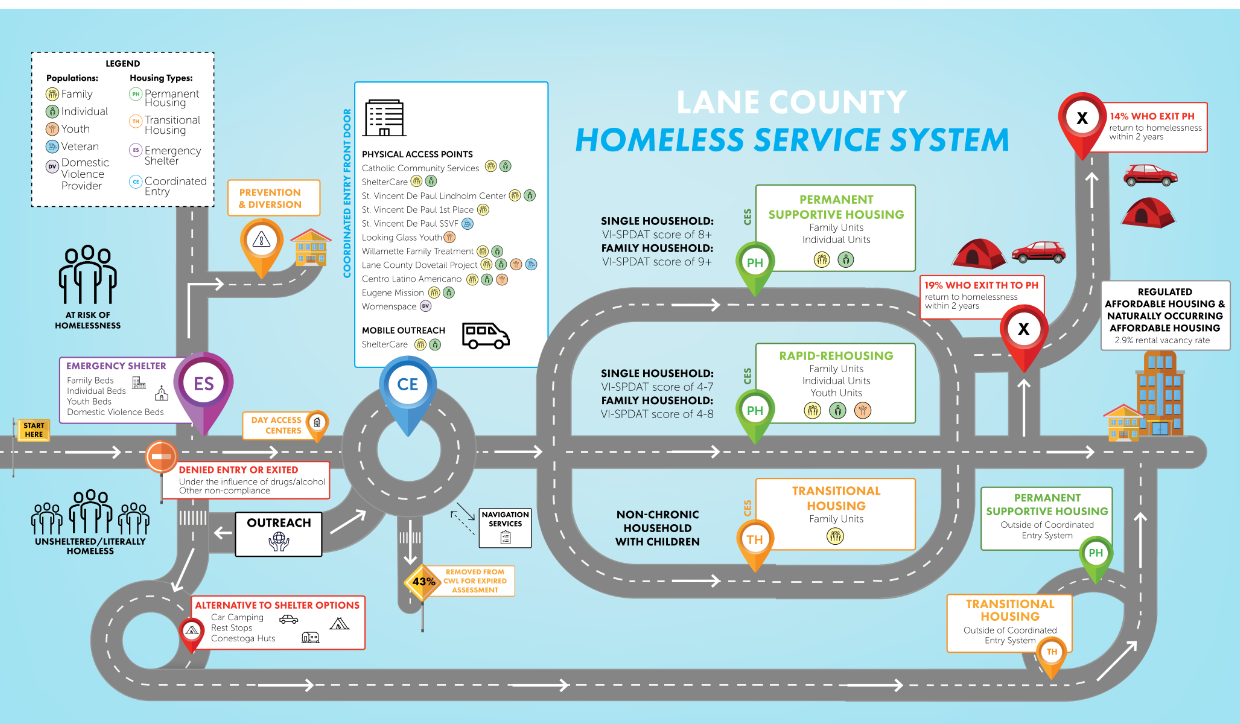
Lane County 2018 Homeless Service System Map
To use Lane County as example:

Lane County formed a CoC in the 1990s, just after HUD started the program.  Having the county health department become the community action agency, and having only one housing authority and county commission helped to simplify things.  A regional CoC will have one or two community action agencies, three or four housing authorities, two or three health departments, and two or three county commissions.

The Lane County CoC has been working together for decades, planning and coordinating in accordance with HUD guidance, strategically allocating resources and competing successfully for HUD CoC funding.  As a result, the Lane County CoC today receives about four times more CoC funding per homeless individual than ROCC receives, based on PIT Count figures.

Lane County's 2018 TAC Study
Even so, the Lane County CoC faces significant challenges.  The current "system" doesn't work like it's supposed to (see Homeless Service System Map above).  Better coordination is needed across all aspects of the system.  They need to do better about street outreach, to beef-up coordinated entry, diversion and "move-on" strategies.  They need 350 units of permanent supportive housing and a low-barrier public shelter.  They need more partnerships with landlords and better tenant supports.  They need to implement frequent worker turnover training systems.          

Lane County knows all this because, in March 2018, the City of Eugene hired Technical Assistance Collaborative (TAC) out of Boston, Mass., to conduct a Public Shelter Feasibility Study and Homeless Service System analysis. The purpose of the study was to provide information about Lane County's homeless service system needs and gaps, and recommend ways to fill the gaps and make the system more effective.

The Eugene City Council and the Lane County Board of Commissioners held a joint session last week to discuss a plan to implement the recommendations over the next three to five years.  The video of the meeting is a "must see" for Marion, Polk and Yamhill electeds and for anyone still under the misapprehension that reorganizing for homeless system planning purposes and for purposes of receiving HUD CoC Program funding is any kind of a guarantee.  Of anything.

Of note, the City of Eugene does not shirk a leadership role on the grounds that "homelessness is not our problem", as Salem's City Manager has been heard to say, with echoes from the Mayor and some City Councilors, who say they want to see the counties do more but do nothing to facilitate their involvement.

Also of note, even after years of organized cooperation, problems in understanding and relationships persist.  Springfield, perhaps feeling slighted, wasn't at the table.  The conservatives always tend to want more "balance" (code for enforcement strategies), even though that has nothing to do with homeless or housing services.  Cost considerations will always fail to account for the costs of allowing the service and housing system to deteriorate further.  The point of all this is that, even after years of experience building systems and relationships, the work doesn't get any easier.  Knowing that will not only help electeds build systems and relationships, it will help them manage community, and their own, expectations.


Tuesday, April 30, 2019

Kroc Center Hosts CoC Convo


Janet Carlson et al, sharing the case for leaving ROCC and forming a local CoC

By Sarah Owens and Michael Livingston


About two dozen bigwigs from Salem-area housing and social services agencies met at the Kroc Center last week to hear about the movement initiated by the Mid Willamette Homeless Initiative (MWHI) Steering Committee to pull out of the 28-county Rural Oregon Continuum of Care (ROCC) and form a local CoC.

Invitations to the two-hour meeting came from Jimmy Jones, Executive Director of the Mid Willamette Valley Community Action Agency (MWVCAA), who has been working closely on with the steering committee and Mid Willamette Valley Council of Governments (MWVCOG) staff, Sean O’Day, Janet Carlson, and Jan Calvin on community outreach.  The MWHI Steering Committee is housed at MWVCOG.

To pull the sting of anticipated negative feedback during the main meeting, Carlson et al, met beforehand with reps of the three local agencies awarded CoC Program grants for 2019:  Robin Winkle, Homeless Services Director for Shangri-La, Jayne Downing, Executive Director for Center for Hope and Safety, and TJ Putman, Executive Director for Salem Interfaith Housing Network.  The strategey must have worked, because none of them raised any objections or concerns during the meeting.  

Beside the community (including the homeless community), those most likely to be affected by the restructuring are homeless shelter and housing providers.  Housing reps at the meeting:  Candace Jamison, Executive Director for Marion County Housing Authority;  Christian Edelblute, Executive Director for West Valley Housing Authority;  Nicole Utz, Acting Administrator for Salem Housing Authority;  Rita Grady, Executive Director for Polk Community Development Corporation;  Kim Lyell, Polk CDC;  Shelly Ehenger, Federal Programs Manager, City of Salem;  Brent DeMoe, Director of Family and Community Outreach for Polk County;  Dan Clem, Executive Director for the Union Gospel Mission;  Kristin Keunz-Barber, Strategic Partnerships Manager for Northwest Human Services;  Dan Williams, Administrator for the Salvation Army of Marion and Polk Counties' Kroc Center;  Jason Ramos, Director of Social Services for TSA;  Josh Graves, Deputy Executive Director for Catholic Community Services;  Kim Lemman, Executive Director for St. Francis Shelter.  (Notably missing:  reps from the Oregon Departments of Human Services and Housing and Community Services, WestCare Veterans Home, Shelly's House, Sable House, Titus 3 House.)

But, supportive and preventative services reps were also present:  Melissa Baurer, Community Liason and Service Integration Coordinator for Santiam Hospital; Cyndi Leinassar, Community Relations Liason for Salem Health;  Ian Dixon-MacDonald, Vice President of Programs for Marion Polk Food Share; Heather Wright, Polk County Homeless Connect;  Christina Korkow, Executive Director for Recovery Outreach Community Center;  Cathy Todd, Director of Employment Services for Easter Seals;   Patrice Altenhofen, Executive Director for Family Building Blocks;  Lisa Harnisch, Executive Director for Early Learning Hub.

Also present were Caleb Green, Assistant Program Coordinator for Community Action Partners of Oregon, which houses ROCC staff, and Pegge McGuire, Deputy Director of Programs for Community Services Consortium of Linn, Benton and Lincoln Counties.  

Ehenger, Winkle, Jamison, Harnish, Downing, Lemman
The atmosphere in the main meeting was one of intense, but aloof, interest, with repressed hostility emanating from one corner.  There were few questions, and no apparent enthusiasm.  We asked Jones after the meeting how he thought it went.  "Better than I thought it would", he said.

Below are our notes on the meeting, which we found impossible to summarize accurately.

Jones thanked everyone for coming. O'Day gave what has become his standard introduction, and Carlson started going through her slides.  (See "CoC Issue at City Council" for links to slides and the video of the same presentation to the Salem City Council.)

At the slide about all the funding sources that a functional CoC might target strategically, Carlson told of her experience applying for a Youth Homelessness Demonstration Project grant along with other members of the ROCC, and how impossible it was for Marion County to show it was collaborating with distant counties like Harney.

Jones shared how he had tried to persuade Salem providers to support a local coordinated entry system, and how his work group "collapsed on its own weight" because it didn’t have the support of government.  (See "Coordinated Entry After One Year.")

Carlson admitted that the continuum had gaps,  that people had looked the other way on homelessness, that there was no hub, no overarching planing or oversight.  She said the steering committee's Homeless Program Coordinator had counted 550 programs delivering some form services to the homeless in Marion and Polk Counties.

Jones talked about ROCC scoring a 17 out of 50 possible points for data quality in the 2019 competition due to "unforced errors", and came in well below the weighted mean of 166 (out of a possible 200 points).  He said that CoCs scoring above the weighted mean "get all their Tier 1 [renewal] projects funded."  (See "ROCC Fissures Continue to Grow.") 

Carlson made her "usual disclaimer" that the move to form a local CoC is "not about the money, but it's always about the money."  She spoke of the broken promises of support ROCC made in 2011 when  the decision was made to merge with ROCC, and how ROCC was not receiving less HUD funding since that time, but Marion and Polk County programs were.

DeMoe asked how many of ROCC's 6,392  homeless are in Marion and Polk Counties, and Jones answered about a third.  (Based on the point-in-time numbers, it's about a fifth.)  Ehenger asked about Yamhill County's numbers. (Yamhill counted 657 individuals in the 2018.)

In response to a question about including Yamhill County, O'Day repeated what Carlson had said, that it's not about money, but about having measurable impact.  He said Willamina and the Confederated Tribes span Polk and Yamhill, and that Marion, Polk and Yamhill have regional ties through other organizations like the Regional Solutions Task Force and United Way.  He said the problem with ROCC was both performance and redistributing the region's dollars across ROCC.  In response to a question from Jamison about what resources the CoC would plan for, Carlson said the CoC would ultimately need to plan around all dollars, setting community priorities in the context of national priorities.

Jones called on McGuire to talk about about Linn, Benton and Lincoln Counties' interest in forming a  regional CoC.  McGuire said that, in the past, the Community Services Consortium had discouraged any talk of separation from ROCC, but they were now interested.  (For logistical and other reasons, the MWHI steering committee decided at the regular April meeting that they do not favor including LBL.)

O'Day said that MWVCOG was a member-based organization that waited for members to say what they would like to have happen, so whether MWVCOG would host the local CoC remained to be seen.  He said that MWVCOG is experienced and knowledgeable in allocating federal resources effectively and in partnering with non-profits.  He said MWVCOG was not, however, interested in "empire-building or stealing community resources."

Clem asked whether NGOs could participate in the CoC and whether MWVCOG could attract private dollars.  O'Day talked about various MWVCOG committees that currently incorporate NGOs.  He said MWVCOG had historically not worked with private dollars but some Councils of Government did, citing MPOs as an example.  Carlson said she would discourage "the private course", and that "the focus and purpose was on government" involvement.

Williams asked how ROCC viewed the leave effort.  Carlson related a brief history of communications, and said HUD had assigned someone to offer the steering committee technical assistance.

Ehenger suggested following "the Atlanta model" instead of a government model, so that the region would be better able to work with private entities like the Ford Foundation.  O'Day answered that MWVCOG had "no problem" working with the Ford Foundation and similar entities.  DeMoe asked the group not lean too early one way or the other with respect to public versus private host entity.

Carlson reached the end of the slides at about 11:00, and called for questions/comments.  "I like it", DeMoe said, and left.  Clem asked whether there were any anecdotes about what it was like for Lane County and Clackamas County to bring  together local organizations for this kind of work.   (Lane and Clackamas each formed a CoC in the 1990s.)  Carlson talked about the advantages of the single-county CoC model, the length of the relationships in Lane, and the strength of its structures and systems approach.  Jones talked about Clackamas having a "homeless czar" with a lot of authority to make decisions.

Williams asked whether the staff positions were a HUD expectation.  Carlson said no, but they were needed.  She explained that HUD provided funds for planning and admin.

Jamison talked about her experience in the Multnomah County CoC, and its success in bringing a functional end to veteran homelessness.  She spoke of the advantages of having a system in place, so that when funding does comes available, the community is ready to act.  She said she had seen firsthand that this approach works.

Graves said he had been working more with affordable housing, and was frustrated with how hard regulations made it to "get people into housing."  He said "parts of the system are missing", and asked if the restructuring would bring any additional restrictions that would make it more difficult to get people into housing.  In response, Jones said "affordable housing in Marion County is a catastrophe."  Utz commented that regulatory compliance was one of biggest hurdles in getting Housing First projects up and running, giving as an example that project-based vouchers require sobriety.  She said all the subsidy layering needed to make a project viable adds years because of the competing compliance standards.

Michael reminded the group what Jon Reeves and others on the MWHI Task Force had said about how siloed Salem-area organizations are.  He pointed out that, in reforming a local CoC, the region was not joining some new program, "so it's not going to make your work harder."  Graves said he was hoping it would make his work easier.  Carlson returned to the points she'd made about the ultimate purpose of the restructuring being collective impact on the problem.  Sarah added that the reason organizations end up in silos is that silos are easier.  Collaborating is a challenge, having to share resources and data is a challenge.  Those things don't occur now, but they'll need to in a functioning CoC.  Downing said  with obvious irritation, "We already do those things."  (Jayne often says this.)  
   
Carlson asked the group for letters of support, and wanted to know how they wanted to participate in the process.  Meetings?  Updates?  How often?  O'Day said MWVCOG planned to use the remaining steering committee resources for planning if there was agreement to move forward.  Leinassar said yes it should go forward, and that Salem Health wants to be a part of it.  Maybe quarterly updates.  Carlson said the most important question now was size, and that would need to be determined in the next 6 weeks.  Williams offered the Kroc Center for meetings.  Clem suggested the next update come after the size is determined, maybe one in June and again in the fall.  By this time, several people had left, and the meeting was adjourned about a quarter to noon. 

Saturday, April 27, 2019

Yamhill Poised to Vote "Leave"


Janet Carlson, Jimmy Jones and Sean O'Day at the 4/23/19 Yamhill County BoC Work Session

By Sarah Owens and Michael Livingston


"It's really the ROCC, isn't it?", asked Yamhill County Commissioner Casey Kulla, in response to Janet Carlson's "Continuum of Care" presentation on behalf of the Mid Willamette Homeless Initiative (MWHI) steering committee, which is housed in the Mid Willamette Valley Council of Governments (MWVCOG).  He was ready to vote "Leave."  Commissioner Rick Olson was also heard to say, "just do it", but Commissioner Mary Starrett (not pictured because she arrived late to the work session) said she wanted to have further discussion. 

The presentation last Tuesday to Yamhill County on ROCC: Leave or Remain? came on the heels of Monday night's presentation to the Salem City Council.  See "CoC Issue at City Council."    

Commissioner Starrett also sits on the board of Yamhill County Community Action Partnerships (YCAP), which holds three 2018 CoC grants totaling about $182K and is the Yamhill County-based provider participating in ROCC.  Starrett's first question was, "What happens to existing contracts with HUD?"  She also wanted to know, "Will we be dinged for all the people who are homeless by choice?", to which Jimmy Jones replied, "No, not at all."

HUD does not recognize a category of people who are "homeless by choice."  For more about this concept, see "10 Myths about Homelessness" and Gionfriddo, P. "Homeless by Choice The choices we made are what put my son with schizophrenia on the streets."  (12 March 2015, Psychology Today.)  

Starrett also asked about gap funding.  Carlson replied that the steering committee had "two staff funded through the application process" but would need "$212,000 in 12 months."  The minutes of the March 2019 steering committee meeting record a vote to retain Carlson and Jan Calvin for up to 30 and 20 hours/wk at $85/hr through March 2020, based on available funds, currently totaling $80K.  Carlson said the steering committee would need to have a resolution of support by "late May, early June."

McMinnville's Mayor Hill, Manager Jeff Towery, and Council President Kellie Menke also attended the work session and heard Carlson's presentation.  We spoke to Mayor Hill and Councilor Menke afterward.  Their enthusiasm for leaving was palpable and unqualified.  They said they'd already had several meetings about it.  A resolution of support is scheduled to go before the Mac Council on May 14.
   
In addition to Yamhill County and McMinnville last week, Carlson et al also pitched to Keizer, Monmouth, Independence and the Confederated Tribes of the Grand Ronde.  All were receptive and are expected to pass resolutions of support.

Contributing to the gap funding for staff might be an issue for some.  MWVCOG members are asked to contribute annual dues based on population (less the population of major cities) and resources available.  Marion County and Salem are the largest contributors, each paying $32,455 for FY 2018-19, while Polk County paid only $6,592.  Marion County and Salem also contributed $45,000 each to the homeless coordinator position, while Keizer, Monmouth and Independence each contributed $5,000.  McMinnville's dues for FY 2018-19 were $15,366, while Yamhill County's were $12,006.  Carlson told the steering committee at its regular monthly meeting on Thursday that she will be developing possible formulas for calculating new steering committee member contributions, which would need to total $107,000 in order to fill the gap in the gap funding for staff. 

5/21/19 Update:  after a second work session, the Board of Commissioners decided against leaving ROCC to form a regional CoC with Marion and Polk counties.  See "Yamhill County to Remain in ROCC."