Showing posts with label cold-weather shelters. Show all posts

Sunday, May 2, 2021

MWVCAA's C19/Cold Weather Shelter 2020-2021

 By Sarah Owens and Michael Livingston

As happened last season, an October cold snap accelerated the cold-weather sheltering effort in Salem, only this year, those efforts were complicated by a surging pandemic that limited congregate shelter capacity (e.g., UGM Men's Mission's winter capacity was reduced to from 198 to 125).  See Harrell, S. "As warming season approaches, agencies compensate for lost shelter space with new sites."  (26 October 2020, Salem Reporter.) 

The cold spell lasted only two days (Saturday October 25 and Sunday the 26th), during which Salem First Presbyterian Church's overnight shelter had a limited capacity of 30 (down from 93).  The ARCHES Project day shelter was open the coldest day, Sunday, during the day.  Otherwise, people did the best they could, both where the City allowed camping -- Wallace Marine and Cascades Gateway parks and several vehicle camps -- and where it did not (e.g., along Market Street at 1-5), because the new sites were not open.  See Woodworth, W.  "Salem considers more options for 1,500 homeless as winter looms, COVID cases spike."  (31 October 2020, Statesman Journal.)  The mercury dropped again November 8, and the City's only open warming center, First Presbyterian, was at capacity.

2640 PDX Rd NE (l) and 1787 State Street (r)

As we all know, the presence of C19 changed how we did everything, and crushed delicate plans.  The City and the Mid-Willamette Valley Community Action Agency (MWVCAA) sponsored two duration shelters at new locations.  "Duration" means, once opened, the shelter opens nightly, regardless of temperature.  Because of C19, providers planned to use what they called a cohort model for the duration shelters, whereby select individuals would enroll and shelter together for at least 30 days vs. different guest every night (fewer people swapping air).  Initially, the idea was to enroll those assessed to be highly vulnerable if left outside and needing supports through MWVCAA's Coordinated Entry program. 

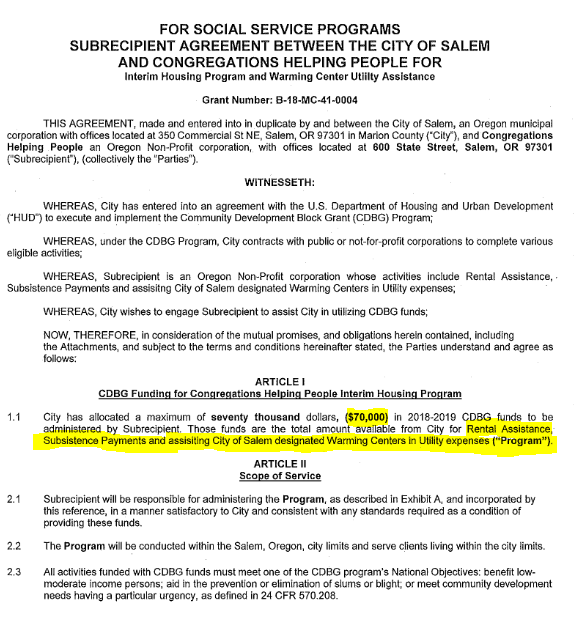
One of the duration shelters was on State Street (25 places, opened November 22) and one was on Portland Road (25 places, opened ~December 1) (see "MWVCAA's Cold Weather Shelter 2020-2021").  On November 5, the City held a fairly well-attended information/Q&A session to discuss the opening of the Portland Road program, and offer advance reassurance to NIMBYs that the program would not last more than 18 months. 

2640 Portland Road NE Shelter Community Meeting 11/5/20

Also on December 1 -- because the mercury was dropping below 33 for several days -- MWVCAA began offering a limited number of hotel rooms on a first-come, first serve basis, to those without other shelter options such as Safe Sleep United and Union Gospel Mission.  The hotel program was needed because Salem, and indeed the country, was seeing a new surge in C19 cases, making the volunteer-dependent, temp-activated shelter program impracticable.   

“COVID-19 is spreading faster in all parts of Oregon. It took six months before 25,000 Oregonians became sick with COVID-19 and two months more until we reached 50,000 total COVID-19 infections in Oregon. Most recently, it took three weeks to go from 50,000 cases to 75,000, and this weekend we crossed 900 total deaths,” said OHA Director Patrick Allen on November 30. 

Due in part to the hotel program, the State Street location, called "Shelter on State" or SOS, operated by Church at the Park, was initially under-subscribed.  A decision was made to revert to first-come-first served, despite the C19 risk, and participation increased.  Partly as a result of the SOS experience, the plan for the Portland Road location was changed from a pre-selected cohort plan, to a first-come-first-enrolled plan, effective December 22.

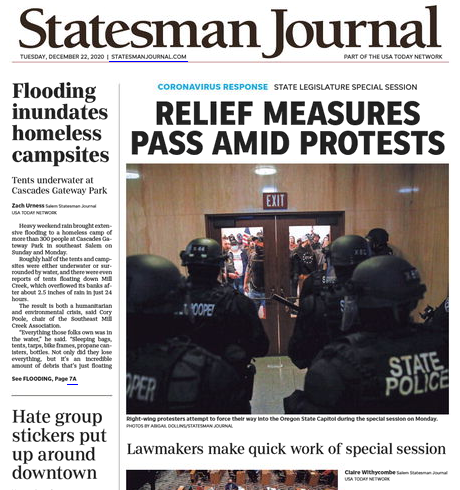
Mid-December, winter flooding began out at Cascades Gateway Park (see Harrell, S. "Homeless campers flooded out of Cascades Gateway after heavy rain."  (21 December 2020, Salem Reporter.);  Urness, Z.  "'People are suffering:' Floodwaters inundate homeless camp of 300 at Cascades Gateway Park."  (21 December 2020, Statesman Journal.);  Barreda, V.  "Crews pick up debris, help replace belongings for campers flooded out of Cascades Gateway Park."  (23 December 2020, Statesman Journal.)) and violent (but ineffectual) protests broke out in the Capitol during a one-day emergency legislative session.  About 100 of the most vulnerable were offered hotel accommodations through February 10, according to news reports, which quoted MWVCAA Director Jimmy Jones as saying "Every single year the water comes up in these locations ... Cascades flooded out last year, the only real difference is that density issue, we had a much larger number affected this time around."  
Following the flooding, the number of camps around the City continued to grow, as did the number of C19 cases and related deaths.  New groups organized to provide meals and pick up trash on Market Street at I-5.  Woodworth, W.  "'Nobody was doing anything for them': Salem volunteers help homeless encampment under I-5"  (12 February 2021, Statesman Journal.)

On February 1, Church at the Park opened a ten-week, 24-hour duration indoor camping program at the Fairgrounds Pavilion.  (50 tents/100 person capacity) on a budget of $602K, paid for with $250K from MWVCAA's share of "Out of the Cold" state program funds and $352K from the City of Salem.  See Harrell, S. "Salem fairgrounds welcomes unsheltered to temporary campground."  (1 February 2021, Salem Reporter.)  Whitworth, W.  "100-space homeless shelter opens at Oregon State Fairgrounds."  (1 February 2021, Statesman Journal.)  Another "Safe Park" vehicle campsite was set up in the parking lot.

Within 24 hours, the Pavilion program was full.  Whitworth, W.  "100-space homeless shelter opened Monday at Oregon State Fairgrounds fills up in 24 hours."  (5 February 2021, Statesman Journal.)  A good thing, because Mayor Bennett was ready (or at least wanting) to force people into the shelters, according to what he told the City's Legislative Committee in March.  Had the Pavilion not filled up, "We could have demanded they [sidewalk campers] move.  I think we would have had a whole bunch of people say, 'Nah, we're going to go over here and live.'  The question is, do we have any coercive power..."  "House Bill Kills Mayor's Sit-Lie Buzz" (4 March 2021). 


On February 9, the City Manager reported:
The Oregon State Fairgrounds Pavilion shelter and Safe Park [Network (vehicle camping)] are at capacity.  The Safe Park site [at the fairgrounds] has a waiting list. Persons sheltering at the fairgrounds are a mix of families and individuals, including relocations from Cascades Gateway, Wallace Marine, I-5/Market Street, and throughout the area. The City and Salem Housing Authority work with non-profit organizations through a coordinated intake process so there is a best fit for a person or family in need and available shelter. Hotel rooms are also a part of the sheltering system this winter. The City leveraged federal and state funding to expand use this year of hotel rooms. Our most vulnerable in Salem, including families, people who have chronic health conditions, and people age 65 and older, are in priority order for hotel rooms.
Church at the Park hired about 60 workers to run its programs, about half of whom were themselves homeless.  Some volunteer workers expressed grave doubts about the quality of the Church's hiring decisions, even though workers had to pass background check and receive random drug tests "about quarterly."  On February 22, one of the Church's shuttle drivers swerved off the road and onto the sidewalk and reportedly struck Salem lawyer David Runner, who suffered a head injury.  Harrell, S.  "Shuttle driver for Church at the Park charged with drug possession following off-duty crash." (3 March 2021, Salem Reporter.)  Luckily, she was off-duty at the time.  
 
The Portland Road, SOS and Pavilion programs closed down at the end of March.  Church at the Park gave Pavillion residents an eviction notice, below, copy to City Council.  Ten days beforehand, the City put out a news release stating that the City was still looking for "additional homeless shelter sites" and in the interim, "continues to develop other concepts and innovative solutions" with a link to its strategic plan.  As for its plan to address homelessness, see "Council Adopts 2021 Homeless Action Plan"  (10 March 2021). 
 
On 23 March 2021, the City agreed to allow Church at the Park to use the Portland Road site for 24 hr vehicle and pallet structure camping through the end of October by enactment of Resolution 2021-11, which amended Resolution 2020-49 which had declared a state of emergency relating to unsheltered persons through 26 October 2021. See "News from the Continuum" (24 March 2021).  The site re-opened under this new authorization on April 19, 2021.

Jimmy Jones summed up the season for the MWVCAA board this way.  

The winter sheltering season is complete, though the motel program will continue until mid-June.  I cannot tell you how grateful we have been to have these extra resources.  Many of the folks we’ve sheltered have grave health conditions and some of them would not have made it through the winter without this work. At day’s end, in the middle of a pandemic, we managed to provide more bed nights than at any time in our history (currently at 11,054).  Our goal for this winter, after last winter, was a bed count of 10,000 for the winter of 2020-2021.  I never thought we would get there, given the space limitations from COVID. But the motel program saved us.

Saturday, May 16, 2020

MWVCAA's Cold Weather Shelter 2019-2020

By Sarah Owens and Michael Livingston

First Presbyterian Church on Chemeketa Street, one of four 2019-2020 shelters
The 2019-2020 winter warming effort began in late October with "[a]n unexpected cold snap" that "sent Salem's warming shelters scrambling to open early."  Radnovich, C. "Salem's warming shelters serving homeless scramble to open early for cold snap."  (28 October 2019, Statesman Journal.)

Typically, the season runs November 1 through March 31.  Mid-Willamette Valley Community Action Agency's Ashley Hamilton told Statesman that, "The biggest hurdle [to opening three days early was] having each location cleared by Salem's fire marshal."

The Salem Warming Network, as it's now called, added a fourth warming center last year -- Capitol Park Wesleyan.  Total mat capacity of the four locations: 140.  The "primary" location was First Presbyterian (photo above) (capacity 78), with "auxiliary" locations at South Salem Friends Church, Church at the Park, and Capitol Park Wesleyan.  Auxiliary locations were opened, or not, based on how many volunteers signed up for a shift.  To open all four locations in one night required 70 slots to be filled.  The network was never able to open the fourth location.

Fortunately, last winter was mild; warming was "activated" a mere 17 nights. (Activation occurs when overnight lows of <33 degrees Fahrenheit are forecast.)  But, the network had other challenges.

In December, City Council banned camping on City-owned property and rights-of-way.  See "Camping Ban for Christmas."  Responding to criticism, Council allocated $113K to keep the warming centers open every night for the rest of the season, beginning January 1, 2020, to give campers somewhere to spend the night.   

Unfortunately, only one location was willing to participate in this "duration warming" model:  Church at the Park, which could accommodate up to 30 (some had to sit up) under an emergency declaration.  The effort required that 12 volunteer slots be filled every night, but the volunteers came through 72 nights in a row, and the program likely would have continued past March 16, but for the coronavirus pandemic.  See "COVID-19 Returns Campers to City Parks."

The continued presence of the coronavirus will require the network to make drastic program adjustments for the coming winter, and, quite possibly, the one after.  Add to that the fact that the network's primary (paid) coordinator, Kaylynn Gesner, recently announced she was leaving MWVCAA.  Fortunately, the City is making plans to address the situation.

Former DMV building at 2640 Portland Road NE to be a warming center
According to the most recent City Manager's Update (dated 13 May 2020), the City plans to locate a warming center at 2640 Portland Road NE (see photo at right).  According to that update:

"The building is currently leased by the Urban Renewal Agency to MERIT, an organization that provides economic and business development services to disadvantaged populations. MERIT is unable to make lease payments, has gone through leadership changes, and wishes to terminate the lease effective August 31. [MWVCAA's] ARCHES [Project] would have a couple of months to get the building ready for use before winter. The shelter use is limited by DEQ rules to no more than 18 months. Opening this winter would allow use for two winters. By then, the building [acquisition and rehab] discussed in executive session [likely 615 Commercial Street NE] would be ready [renovated to accommodate a few overnight, low-barrier shelter beds]. This all predicated on the state funding for navigation centers.

We asked City Manager Steve Powers if, in fact, the use of the Portland Road building as a warming center is "predicated on the state funding for navigation centers" but have not yet received a reply.  Likely, the City just needs state nav center funding to operate the ARCHES overnight shelter/nav center, because the Urban Renewal Agency/City Council are almost certainly going to approve using $4.4M of RDURA funds for the necessary acquisition(s) and rehab.  See "DAB Says NIMBY to Nav Center."

We asked MWVCAA Director Jimmy Jones about future prospects. He told us:
  1. Even if there is a navigation center or low barrier shelter, it is absolutely NOT going to be sufficient to support even 1/10th of the people who are outside.  
  2. There is no money coming from the state for navigation centers this year or likely next.  Gov’s office is projecting a revenue reduction of $2-3B, though it could be as low as $1B and as high as $5B.  Each department has been told to prepare a budget that has a 8.5% reduction just in case.  
  3. The viral situation is going to shift focus away from congregate shelters to motels or organized camping.  
  4. Rooted in all these [FB] comments [on recent Council actions] (and some on the Council too) is the general belief that most of the people outside WANT to be homeless, and that there is a choice involved.   
  5. Redwood [Crossings] is not going to be a panacea.  It’s only 38 spots, and because of the design (shared bathrooms) we will have many very high needs people who can’t go there because they won’t be able to share a bathroom.
Jones says "we need a city-wide strategy that does more than rely on these housing projects which (while important progress) will not solve the issue of unsheltered homelessness."  He says the most important question facing the City on the homeless front is, "What do we plan to do with the large numbers of unsheltered after the COVID crisis is over, the ones who either cannot or will not be served by these new projects?"  The response, he believes, will prove "where we are as a city, in our leadership, our social services, and our respect for human dignity."

Jones has asked the Mid-Willamette Valley Homeless Alliance (the name of the new Marion and Polk County Continuum of Care or CoC) to form a workgroup to develop a regional plan for winter warming.  In his request, he asserted that the issue wasn't only Salem's.
Unsheltered homelessness affects [] Marion and Polk counties, too.  I think making this more of a CoC planning level element will get us to a better winter warming policy, and one that shares the burdens across all agencies and governments. 
The Alliance Board met this past week, but the request was not discussed.

6/17/20 Update:  The Alliance's Collaborative Committee created a subcommittee to coordinate winter warming shelters, see meeting minutes here.

Friday, April 5, 2019

MWVCAA's Cold Weather Shelter 2018-2019

The Church at the Park on Turner Road, one of three 2018-2019 shelters


By Sarah Owens and Michael Livingston


The winter of 2017-2018 was cold and controversial.  The weather wasn't nearly as bad (a total of 11  shelter nights in three locations downtown with an average of 76 guests per night) as its timing -- no one wants to see people suffering in the streets during the height of the Christmas season.  See Bach, J. "Salem's first emergency warming shelter brings relief to homeless."  (21 December 2017, Statesman Journal.)

Then in February, the unexpected occurred.  A bureaucratic miracle removed responsibility for Salem's cold-weather shelters from Mid Willamette Valley Community Action Agency (MWVCAA)'s then Deputy Director, Cyndi Leinassar, and gave it to MWVCAA's then Community Resources Program Director, Jimmy Jones.  Suddenly, the community had resources for cold weather shelters. 
   
"Salem Warming" created for 2018-2019 season
By the fall of 2018, MWVCAA had hired a volunteer coordinator, put up a website, and announced the creation of a Salem Warming Network which proposed to open warming centers when the temp was expected to drop below 33.

There was just one little problem.  The warming centers -- church buildings --  were not approved for use as shelters.  To get around that, the City would have  to declare a "Weather Event Emergency", as it had in 2017.

The Fire Department said no, initially.  The City's standard for what constituted an "emergency" (set while Leinassar was in charge), was three consecutive days when the temp was expected to drop below 28.

The simple "below 33" didn't constitute  a Weather Event Emergency.

There had to be a work-around.  Per Assistant Fire Department Chief Greg Hadley, it was determined/agreed that the warming centers could be opened a maximum of 90 days in a calendar year on these conditions:  they had to be identified and inspected. If the building did not have a sprinkler system, people had to sleep on the ground floor.  There had to be smoke and CO2 alarms, at least two exit/entrances, an emergency evacuation plan, a fire watch posted, maximum occupancy of 1 person per 50sf, rules posted and compliance documented.  Hadley told us that the solution seemed to work well, and could be applied next season (2019-2020).

The Network website offered/offers visitors basic information about hours, locations, transportation, training opportunities, sign ups, and program changes.

The 2018-19 program looked like this (info taken from a FB post)(compare the volunteer manual):

Three locations, not all downtown:  First Presbyterian Church in CANDO, Church at the Park, and South Salem Friends Church can accommodate 190 total.

Fewer volunteers per shift/per night  than previously.  At First Presbyterian Church, they were reportedly:

Shift 1: 6:30p - 11:00p ~ 7
Shift 2: 10:30p - 3:30a ~ 5
Shift 3: 3:00a - 7:30a ~ 7

A "lead" on every shift arrived early to set up floor mats and the "beverage station" (decaf, sugar substitute at night).  Leads were familiar with most of the guests, and responsible to assign duties, taking preferences into account.  Training on how to be a lead was available.

Other roles:

outside greeter - lets ppl know they will need to check all property (including food, drink, meds) except coat, cell phone, book

inside greeter - welcomes and record name on numbered roster and wrist band (like in a hospital)

bike mgr - checks in and locks bikes (outside)

property mgr - record name/roster number of any personal items on tag(s), hand to bagger  

bagger - bag property and attach tag(s)

runner - take bags to secured storage room

property room mgr - stage and organize property in numeric order

blanket mgr - hand out new or reserved blankets (returning guests)

beverage station workers - offer hospitality, keep area tidy, monitor supplies in cooperation with host church volunteers

hall and bathroom monitors or floater - (as in school)

sleeping area monitor - respond to questions, clean and de-escalate as needed 

patrol - walk "the perimeter" checking that doors are locked, encouraging anyone hanging around outside to come in and get warm

3d shift/closers - make coffee, wake guests, sanitize and stow mats, bag and label blankets, tidy area 

As in years past, Willamette Valley Yellow Cab provided rides to and between shelters.  Animals/pets were allowed, and did not need to be crated as long as they were leashed and under control.       

Lowering the standard for activation added 31 nights, for a total of 42 in 2018-2019.  Salem shelters were opened 14 nights in November and December, and 7 in January.

By the end of January, MWVCAA had determined that volunteer labor would not be sufficient to meet the demands of running even two cold-weather, emergency shelters under the new criteria.  So, they announced they'd be hiring 8-10 "Warming Representatives" to be on call to help out until the season closed March 31.  Unfortunately, the decision was not made in time to avert a shortage during an extended February cold snap, when flu was also making rounds.  At one point, the Marion County court was even ordering offenders to do community service at the shelters.

On February 5, 20 people seeking shelter were turned away.  See Brynelson, T. "As cold snap lingers, warming shelters face volunteer shortage and potential closures."  6 February 2019, Salem Reporter.), Harbarger, M. "Cold weather homeless shelters stay open for fourth night."  (6 February 2019, Oregonian.)  According to Salem Reporter, MWVCAA had about 125 active volunteers, and needed about 300.  Through media, social media and other forms of appeal, MWVCAA managed to add another 204 volunteers, for a total of 329 at season's end.  An estimated 922 (+ 5-10%) unique individuals received shelter through this effort. 

So what did all this cost?  Not counting the in-kind donations from Willamette Valley Yellow Cab and members of the community, roughly $82K.  The biggest cost, as usual, was staff.  A volunteer coordinator plus paid staff shifts cost MWVCAA about $50K.  The remaining $32K was half heating, half everything else (repairs, mats, blankets, licenses, supplies).  The City of Salem provided $16K in "utility stipends" to the churches to cover additional heating costs (that's roughly $900/mo per location), and "everything else" was paid for by the host sites ($10K) and MWVCAA ($6K).

Looking to next winter, MWVCAA reports having applied for a $100K grant from the City of Salem (presumably from General Fund and/or CDBG social services fund) for next year.  Asked about the plan should the City award the grant, Jones, who is now MWVCAA's executive director, stated,

We would use the $100,000 to subsidize the costs of expanded warming, which include a full time coordinator and paid shift leads.  Volunteer models are not fully adequate to cover either the cost or manpower needed to successfully provide warming throughout the winter.  If possible we would like to continue to expand winter warming to something that more closely resembles a duration model.

(A "duration model" shelter would open and remain open for a given period [the "duration"] versus the current model shelter, which opens and remains open only if certain circumstances exist.) 

Friday, March 30, 2018

MWVCAA's Cold Weather Shelter 2017-2018

By Sarah Owens and Michael Livingston


In October 2017, the Mid Willamette Community Action Agency (MWVCAA) said they were going back to Plan A for an overnight warming shelter/center, namely relying on the same downtown churches, specifically the First Christian, Congregational and Presbyterian to host, using the same "prevent-death" guidelines.  

Deputy Director asked "key stakeholders" (TSA, UGM, other Emergency Housing Network members, Salem PD & FD) to commit 12 staff hours to "support" the "Lead Volunteer" in opening and closing duties, in order to relieve MWVCAA, who would otherwise be responsible.  (See here at p 20.)

But by December, the community was in a bit of an uproar.  See "The Perennial Overnight Warming Shelter Problem." Sorry, MWVCAA seemed to say, that's the best we can do.

Single Night Only Warming Shelter
Then, on Monday, February 12, MWVCAA announced they would be opening an emergency warming shelter in the new ARCHES building, based on the forecast of an overnight low in the 20s.

Just like that:  no requirement of 32 volunteers, no emergency declaration from the City, no 3 consecutive days below 27.

Turns out, as everyone suspected, none of that stuff was really necessary.  They could just "do it."  Goodbye guidelines.

The Men's Mission turned people away Monday night.  

Because They Wanted To
There were 27 at the emergency shelter, which got moved to First Christian Church shortly after MWVCAA announced the decision to open one at ARCHES.

There wasn't even a frantic call for volunteers.

"We are good on volunteers", CRP Director Jimmy Jones posted to FB in response to offers of help, "We are using mostly my staff." As if by magic, there was no more perennial problem.

MWVCAA opened another overnight warming shelter on Sunday, February 18 through Wednesday February 21.

First they said it would be at ARCHES, but the venue was quickly switched to First Congregational Church (two nights), then to the First Christian Church's Morgan Building (third night).

They asked for experienced/trained volunteers, about 10 per shift, and got about 7 per shift, according to the sign up sheet.

Altogether this season, there were ten shelter nights in three locations downtown:  First Christian, First Congregational and First Presbyterian, with an average of 76 guests per night.  See here at page 40.  

The Oregon Community Foundation recently gave MWVCAA $7,000 to support the overnight warming shelters, which MWVCAA says they will use to purchase replacement blankets and mats.

Saturday, December 30, 2017

The Perennial Overnight Warming Shelter Problem

By Sarah Owens and Michael Livingston


Wednesday12/13/17
Saturday 12/16/17


Winter.  The holidays.  The cold.  The dark.  People are seen sleeping on the streets, and they make others --  those with homes to go to -- feel uncomfortable.  Not afraid, just uncomfortable.  It's, you know, a moral thing, that descends with the winter darkness, and  weighs on one's soul.
  
The grumbling begins, first on FB.  It moves to email (Mayor, City Manager, MWVCAA).  Then the Statesman Journal runs a story.  Then a local business steps up.  Then there's a story about that, and then City officials say they're exploring other options. Then AP and the Oregonian pick up the story about the local business stepping up.  Then there's a meeting at City Hall, and...nothing changes, except the critical audience has expanded to the state and the nation.  Before the week is out, the warm and fuzzy from The Great American Eclipse is all but forgotten.

Given the planning that made the Eclipse such a success, you'd have thought the City would be able to get out in front of something that happens every winter.  Sadly, you'd have been wrong.  At our October meeting, Ward 1 Councilor Kaser reported "plans are in place for a warming center", but she didn't go into any detail.  MWVCAA was handling it, weren't they?   
Thursday Evening 12/14/17
Sunday 12/10/17
If the City's at fault, it's for blindly relying on MWVCAA, Charlie Brown style, year after year, despite previous disap-pointments.  Or, as Virginia Tate put it in a post  about MWVCAA's "coordinated entry" program:

"This has been my experience with every program the MWVCAA offers. When I lost my job and was afraid I’d lose my home, I went to the office. There was one woman sitting in a very nice office and no other activity going on. I shared my experience and she handed me a booklet of agencies and that was that.  No other personal contact. No other assistance.  The booklet had one or two places that might help, but other information was out of date.   In fact, every time I’ve called their office, nothing.  Their staff is ridiculously uninformed and have no idea how to deal with vulnerable populations."

Monday 12/11/17
Tuesday 12/12/17
Tate con-tinued, "I’ve been fortunate to be a part of a group of agencies that came together to build an adult learning center that offered GED, adult literacy, support services, job opportunities, and computer classes. Until all of these agencies come together and discuss how best to spend their resources and limited funds, fewer and fewer people will be served."  (Emphasis added.)  Make that, fewer people are being served.

Wednesday 12/13/17
Thursday Evening 12/14/17


The hope that the City would step in with resources continued into Friday, December 15, by which time the focus had shifted from where to locate the warming shelter (MWVCAA having claimed initially -- and falsely -- that the problem was the lack of a dedicated space) to volunteers trained to staff the shelter.

Friday Morning 12/15/17
Virginia posted another comment: "I hate to nitpick now that things are moving (sorta) but I see where they [MWVCAA] had a volunteer training on Nov 6th for warming centers. People commented they were interested and how do they sign up. They answered no new training was scheduled. I also saw where they [MWVCAA] posted in early Dec for volunteers for other counties - Polk, Yamhill, etc. Nothing for Marion. I don't see a new training post. So, where are the volunteers that were trained in Nov?  I feel they may have let this fall through the cracks and now here we are." (Emphasis added.) 

Les Margosian replied: "Having volunteered at warming shelters over the last several years, I'm surprised to read that a shortage of volunteers is a major reason for not being able to open. We have not received the customary call for volunteers and I'm thinking that IF this is one of the reasons, its strictly a BS reason. Also, I'm thinking that waiting til Hell freezes over for opening our shelters is probably not a valid criteria."  (Emphasis added.)  Nevertheless, the "hell freezes over" criteria remained in place following Friday's meeting between City officials and MWVCAA's director, Jon Reeves.

Friday Afternoon 12/15/17
"
The forecast looks pretty evident,"  Reeves told the Statesman Journal  on Friday, as if the decision to open was entirely in the hands of meteorologists.  Anything to distract from questions on the practical issues allegedly preventing MWVCAA from asking the City for the emergency declaration that would permit available spaces to be used as warming shelters.   

Reeves also told the SJ on Friday that "City officials are 'definitely working on ways to support the effort'."  And he didn't want to say what those "ways" might be because, what?  We might expect results? 

Colt Broadlayson, agreeing with Les, felt like "MWVCAA has been giving us the run around."  Susann Kaltwasser said she'd "come to the same conclusion. MWVCAA is not doing a good job on several levels. I think the problems run deep and I am going to urge my elected representatives to start digging into some issues."

Saturday 12/16/17
"They [MWVCAA] said the criteria for not opening was based on Red Cross criteria, then when checked out, we find out that RC has no criteria." 

"When some try to volunteer they are told by MWVCAA that they have enough volunteers and the next training is in January. Something is not right."


Bonnie Davidson commented, "Perhaps a good strong look into how MWVCAA really spends the various grants and donations it receives is due. Shame on this agency that purportedly exists (and whose employees are very well paid and comfy warm at night) to serve the poor. Salem residents should keep shining a light on how the least among us are not being served by MWVCAA.

Dana Sidhe Seer Canning commented, "MWVCAA in my humble opinion should be removed from the city's go to list period! Churches/ Businesses should be involved and volunteers can staff. Aren't we paying someone $55k to coordinate the homeless [services delivery]? Surely if the city would green light use of a building I would gladly take responsibility to staff and care for our fellow community members.

Yes, the City is paying someone to coordinate homeless services.  In fact, they're paying several.  In addition to the recently funded Homeless Program Coordinator position at the Council of Governments (which support was a trade off for the County's support of the Mayor's sobering center -- the City's share being $45K, not $55K), there are two Federal Programs staff in the Urban Development Department overseeing the Community Services and Housing Commission which is charged under SRC Chapter 20G to execute certain duties, including "Initiat[ing] efforts toward exchanging information for the purpose of coordinating social service delivery systems, public and private, and their governing and administrative bodies that affect the Salem area population."  There's also the Salem Housing Authority that staff the Emergency Housing Network and coordinate all the service providers needed to run their Housing Rental Assistance Program (HRAP). 

Monday 12/18/18
By week's end, it was clear to the community that the problem wasn't a lack of space or insufficient trained volunteers, it was MWVCAA, which remained steadfast in its commitment to a "prevent death" standard, when some, maybe many, in the community believe the standard should be higher, more along the lines of "prevent suffering."  But, preventing suffering takes many more resources than preventing death.  This question -- what are we really wanting to do --  is Salem's perennial warming shelter problem.  

Will the community retain in 2018 what it has learned in 2017?  Or will they/we and the City again rely on MWVCAA for warming center planning?  Because, if we do rely on MWVCAA, it's Groundhog Day.  

Golf, anyone?  

Monday 12/18/17

Update 12/18/17:  MWVCAA determined that their forecast criteria had been met, and activated a warming shelter in the central area for the period Wednesday 12/20/17 thru Tuesday 12/26/17.  (First Presbyterian Church (Chemeketa and Winter.)  They say they require 32 volunteers/staff per four hour shift.  Professionals we talked to think experienced shelter operators probably would not require as many volunteers.

Update 12/27/17:  The requisite number of volunteers signed up, and MWVCAA stayed open through 6:30a Tuesday, despite the thermometer and forecasts rising a few degrees above 27.  Lows over the New Year's Day weekend are expected to hover around freezing, rising to mid thirties later in the week.  For more about the 2017-2018 sheltering season, see "MWVCAA's Cold Weather Shelter 2017-2018."


Sunday, January 22, 2017

Out of the Cold

By Sarah Rohrs


Warming Center at 770 Commercial St
A warming center is, obviously, a place to get out of the cold and warm up. The very name conjures up something temporary, a place to take refuge for a bit before heading back out into the weather.

For more than one hundred homeless people in Salem, a warming center set up in the former Oregon Department of Energy was exactly that – a place to get out of the cold for a few hours.

It was certainly not ideal but it was better than nothing in the recent cold snap when temperatures plunged.

The primary purpose of warming centers is to prevent homeless people from freezing to death.  Last year the Community Action Agency activated the warming shelter only four nights. So far, this season the center has been activated 17 nights.

The decision to activate has something to do with where the mercury falls on the thermometer and for how long. But for anyone sleeping outside, I image that kind of criteria means nothing. If the temperature is just above or below freezing hardly matters.

Most of us could, conceivably, call our homes “warming centers.” After we’ve been outside running errands we can go inside and warm up. The big difference is that we have access to our homes 24/7 . We have hot water, food, a bed with plenty of blankets, plus our possessions under one roof. For the homeless their access to the warming center is restricted to nighttime hours only.

I contemplated all this and more when I volunteered for one four-hour shift at the Salem warming center. As a KMUZ Community Radio volunteer I had heard announcements about the center opening up in late December when the temperatures turned frigid. A fellow radio volunteer posted on Facebook that the centers could not operate without volunteers. Then I saw a notice on this blog about volunteers. I figured I could leave my home for a few hours to help out.

I picked a 7:30 to 11:30 p.m. shift rather than the 11:30 p.m. to 3:30 a.m. shift, or the 3:30 a.m. to 7:30 a.m. shift. I go to bed early. I have no idea how volunteers in the later shifts could stay away in the wee hours of the morning. When I arrived around 7:20pm, I saw a long line of people with their shopping carts, bicycles, pets and other belongings up against the building. It was already freezing outside but they had to wait until all the volunteers were ready inside.

So, I went inside and stood around feeling pretty stupid and useless until our shift’s crew leader, Pam, assembled us all together, showed us around and told us how things operated. She told us that each guest got a number and a bracelet like the kind you get at the hospital. They had to leave their shopping carts and other large items outside, and then got a large plastic bag with a blanket in it to use when they went to sleep. I looked around a large room and saw thin, narrow mats like yoga mats lined up in long rows.

I got assigned to the hot beverage area, a long table with large containers of hot decaf coffee, and hot water for tea and bullion. Two of us in that area also had to clean off tables where people ate, and also straighten out piles of donated jeans, sweaters, coats, gloves and hats. It was easy. Other volunteers had to keep the bathrooms cleaned, check people in and monitor the crowd outside.

Pam had told us about guests with incontinence problems and said adult diapers would be available. One man named Dave clearly had this problem. Both his pant legs were deeply soiled. We had been told to offer to help such people like Dave, coax them to take a shower and put on clean clothes. But I was afraid when I saw him and didn’t do anything.

Other guests finally complained about him smelling so bad. Pam asked a couple of men to help her convince Dave to get cleaned up but they declined. I saw her walk over to where he was laying on a mat but he was apparently asleep and she left him alone.

As people checked in and got their blankets, the room quickly filled up with people claiming their mats on the linoleum floor. Some of the people clearly suffered from mental disorders of various kinds and degrees, such as paranoia and schizophrenia. Some paced around the tables while others sat and laughed and talked to themselves. One man believed he was the owner of the Raiders and spent hours trying to corral garbage bins and other items into one area of the room for the football team. He yelled at me when I told him he couldn’t take an entire box of knitted hats away from the clothing area. To distract him I offered him a pair of clean socks I found and he sat down on the floor to put them on. Then I saw he had a flexible cast on one leg which he laboriously unwrapped and then wrapped up again. When not on his crusade to keep things safe for the Raiders he was quite pleasant and coherent.

Warming Center at frmr DOE Building
As I tried to stay busy, I remembered a recording a fellow KMUZ volunteer made of a woman at the Polk County Connect saying that she had been afraid of homeless people but then came to realize they were just people like everyone else. I kept those words in mind as I talked to guests. I offered to help them find pants in their sizes, or talked with one man about dry skin after he showed me the deep cracks in his chapped fingers. I accompanied one lady to the bathroom because she was afraid someone was hurt inside.

At one table, a group of Latino men laughed and talked. It was nice to see the warming center a spot for laughter and socializing. Someone had given them a cake at “the bridge” which I assumed to mean the Marion Street Bridge, and they seemed to be enjoying themselves as they talked and passed out slices of cake. I assured them I’d clean up after them which I gladly did. At another table, a young couple sat close to one another sharing a container of Ramen noodles they had heated up with the hot water. They huddled together at the table with their hoods and jackets tightly cinched and closed. They looked cold, and tired to the bone. After they ate their meager dinner, they kissed briefly and that kiss seemed more sad than sweet.

At 10 p.m., the lights dimmed. Most of the guests were already settled on their mats, some even in some semblance of night clothes. I watched one woman writing in her journal and her male companion reading a book. Some guests snored and others fidgeted and complained about their neighbors.

Center volunteers continuously walked up and down the lines of mats, often settling minor disputes and asking people to quiet down. Around the front door, some guests had a last smoke before trying to get to sleep and others kept going outside, worried about their shopping carts.

I was grateful when my shift was over but felt vaguely guilty as I got into a car, blasted the heat and then drove to my “warming center,” a home I found conspicuously well heated when I got inside. Other than keep sugar bowls full and tables clean I felt I did very little to help the guests out in any meaningful way. I was grateful they were able to get out of the cold, and grateful for the more experienced social workers in the room who were able to work with them on a more one-on-one basis.

I certainly had no say, nor input into the welcoming center, nor did I do anything to help get it started, staffed or stocked with a myriad number of donated items. Still, I was a bit sad at the narrow, thin mats the guests slept on, and how close those mats were placed together. It seemed heartless that the guests would be back out into the cold in the morning. It took the city of Salem and social service organizations weeks to get this temporary facility open and running. I’m glad it was available, but it’s hardly any kind of solution to the large number of homeless people outside in the winter. What will it take for something more permanent or at least more comfortable?

Tuesday, December 13, 2016

MWVCAA's Cold Weather Shelter 2016-2017

Revised: December 2018

By Sarah Owens and Michael Livingston


The winter of 2016-2017 continued a cherished holiday tradition in Salem: the frantic search for shelter for citizens threatened by freezing weather.  See here for the story on the winter of 2015-2016.
Guests Prepare to Depart 770 Commercial St Ctr on 12/15


Salem Forecast for December 13 through December 17, 2016

This winter's tale began December 5, 2016, with the Mid-Willamette Valley Community Action Agency's announcement that a warming shelter for veterans would be opening the following night, if they could secure enough volunteers.

When questioned, CAA staff said no one seeking shelter would be turned away, regardless of their veteran status.

Around this time, a guest of UGM complained to the Fire Marshall about the crowded conditions at the Men's Mission (capacity at that time said to be ~180, with overflow capacity for an additional ~90).  After an inspection, UGM began limiting the number of overnight guests to 28, leaving many nowhere to go.  At 3pm on December 7, John Olivera, owner of Steeles Karate, opened his gym at 860 High St. NE to anyone  needing shelter.  The night of December 8, 20 guests took shelter at the gym.

John Olivera at City Council on 12/12
The Mid-Willamette Valley Community Action Agency's decision to open its church-based overnight shelter only under limited circumstances [see 12/8 announcement below] was criticized in local and social media.  See Currie, C. "Warming centers scarce for homeless." (Statesman Journal, 8 December 2016).

The weekend of December 10/11, the national weather service predicted freezing temperatures and a wintry mix of precipitation beginning the middle of the following week.  Also about this time, the churches in line to host MWVCAA's overnight shelter discovered that they were scheduled to host homeless families through the Salem Interfaith Hospitality Network  (SIHN) "over the next couple of weeks."

Those churches told MWVCAA, and later the City Council, that they could not host the MWVCAA overnight shelter in the coming weeks because of their commitment to SIHN.

On Monday, December 12, the Salem City Council moved to second reading Ordinance Bill 26-16, which, basically, allows weather events to be considered emergencies, and allows the City to open and operate something called "mass shelters" on City-controlled property in conjunction with a Declaration of Weather Event Emergency.  See staff report here.  See Statesman Journal coverage here.

Laura Perez, FCUCC, at City Council
On Tuesday, December 13, a "weather event emergency" began at 6pm.  The City, MWVCAA and local providers scrambled to prepare two shelters.  One at the "O'Brien Site" at Liberty and Division, which the City was leasing in the hope it would one day be the site of a new police facility, the other at First Christian Church, where CANDO holds its regular monthly meetings.   

The Mid Willamette Homeless Initiative Task Force never discussed the need for warming shelters.

On December 15, guests departing both shelters as snow was falling reported having had a good night, except for the talking, with around 30 guests total at each shelter.  According to Statesman Journal reports, the Commercial Street shelter had 40 guests and First Christian had 38, supported by >60 volunteers, neither reaching capacity.

Both facilities had crates for guests' animals.  Yellow Cab  transported volunteers without charge.  Total snowfall in Salem was around 5".  The initial call for volunteers was for 8-10 per shift at the Liberty Street shelter, and 24 per shift at First Christian Church.   The call for the Liberty St shelter was later changed to 27 per shift.  The temp was 19 degrees F at 5 am, with 32 degrees F the expected high for the day, which was predicted to be sunny.  The low temps meant there was very little melting of the snow during the day.

Both shelters opened Saturday and Sunday, December 17 and 18. Rain and above-freezing temperatures were predicted for the rest of the week.

MWVCAA notice issued 12/8/16
First Christian Church on 12/15 am - Entrance to Shelter
On December 28, MWVCAA reported the following:

Total Unique Guests: 187 (91 at First Christian and 96 at Commercial St)

Total Pets: 11 (1 dog at First Christian and 7 dogs, 3 cats at Commercial St)

Total Nights of Shelter: 187 people stayed 342 nights 
* 26 guests stayed 4 nights
* 17 guests stayed 3 nights
* 47 guests stayed 2 nights
* 93 guests stayed 1 night

Total Volunteers: 175 (at First Christian = 97/580 hours) (at
Commercial St = 78/511 hours)
 
MWVCAA activated warming shelters for New Years Day 1/1/7 thru 1/4/17 at the former Department of Energy building owned by First Christian Church, located between the Church and Cinebarre, below.  It later was extended  through 1/6/17.

On January 9, MWVCAA announced it was activating another warming shelter, beginning Wednesday night 1/11 to run through Friday 1/13.

Tuesday's predicted low is 29, with
rain/snow expected.  The forecast  doesn't meet MWVCAA's criteria for activation, which is 27 degrees F for 3 consecutive nights.

Former Department of Energy (owned by First Christian Church)


Forecast for Friday 1/6/17 thru 1/9/17


Forecast for 1/10 thru 1/13