Showing posts with label Resolutions. Show all posts

Sunday, February 23, 2020

in re City Camping Program

CANDO RESOLUTION NO. 2020-1
 
A RESOLUTION REGARDING CITY-SPONSORED ORGANIZED TENT-CAMPING 

WHEREAS, at its December 9, 2019, meeting, the Salem City Council discussed -- and apparently still is considering -- a plan to provide public funds, property and other resources to establish an organized tent-camping program that would accommodate approximately 35 “homeless” residents, would cost about $1 million a year and would create housing for no one;

WHEREAS, in the past two years, the Salem Housing Authority’s Homeless Rental Assistance Program (HRAP) has placed more than 100 chronically homeless individuals in permanent supportive housing;

WHEREAS, in addition to more permanent supportive housing, Salem also needs a “low-barrier” shelter facility;

WHEREAS, as City staff acknowledges in the staff report outlining the proposed organized tent-camping program, “[t]he City’s resources needed to support paid staffing of an organized temporary shelter/campsite would be better invested in a low-barrier shelter or the HRAP program”;

WHEREAS, the City is facing an approximately $16.2 million annual General Fund budget deficit, and, in order to address that revenue shortfall, the City Council (a) enacted an ordinance establishing an “operations fee” to be collected through utility billing and (b) referred a proposed employee-paid payroll tax to the voters in the May 2020 election;

WHEREAS, organized tent-camping puts no one in housing, does not constitute shelter under HUD regulations, is expensive to operate and has high “lost opportunity” costs, and many of those who are chronically homeless either will not, or cannot, participate in such programs;

WHEREAS, the Central Area Neighborhood Downtown Organization (CANDO) is a neighborhood association created by the City of Salem and, as such, has legal standing in all land use matters within its boundaries and also is asked by the City and other jurisdictions to comment on a variety of matters important to the community;

WHEREAS, two of the favored sites identified by City staff as suitable for an organized tent-camping program are in CANDO;

WHEREAS, in 2016, the City of Salem helped launch the Mid-Willamette Homeless Initiative “to identify and launch proven strategies to reduce homelessness” in the region; 

WHEREAS, on September 9, 2019, the City Council authorized a Memorandum of Agreement to create a Development Council to oversee and manage the development of a local continuum of care (aka “Mid-Willamette Valley Homeless Alliance”) for purposes of receiving much-needed homeless assistance funding through HUD’s Continuum of Care Program;

WHEREAS, a city-sponsored organized camping program is inconsistent with
a. CANDO’s goal to “Support initiatives offering practical solutions for neighbors living on the streets”;
b. the mission and purpose of the Homeless Rental Assistance Program;
c. the mission and purpose of the Mid-Willamette Homeless Initiative;
d. the mission and purpose of the Mid-Willamette Valley Homeless Alliance.  
NOW. THEREFORE, BE IT RESOLVED that CANDO recommends to the City Council AGAINST using public funds and resources, including city property, to establish and /or administer an organized camping program. 

ADOPTED by the CANDO Board of Directors, this 18th day of February, 2020.

ATTEST:

CANDO Secretary/Treasurer

Wednesday, September 18, 2019

in re Sidewalk Behavior Ordinance

CANDO RESOLUTION NO. 2019-1 
A RESOLUTION REGARDING PROPOSED SIDEWALK BEHAVIOR ORDINANCE 
WHEREAS, between October 2016 and January 2019, more than 2,600 residents of Marion and Polk counties were identified through evidence-based assessments to be at risk due to living outdoors or in places not fit for human habitation;
WHEREAS, these “homeless” residents include children, families, veterans, and those suffering from addiction and physical and mental illnesses, some of whom have been “homeless” off and on for many years, many of whom have sought housing and been denied for lack of resources; 
WHEREAS, approximately 1,800 of these residents live within Salem’s Urban Growth Boundary, with as many as 700 living within one mile of Marion Square Park, including the Union Gospel Mission and Wallace Marine Park;
WHEREAS, the vast majority of these residents go out of their way not to draw attention to themselves and to avoid causing a disturbance on the sidewalk;  
WHEREAS, petty offenses can lead to misdemeanor convictions that can and do have collateral consequences that create barriers to housing and employment;  
WHEREAS, the Salem Revised Code includes a number of petty offenses, so-called “quality of life” crimes punishable by exclusion, such as disorderly conduct (SRC 95.120), urinating and defecating in public (SRC 95.125), trespass (SRC 95.550), drinking in public (SRC 90.020), public indecency (SRC 96.220), noise disturbance (SRC 93.010), and pedestrian interference (SRC 95.700); 
WHEREAS, proposed Ordinance 10-19 seeks to expand the list of “quality of life” crimes to include sitting and lying on sidewalks during the day and evening hours;  
WHEREAS, for residents living in the streets, sitting and lying on the sidewalk during the day and evening hours may reasonably considered “acts of living”; 
WHEREAS, making “acts of living” illegal is cruel, stigmatizing, counterproductive and bad public policy;    
WHEREAS, in 2012, the United States Interagency Council on Homelessness (USICH), in partnership with Department of Justice and U.S. Department of Housing and Urban Development (HUD), published “Searching out Solutions: Constructive Alternatives to Criminalization”, which outlined “alternatives for communities who implement local measures that criminalize ‘acts of living’"; 
WHEREAS, in 2014, HUD issued guidance citing a recent report by the National Law Center on Homelessness and Poverty, “No Safe Place: The Criminalization of Homelessness in U.S. Cities”, finding that there had been a significant increase in city-wide bans on camping, loitering, and begging in public areas, which HUD characterized as “effectively criminalizing people’s need to survive” (emphasis in original) and “exacerbat[ing] existing problems”;
WHEREAS, in 2015, HUD required applicants for Continuum of Care Program funding to describe “specific strategies implemented” — such as engaging local policymakers and law enforcement officials — to “ensure that homelessness is not criminalized”;  
WHEREAS, in 2016, the City of Salem helped launch the Mid-Willamette Homeless Initiative “to identify and launch proven strategies to reduce homelessness” in the region; 
WHEREAS, the Initiative’s strategic plan included numerous recommendations, some of which concerned code amendments specific to Salem, but none of which involved prohibitions on sidewalk conduct; 
WHEREAS, in 2017, the City Council considered and refused to enact a substantially similar sit-lie ordinance for reasons including that it criminalized homelessness, failed to address “root causes”, and did not address the behaviors businesses typically complain about, many of which already are illegal;
WHEREAS, the City Council subsequently authorized the Mayor to appoint (what would become) the Downtown Homeless Solutions Task Force to identify practical solutions to the problems experienced by downtown businesses;
WHEREAS, in 2018, the Downtown Homeless Solutions Task Force repeatedly declined on policy grounds to support the enactment of a sit-lie ordinance;
WHEREAS, in 2019, the City convened the Good Neighbor Partnership in follow up to recommendations made by the Downtown Homeless Solutions Task Force;
WHEREAS, the Good Neighbor Partnership has also refused to endorse, tacitly or otherwise, a sit-lie ordinance; 
WHEREAS, on September 9, 2019, the City Council authorized a Memorandum of Agreement to create a Development Council to oversee and manage the development of a local Continuum of Care for purposes of receiving much-needed homeless assistance funding through HUD’s Continuum of Care Program;
WHEREAS, to compete successfully for Continuum of Care Program funding, the region must demonstrate compliance with HUD policy and guidance, potentially  including being able to describe specific strategies implemented to ensure that within their jurisdictions, homelessness is not criminalized;  
WHEREAS, insofar as proposed Ordinance 10-19 criminalizes homelessness by making what might reasonably be considered “acts of living” illegal, it is inconsistent with 
  1. CANDO’s goal to “Support initiatives offering practical solutions for neighbors living in the streets”;
  2. the mission and purpose of organizations that CANDO supports, like the Salem Housing Authority, the Union Gospel Mission, Northwest Human Services, the Mid-Willamette Valley Community Action Agency and United Way;
  3. the mission and purpose of the Homeless Rental Assistance Program, whose activities include the expenditure of General Fund dollars to remove criminal history barriers to housing and employment;   
WHEREAS, proposed Ordinance 10-19 targets people experiencing homelessness, is not designed to address the substantive complaints of downtown businesses and is likely to inflict adverse, unintended  harm on Salem’s most vulnerable residents, including further stigmatization of their condition, whether or not they are found to be in violation of proposed Ordinance 10-19;
NOW. THEREFORE, BE IT RESOLVED that CANDO recommends to the City Council AGAINST enactment of proposed Ordinance 10-19. 
ADOPTED by the CANDO Board of Directors, this 17th day of September, 2019.

ATTEST:
CANDO Secretary/Treasurer

Sunday, June 3, 2018

re "Assessing Codes and Ordinances"

June 13 Mtg Agenda
Motion:  (Sarah Owens) to oppose recommending that the City Council "assess codes and ordinances" as a "solution" to the problems of homelessness downtown (item 4.f. on the Downtown Homeless Solutions Task Force June 13 Meeting Agenda)

Discussion:  On June 13, the Task Force is scheduled to receive public comment on seven "proposed solutions" to the problems associated with homelessness downtown, one of which is to "assess codes and ordinances."

First, it must be understood that "assess codes and ordinances" is an indirect/politic way of saying the Council should revisit failed Ordinance Bill 22-17, aka the "sit-lie" ordinance, which they rejected last September 2017.  See here, here and here.   

Second, while there was general agreement among the Task Force members about the need for the other six "solutions" (all of which are intended to aid and assist people experiencing homelessness), there was not general agreement about the need for a "sit-lie" ordinance, although it was made clear to the Task Force that the Salem Police Department wants one, as does the Mayor.

Third, the "sit-lie" ordinance is not intended primarily to aid and assist people experiencing homelessness, but to be an "enforcement" mechanism -- a last resort -- in the event the other six "solutions" are insufficient to address the problems of homelessness downtown.  However, the other solutions will take time and trust for them to begin to make a difference.  If an enforcement tool is made available too early, it will be tempting to resort to enforcement too quickly, especially given how long the problems of homelessness downtown have been neglected, and that patience is, for some, in very short supply.  If that happens, it will likely undermine the trust-building strategy the Task Force seems to prefer.

Fourth, even if you think "assess codes and ordinances" is not meant to refer to revisiting failed Ordinance Bill 22-17, the City Attorney, Chief of Police and other city staff and elected officials have already assessed the code, and the result was Ordinance Bill 22-17, which failed to pass.  Unless the Task Force has something specific to recommend, there's no point.  Council can direct staff to "assess codes and ordinances" anytime they choose. 

Draft April 4 Minutes
Finally, the seven "proposed solutions" listed in the June 13 agenda were selected from a wide range  of "solutions" put before the Task Force during the course of four meetings and through "homework assignments."  However, we do not know who made the selection, or how.

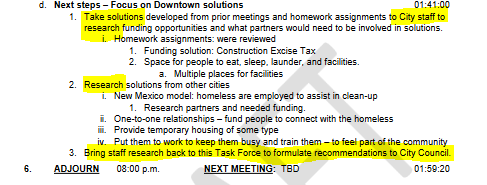
At the Task Force's last meeting, it was agreed that staff were to "take solutions developed from prior meetings and homework assignments", do some research, and then bring that research back to the Task Force, who would then "formulate recommendations to City Council."  (See draft minutes of the April 4 meeting here.)

Since that meeting in April, the Task Force has not met, and so could not have selected the seven "proposed solutions" listed on the June 13 meeting agenda. 

Why does it matter who chose the seven, if they are only listed for purposes of facilitating public comment, and not the Task Force's final say on the matter?  It matters precisely because the list gives  the false impression that the Task Force believes there's a need to "assess codes and ordinances", thereby influencing public discussion and providing political cover for revisiting controversial  Ordinance Bill 22-17 when the "assessment" is completed.    

In sum, CANDO should oppose this "proposed solution" because it doesn't come from the Task Force, it isn't specific or straightforward in its purpose, and it's premature.  If and when the preferred strategy of relationship- and trust-building has been given a chance to make a difference, there appears to be a good faith need for a code enforcement mechanism, that will be the time for the City Council to "assess codes and ordinances."

For all the reasons discussed above, CANDO should oppose recommending that the City Council "assess codes and ordinances" as a "solution" to the problems of homelessness downtown (item 4.f. on the Downtown Homeless Solutions Task Force June 13 Meeting Agenda).

[6/22/18 Update: as shown by the minutes of CANDO's 6/19 meeting, this agenda item was postponed to the July meeting due to the absence of a quorum by the time the item was reached.  At the sixth meeting of the DHSTF, which as of this writing has not been scheduled, the DHSTF is supposed to develop its specific recommendations.  Based on the opposition to enforcement action expressed at the public hearing on June 13, it appears the task force might be unable to agree on a specific enforcement recommendation, in which case there would be no need for CANDO to take a position on the matter.] 

Wednesday, March 1, 2017

Winkle Letter re ROCC

Revised: January 2019
 

By Sarah Owens and Michael Livingston


At left is the first page of a letter from Robin Winkle, an officer in the ROCC (Secretary).  She also happens to work for one of two providers serving Marion and Polk Counties that, for years, has received funding through ROCC.  She also happens to be a good friend of ROCC's paid Program Coordinator, Jo Ann Zimmer.

The letter was sent to CANDO the day we were considering this resolution.

The letter makes no representations about funding levels or costs, as it assumes those matters will be addressed in the planning phase, at which point it will be determined "how much funding will actually come to our community should this separation move forward."

Same with respect to costs associated with ServicePoint (Oregon's HMIS) and Winkle's bulleted questions (see below).

For the record, several weeks before Winkle wrote the letter, we met with her to ask her views on a possible separation, and we assured her that her concerns would be dealt with to everyone's satisfaction during the planning process, a fact she omits from her letter.

On page two (at right), Winkle refers to us condescendingly as "a few community members that have never participated in a HUD Continuum of Care", a reference that unsurprisingly ignores HUD's definition of a CoC, which consists of all those in the community who serve or care about the homeless, and the fact that we've been members of the ROCC and attending meetings since June 2016.

Sadly, although we've come to expect this haughty lack of respect from the ROCC leadership, we know it's not personal; it's merely a symptom of ROCC's many internal problems.

Winkle's letter asks, "Are there changes that need to occur in the current CoC system that can be made without separating from the Oregon Balance of State CoC [aka the ROCC]?" and then answers it with "I believe that our community can come together to provide a continuum of care without separating."  In other words, we are admonished to "work from within", without any admission that there is a problem and without any offer of assistance.  Precisely what one might expect from a 17-year veteran of a closed system/organization.

Having given all due consideration to the concerns raised in this letter, the CANDO board at its February meeting voted unanimously in favor of proceeding "to the planning phase to determine how best to proceed with recreating a Marion & Polk Counties CoC." 

Brief responses to Winkle's bulleted questions 


Why does HUD recommend that smaller CoCs merge with larger CoCs?  Well, first, what's a "small CoC", and when has HUD recommended that, to whom, based on what information?  It's certainly not general advice.  We asked Ms. Winkle these questions, and she declined to answer.  So, that would be a question for HUD.  Certainly HUD might advise CoCs with insufficient capacity/resources (like OR-504 back in 2011) to merge, but that doesn't mean HUD would advise against Marion and Polk Counties recreating an effective and sufficiently resourced local CoC today.

Why did Marion and Polk Counties merge with the Oregon Balance of State [ROCC] in 2012?  Because MWVCAA lacked the organizational capacity to continue as the lead agency, and they just more or less threw up their hands.  It wasn't a considered or even thoughtful solution.  It was just the first door out.

How much funding would truly come back to the Marion and Polk Communities?  Not sure what "truly" means here, but, as Ms. Winkle well knows, that question is for HUD, and someone with a relationship with HUD will need to ask it in order to get a straight answer.  That said, MWVCAA and Shangri-La received $610K in this last cycle.  In 2010, Marion and Polk received over $900K.  Although there will be a gap in funding due to the transition, it seems unlikely we'll do worse in the long run.

What will the implementation of an HMIS cost the grantees, in addition to what each grantee pays for? The current grantees (MWVCAA and Shangri-La), and many potential grantees in Marion and Polk Counties have already implemented an HMIS (in Oregon, it's ServicePoint).  Licenses are less than $400.  Training/technical assistance funding is a gap issue, but not an issue overall.  It just needs to be planned for, and it will be.

What Marion-Polk agency has the funding, capacity and staff knowledge to be the lead agency and collaborative applicant?  Several, actually.  This is a silly question.  Consider the fact that ROCC relies on a part-time consultant nominally supervised by the admittedly totally uninvolved Community Action Partners of Oregon.  We're hardly likely to do worse, and we certainly intend to do better.

Are there changes that need to occur in the current CoC system that can be made without separating from the Oregon Balance of State CoC [ROCC)]? No.  Not based on what we've seen.  If it coulda happened in ROCC, it woulda happened by now.  It's not gonna happen, and Ms. Winkle can't even bring herself to assert that it could, she can only ask questions. 

What is the true benefit of Marion and Polk Counties separating out from the Oregon Balance of State CoC [ROCC]?  Having a functional, effective, local CoC would include these benefits (note that none focuses on "the money"):

  1. Homelessness, and chronic homelessness in particular, is a humanitarian concern that has significant economic impacts on every community's resources.  Therefore, any reorganization that promises to improve the effectiveness of homeless assistance dollars should be supported.   
  2. Since 2011, Marion and Polk Counties have been working with 26 other counties in Oregon to improve homeless services through a federal program called the Continuum of Care, but progress is very slow.  
  3. If Salem/Marion, Polk Counties were to reorganize as our own CoC, we could concentrate on local programs and services that directly address the unique needs of area residents.
  4. Accurate local data allows providers to respond appropriately to the needs of area residents, but right now, Salem/Marion, Polk Counties' data gets rolled in with the other counties and is difficult to separate. 
  5. Currently, only two providers in Salem/Marion, Polk Counties receive federal CoC Program grants.  Reorganizing under local control would make it easier for Salem/Marion, Polk Counties providers to learn about the program and apply for grants to support and house local residents.
  6. Reorganizing under local control would make it easier to expand the number of providers collecting and sharing data and to improve the quality of the data and use it to allocate resources where they will be most effective.
  7. Developing a coordinated entry system that will allow providers to prioritize resources for the most vulnerable is much more feasible across 2 counties than across 28.  
  8. A locally controlled collaborative can be held to account for progress or lack of progress in preventing and ending area homelessness in ways that a 28-county collaborative cannot.
  9. The local community, including the homeless community and homeless advocates, would be able to participate in and expand the capacity of a locally controlled collaborative in ways that are just not feasible across 28 counties.
  10. A Salem/Marion, Polk Counties collaborative would be more agile and more likely to adopt innovative strategies.]   

Wednesday, February 1, 2017

re ROCC


February 21, 2017

To the Boards of Commission of Marion and Polk Counties, and the Mayors of Salem and Keizer:

It has come to our attention that the Mid-Willamette Homeless Initiative Task Force recently approved a recommendation that Marion and Polk Counties “[a]ssess local inclusion in the Rural Oregon Continuum of Care” (ROCC) to determine whether it was in the community's best interest to remain within this 28-county organization, or to re-form the Marion-Polk CoC.

Having given the matter due consideration, our board has concluded that the goal of preventing and ending homelessness in Marion and Polk Counties could be advanced significantly if the community could concentrate its planning and coordinating efforts on Marion and Polk Counties, rather than continuing to try to plan and coordinate with the other 26 other counties in the ROCC.  We therefore favor a decision to proceed to the planning phase to determine how best to proceed with recreating a Marion & Polk Counties CoC .

Sincerely,


Bruce Hoffman
CANDO Chair

[Approved unanimously 2/21/17]

Saturday, September 3, 2016

re Systemic Response to Homelessness


To:           The CanDo Board
From:       Sarah Owens
Date:        October 18, 2016
Re:           Recommending Certain Actions to the Mid-Willamette
                Homeless Initiative Task Force (revised after 9/20/16 mtg)

Motion:    To adopt the following recommendation:

Recommendation
to the
Mid-Willamette Homeless Initiative Task Force

Consistent with the Board’s responsibilities under SRC 64.290 (g) and (l) to represent central area concerns before public bodies and develop recommendations to submit to appropriate government agencies, and its annual goal to “Support initiatives offering practical solutions to problems of
indigency downtown”, the Board respectfully recommends to the Mid-Willamette Homeless Initiative Task Force that they collectively and individually advocate before the public and before appropriate government and non-governmental agencies, including housing and homeless assistance providers in Marion and Polk Counties, through written and oral communications both formal and informal, the overarching goals of the U. S. Housing and Urban Development Department's Continuum of Care Program, specifically: 

1. Favoring a systemic response to homelessness.  So that homeless assistance is as well coordinated, well managed, inclusive, and transparent as practicable, the Task Force should:
a. Encourage all housing providers to collect and share data.  Servicepoint is the software application that most Continuum of Care Program grantees in ROCC Region 7 use as their Homeless Management Information System (HMIS).  Barriers to use by non-grantees include license fees, training, staff time, and motivation.  The Task Force is uniquely situated to raise awareness of the need for good data and full participation in Servicepoint, and encourage providers who don’t use it to begin doing so (except for projects that are defined as “victim service providers” under the VAWA Act).
b. Encourage all housing providers to measure system performance.  The Task Force should advocate for the use of HUD's system performance measures to assess and improve the overall impact of homeless assistance efforts (e.g., measures that track the average length of homeless episodes, rates of return to homelessness).
c. Encourage providers to create and use an effective Coordinated Entry process.  A  coordinated entry process is used to assess and prioritize needs.  The Task Force should advocate for a well-designed process that achieves these goals:
i. make it easier for persons experiencing homelessness or a housing crisis to access the appropriate housing and service interventions;
ii. prioritize persons with the longest histories of homelessness and the most extensive needs;
iii. lower barriers to entering programs or receiving assistance; and,
iv. ensure that persons receive assistance and are housed as quickly as possible.
2. Favoring the strategic allocation of resources. The Task Force should encourage everyone in the community, including government and non-governmental entities, to allocate resources to homeless assistance programs using cost, performance, and outcome data, and monitor the performance of all programs, including how much each spends to serve and house an individual or family as compared to other programs serving similar populations.  To that end, the Task Force should encourage the community to assist housing providers not using Servicepoint to begin doing so, and give preference to programs that use it.

~~~~~~~~~

Discussion:  (Sarah and Michael)

For some time now, there has been a strong, but largely unrecognized, need for better quality data on local homeless services delivery systemAmong the reasons the need goes unrecognized in this community is the pervasive belief that poverty and homelessness are insurmountable problems that, for the most part, should be left to "charities" whose institutional values generally don't include evidence-based decision-making.  Perhaps for this and other reasons, the Task Force has not had the data issue on its agenda (members have mentioned Servicepoint in passing in discussions on electronic and paper resource guides/referral services, but have not so far focused on data quality/collection.)  The purpose of this recommendation is to prompt a meaningful discussion on the need for better quality data, and move the issue forward.

The concepts and some of the language were borrowed from guidance published by the U. S. Housing and Urban Development Department for communities all across the country grappling with the problems of homelessness.  Revisions were made following public comment at the September CANDO meeting, including removing the section (d) on community monitoring.  The use of the verbs "advocate" and "encourage" (rather than, say "require" and "ensure") is intended to recognize the Task Force's limited legal authority.