Showing posts with label Mid Wmtte Hless Initiative Stg Ctee. Show all posts

Saturday, March 30, 2019

Steering Ctee Says Re-form the Local CoC

By Sarah Owens and Michael Livingston


Members Tom Pessemier, Scott McClure (not shown) Kathy Clark, Chuck Bennett, Steve Powers, Colm Willis 
The Mid Willamette Homeless Initiative Steering Committee -- Tom Pessemier (Independence), Scott McClure (Monmouth), Kathy Clark (Keizer), Steve Powers (Salem) and Colm Willis (Marion County) voted to recommend re-forming the Marion and Polk County Continuum of Care (CoC), possibly including Yamhill County, in 2020.  Re-forming the local CoC would mean leaving the 28-county the Rural Oregon Continuum of Care (ROCC).  See "ROCC: Leave or Remain?"

Draft Resolution of Support
The committee also approved the form of a resolution of support for use as a template (at right), and authorized the Mid Willamette Valley Council of Governments (MWVCOG) to enter into a personal services contract with Jan Calvin, who will work closely with retired Marion County Commissioner Janet Carlson, currently under contract with MWVCOG, to carry out next steps, which include April 22 and 23 presentations at work sessions of the Salem City Council and Yamhill County Board of Commissioners, respectively.

Because Polk and Marion Counties are expected to adopt resolutions of support fairly soon, with Salem following shortly thereafter (see "News from the Continuum", 29 July 2017), much of the discussion focused on Yamhill County, which also is a member of ROCC and MWVCOG.  Would they want to take part?  Mayor Clark said yes, definitely.  Others were not so sure.

Powers emphasized the need to ensure that the burdens and benefits of a broader partnership would be shared "equitably."  Pessemier was concerned not to do anything that might make Marion and Polk less competitive as a CoC.  Willis, noting that Marion and Polk had obvious shared interests, was concerned that Yamhill might have diverse interests that could cause it to pull in a different direction.  Despite these concerns, the consensus seemed to favor including Yamhill County in the CoC, assuming Yamhill County wants to be included.  For any number of reasons, it might not.  

HUD is well aware of recent developments.  In recent days there have been two consultations with HUD officials, one in-person and one conference call.  Per HUD advice, the committee plan to open informal negotiations with ROCC next month on a transition plan.  Outreach to government entities should be wrapped up by the end of May, and to the provider community by the end of October.   

The committee has much to accomplish before the CoC can be registered in March 2020.  Some of the details are mentioned in Carlson's March 28 report to the committee, which can be found on MWVCOG's documents page once it is posted.  See also the City staff report for the April 8, 2019 City Council meeting.   

Friday, January 25, 2019

Homeless Program Coordinator Position Empty, Iffy

by Sarah Owens and Michael Livingston


Homeless Initiative Program Intern, Valerie Lang
The Mid Willamette Valley Council of Governments (MWVCOG) was unsuccessful in recruiting someone to fill the position of Homeless Initiative Program Coordinator, so an intern will be filling in for a term.

MWVCOG Executive Director Sean O'Day said in an email, "the limited duration, tentative funding, and timing of our recruitment (not synched with the end of the academic year) make it very difficult to fill the position in the current employment market."  

The Winter 2019 (and third) issue of Mid Willamette Homeless Initiative News introduces Valerie Lang, an OSU undergraduate student in public health and says she will be completing several Mid-Willamette Homeless Initiative (MWHI) strategic plan projects focused on financial literacy, youth homelessness and service coordination.  It also says Lang will be attending community meetings "to observe how partnerships serve homeless individuals and families." 

According to the MWHI News, Lang has a background in senior services and "sees the homeless initiative internship as a good way to learn about how governments and nonprofits work together to serve people in need."  Lang's Facebook page indicates she lives in Salem and attended Chemeketa Community College.

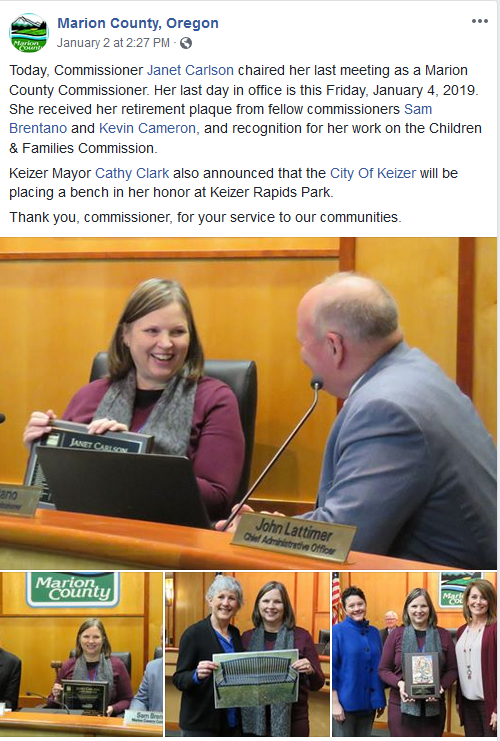
Former Marion County Commissioner, Janet Carlson
On Friday, O'Day announced that recently retired Marion County Commissioner Janet Carlson had contracted with MWVCOG to conclude the continuum of care analysis and a few other projects (e.g., evaluating anti-panhandling programs and a resource map report) that were part of the Homeless Initiative Program Coordinator's year-one work plan.

Carlson also contracted to "evaluate whether there is a longer term need for the position and if so make recommendations to the participating jurisdictions and the COG Board on how to best fund the position for its long term viability."  The term of Carlson's contract is reportedly four months.

In an interview in late December, Carlson was asked if she had any regrets about her tenure as County Commissioner, and she identified the lack of progress on the MWHI strategic plan.  Carlson has plans to move to Idaho "at the end of winter."

The announcement of an unsuccessful recruitment comes on the heels of the Salem City Council's recent decision to repeal SRC Chapter 20G and thereby eliminate the Community Services and Housing Commission (CSHC), which was based, in part, on the representation by Urban Development Department Director, Kristin Retherford, that the Homeless Initiative Program Coordinator "is charged with many of the same duties that are outlined in SRC [20G] as duties of the CSHC."

Retherford is a member of the steering committee that oversees the work of the Homeless Initiative Program Coordinator.

Friday, November 2, 2018

Homeless Program Coordinator Calls it Quits

By Sarah Owens and Michael Livingston


MWHI Program Coordinator Ali Treichel, 10/30/18
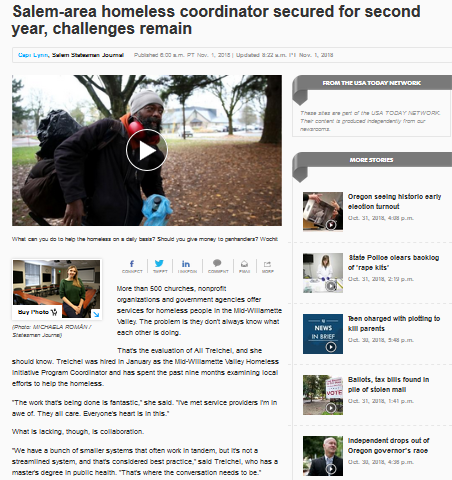
The Mid Willamette Hopeless Initiative Steering Committee (MWHISC) bid farewell to its Program Coordinator this week.  Ali Treichel, who's become a familiar face in the community of local social services providers over the past ten months, is leaving her position at the MWVCOG to take a job closer to her home in southeast Portland.  In her new position, she will be  providing contracted services to Multnomah County as a community health education coordinator.  The steering committee, which had only praise for her work at their meeting on October 30th, is currently recruiting a replacement.  Applications are due by November 30, see here for details. Also see the 11/1/18 Statesman Journal article by Capi Lynn, "Salem-area homeless coordinator secured for second year, challenges remain."

Treichel's departure leaves incomplete several projects in the one-year work plan adopted this past summer (see here and here).  She was, however, able to complete the "Service and Resource Inventory Map", and present her initial findings to the committee this past week (also see here).

Same unidentified man, different story
 The Statesman Journal quotes Treichel as saying "We have a bunch of smaller systems that often work in tandem, but it's not a streamlined system, and that's considered best practice."  Her  assessment, according to the article, "confirmed what the...steering committee...and those who work with the homeless already knew."

But the article gets a couple of things wrong.  Lynn  reported that there "is no centralized list for prioritizing housing and shelter placements", and that data gathered in the 2018 Point-in-Time Count could have been used to start such a list.  

In fact, there is a centralized list.  It's maintained by The ARCHES Project, and the data in it was gathered by trained staff using an assessment tool called the "VI-SPDAT", which stands for vulnerability index service prioritization decision assistance tool.  The problem is, not enough providers use the list to prioritize placements, and that allows for cherry picking.  

Treichel's written report, dated August 10, 2018, but made public and presented on October 30, 2018, states that, as part of the mapping assignment, she was to identify "gaps and inefficiencies within the regional service continuum [of Marion and Polk Counties] as compared to best practice solutions and frameworks."  The report makes findings in four subject areas:  (1) the coordinated homelessness response system, (2) sheltering services outside the Salem-Keizer area, (3) shelter, and (4) housing.

With respect to (1), Treichel found that the "coordinated homelessness response system...is both fragmented and largely uncoordinated" and lacking "key elements needed for an efficient response to homelessness", beginning with a functioning coordinated entry system.  (See our December 16, 2017 post, "Coordinated Entry After One Year", here.)  To address the problem that not enough providers use the list to prioritize placements, Treichel recommended that "participating jurisdictions require providers that receive funding to collect and input quality, timely and comprehensive shareable, data and fully participate in" the local coordinated entry system, with exceptions for programs serving youth and those fleeing domestic violence, etc.

The findings in (2) through (4) can be summed up with "additional sheltering options are needed to serve families of all types and individuals of all need levels" throughout the area.  Treichel recommended that "[a]ny new shelters should be low barrier" and that "the next coordinator further explore the creation of a multi-jurisdictional [housing] development team (originally included as part of the initial year-one work plan."        


Hillcrest Youth Correctional Facility
Notably absent from the report to the committee was any mention of the City of Salem's recent interest in the Hillcrest Youth Correctional Facility as a possible low barrier shelter option (see here and last paragraph here).  Hillcrest closed in September 2017, after the state determined an upgrade to meet modern standards was cost prohibitive.    

Treichel didn't know about the City's interest in Hillcrest, because the City didn't bother to include her in the October 3 "feasibility meeting" where it was discussed, and evidently, steering committee member Kristin Retherford, who did attend the meeting, didn't bother to tell her.

One has to wonder why the City is spending $45K/year on regional homeless program coordination.      

Councilor/Commissioner Lewis
The City also neglected to inform Councilor Lewis (Ward 8, West Salem), or anyone else from Polk County (which presently has no emergency shelter facility, low-barrier or otherwise) of the "feasibility meeting", or the interest in Hillcrest.  So, it was a little awkward when, at the last meeting of the Salem Housing Authority Board of Commissioners (October 22, 2018), Lewis asked SHA Administrator Andy Wilch about Hillcrest:   

There's been some talk about the Hillcrest property...my interest is that there is a dormitory type building sitting there empty, and we have a homeless crisis.  So, putting those two things together, it makes sense to me -- is it usable, can we do it from a capacity standpoint, and let's assume for a minute that the State of Oregon just lets us use the building, if it's within our ability to use it for homelessness.  Comments?

To which Wilch replied,

Hillcrest's many pieces
About three years ago, we went up and looked at the same units that you're talking about, and at that time, we didn't really see the need...the market has changed a lot, for a lot of our clients.  And so we are having some additional conversations, working with the City and SHA.  I know there was a group that went up there [with] DAS...this afternoon to look at it.  One issue that I think is going to be hard to [overcome] is DAS will probably want to have a single sale.  So, unless they're willing to break up some of the pieces, it could be pretty hard to make that work.  But, if you want to, we could work on that, along with the City.


To which Commissioner Lewis replied:

I don't know if I'm interested in purchasing the property and using that part for homelessness.  I'm more interested in using it while it's still vacant or supposedly up for sale.

Whereupon the City Manager in his capacity as Executive Director of the Housing Authority reassured everyone that a report would be forthcoming.

In some ways, the City's Hillcrest project sounds a lot like what's going on in Eugene (just get 'em outta downtown) and Portland (say you'll do anything). 

Lime green = proposed site                                                                                 Red = existing site
 
Lane County is trying to move a camp set up as a protest from downtown out to an industrial area near Hwy 99 and Roosevelt Blvd.  As always, health and safety concerns are cited as reasons, but the proposed camp is actually closer to services.  Hillcrest, on the other hand, would not be close to services, many of which are downtown.

In Portland, gubernatorial candidate Knute Buehler's promised to open Wapato for the homeless if he's elected.  But, as Darrin Brightman points out, the owner's already asked for and failed to receive any viable operating proposal, which suggests a homeless shelter is not a realistic option.  Hillcrest is certainly no more so, not that the City's bothered to ask any providers if they'd be interested, probably because it knows there aren't any.

So, is the City just going through the motions?  Is that why it didn't include Treichel or Lewis or Polk County in their conversations?  Maybe.  But if they're not just going through the motions, what are they doing? 

The MWHI Steering Committee hopes to have a new Program Coordinator starting in January 2019.

[11/10/18 Update: added links to Treichel's inventory map, initial findings and summary.]    

Saturday, August 4, 2018

MWHI Steering Committee Continues Oversight

Revised: January 2019


By Sarah Owens and Michael Livingston


July Mtg of the MWHI Steering Committee at MWVCOG
The Mid Willamette Hopeless Initiative Steering Committee, who appear persuaded they are accomplishing something, perhaps due to all the meetings, mappings and reportage by the Hopeless Initiatives Program Coordinator, Ali Treichel, and the willingness to claim credit for all the outside projects listed in their strategic plan, continue to meet.

At the August meeting, held as usual at MWVCOG offices, the steering committee received a draft of a community survey intended to collect information about all the resources available to people experiencing homelessness or who are at risk of homelessness, a document comparing the Marion and Polk Counties Plan to End Homelessness and the Hopeless Initiative's strategic plan with the elements of a community plan as defined by the HEARTH Act (2009), a list of proposed metrics by which to judge the strategic plan's success or failure, and an updated listing of public funds dedicated to housing and homeless services in Marion and Polk Counties.    

The discussion was unedifying and lasted two and a half hours.  One hour was spent receiving a presentation on the 100-Day Youth Challenge, and the remainder  listening to Ali present her reports.  No action was taken.

The very last bit of business was a request to pitch a proposal for a micro-housing project at the steering committee's next meeting.  The proposal came from some folks working with Home Base Shelters of Salem.  Whereas HBSS's original proposal was to reproduce Eugene's Rest Stop program in Salem (which the City was not interested in), the new proposal for "Habitat & Hope Village" looks more like Eugene's Square One Villages.  The units would be 8x8 duplex construction of lumber/plywood (basically two wooden tents side by side), to be constructed as funds are made available, up to a maximum of 20.  The proposal did not identify a site, funding or managers.

The steering committee heard the proposal at its September meeting, but did not seem interested in supporting it. 

In October, Ali Treichel put in her notice to quit, effective at the end of the month, details here.  Treichel said she was leaving to take another position closer to home (PDX), but sources say the commute was not the primary reason for leaving, nor were the reasons "personal." 

MWVCOG Director Sean O'Day told the steering committee in October that he hoped to recruit and hire a new coordinator by January 2019.  The steering committee did not meet in November or December.

Saturday, July 14, 2018

Homeless Program Coordinator's Year 1 Work Plan

Revised: December 2018

By Sarah Owens and Michael Livingston


Homeless Initiative Program Coordinator Ali Treichel with Chart
In July 2018, Marion County issued a report on the implementation of the strategic plan adopted by the Mid-Willamette Hopeless Initiative Task Force back in February 2017, about sixteen months ago.  It looks an awful lot like the report issued last fall.

The report introduced MWHI Program Coordinator Ali Treichel, who began work at the end of January, and would quit in early November.

The report featured the ARCHES Project renovations, the 100-day Challenge to End Youth Homelessness, and Family Promise's new permanent supportive housing program, which (along with Mountain West's Cornerstone Apartments project, Marion County's LEAD program, and Westcare's transitional housing program for veterans) it characterizes as "significant progress on the strategic plan", even though all those projects were developed independently of the Task Force, and have progressed without the assistance of either Treichel, or her steering committee.

The steering committee approved a plan of work that consisted largely of talking to people and mapping/analyzing systems -- something one might have thought the Task Force would have accomplished in 2016.  Reports were due in October, according to the work plan, but not all were completed before Treichel's departure.  Marion County and the City of Salem both set aside funds to cover the coordinator position a second year, at a total cost of ~$100K. 

Full Plan Here
    
In July, Treichel said she was analyzing "issues, ideas, and potential solutions against best practice."  "Best practice" in the context of homelessness is distinguishable from "promising" and "emerging" practice and has been described as,

[A]n intervention, method or technique that has consistently been proven effective through the most rigorous scientific research (especially conducted by independent researchers) and which has been replicated across several cases or examples. To be a ‘best practice’, an intervention must be able to show that it produces better results than other approaches and that it is a practice that can potentially be adapted with success in other contexts and/or scaled up to a systems-wide approach. In other words, there is a sufficient body of evidence that allows us to confidently say that the described practice is a generalizable example of something that works. It should be noted that some interventions might demonstrate scientific rigor, but never be generalizable in other contexts.     

If the steering committee holds true to this standard, it will, presumably, have to forego prioritizing  things like financial literacy, curbing panhandling, and sobering, which are, at best, unproven (that is, neither best, nor promising, nor emerging) methods for addressing homelessness.

Fall 2017 Update

Summer 2018 Update
At left and right are bits of the last two reports  (same photos, different reports).


Marion County appears to have  stopped updating the MWHITF web page, so if you want to follow develop-ments, you'll need to look on the MWVCOG website for  meeting agendas, minutes,  work plan, and the revised strategic plan.


The steering committee is led by Keizer Mayor Cathy Clark, who, in April of this year, "noted progress being made", according to the minutes of the meeting.  Clark has said she believes increased awareness of homelessness in the community has led to "increased complaints, unfortunately."

The other elected official on the steering committee is Marion County Commissioner Janet Clark, also a conservative.  COG's Executive Director, Sean O'Day, is on the committee, along with two city managers (David Clyne of Independence and Scott McClure of Monmouth) and one urban development director (Kristin Retherford of Salem).

The one to watch is Kristin Retherford.  She's become the City's de facto point person on the City's response to its homelessness issues.  In addition to being the City's rep on the steering committee, a whole lot of federal money (Urban Renewal, HOME, CDBG) runs through her department.  In addition to those federal programs, she oversaw the Community Services and Housing Commission, until SRC Chapter 20G was repealed in January 2019, and she facilitated the Downtown Homeless Solutions Task Force.  Separate and apart from the Housing Authority, what Retherford thinks, believes and knows about homelessness and homeless services delivery influences the City far more than any set of maps, plans or reports likely to come out of the steering committee.

Monday, October 23, 2017

IGA Establishing Homeless Program Coordinator

Revised: January 2019
 

By Sarah Owens and Michael Livingston


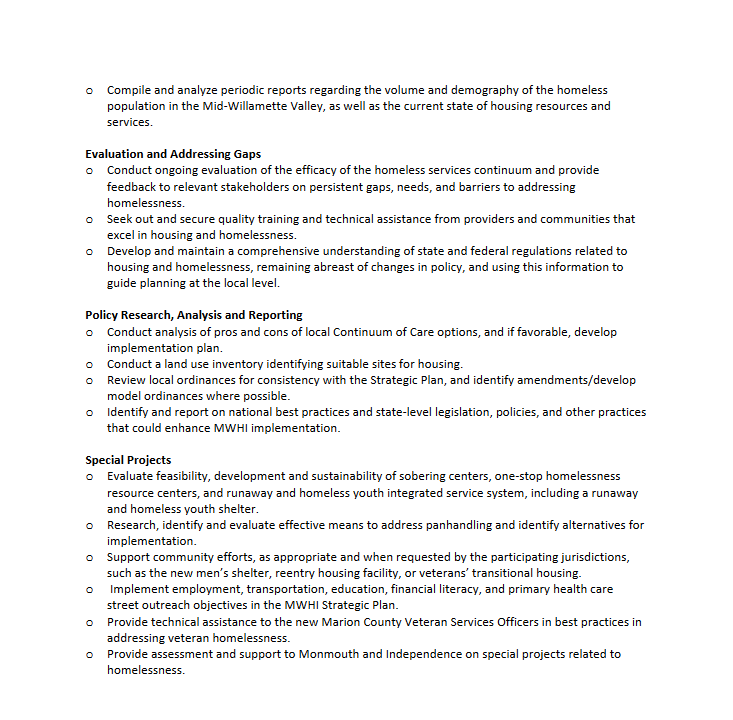
On October 17th, the Mid-Willamette Council of Governments authorized Executive Director Sean O'Day to sign an intergovernmental agreement with Salem, Keizer, Monmouth, Independence and Marion County to establish a Homeless Program Coordinator position within COG. Salary and benefits are to be paid by the cities and County.  Salem and Marion County will put up $45K each, with the remainder cities each putting up $5K.  The Scope of Work includes "Conduct analysis of pros and cons of local Continuum of Care options, and if favorable, develop implementation plan."  See the 10/17/17 meeting packet here:  http://www.mwvcog.org/documents/ at pages 47-48 for the Scope of Work.  The packet also includes the staff report, the IGA and a position description.   (Staff Report, IGA, Scope of Work pasted below.)

In January 2019, the IGA was amended to extend it to June 30, 2020, see here.