Showing posts with label Sobering Station. Show all posts

Friday, February 14, 2020

Council Sets Ambitious 2020 Policy Agenda

Revised 19 February 2020

By Sarah Owens and Michael Livingston


Originally published 2/14/20 under the title "Homeless Crisis Meets 2020 Policy Agenda."  Revisions reflect actual events of the work session.

The work session on the 2020 Policy Agenda was originally scheduled for January 21, 2020, but things kinda got out of hand with the emergency declaration that had been tacked onto the agenda the week before, and the 2020 Policy Agenda was postponed.

Deliberations on annual Council Policy Agendas are not supposed to open with emergency declarations.  Policy agendas are about planning, and emergency declarations and appropriations are, well, the opposite.  So it was probably a good thing that it was postponed, even though the emergency continues through March 31.  

The policy agenda replaces the "wish list" in the budget process.  It's supposed to encourage discipline and restraint.  The wish-listy items covered in this year's staff report came from a  November 18, 2019 work session.  The idea behind the policy agenda was to let staff know what to focus on in the coming year, and give staff a chance to tell councilors what's wrong with their proposals before they're put in the budget.  Sometimes, the strategy works.    

In attendance were Mayor Bennett and Councilors Ausec, Hoy, Nordyke, Nanke and Kaser.  Lewis, Andersen and Leung were absent.

Council added a "single property urban renewal area" (the 10 acres set aside for multifamily) for affordable housing, removed organized camping (new $) as "we've already voted against it."  They went against staff recommendation and retained both the sobering center and the mobile crisis response unit (new $).  They retained the low-barrier shelter/nav center (new $) and deferred expanding the work of the Downtown Clean Team (new $).


The mobile crisis response unit or "Community Response Unit" (CRU) as United Way of the Mid-Willamette Valley is calling its pilot project (see various project updates in the Downtown Good Neighbor Partnership meeting notes here).  CRU is  currently expected to begin July 1 and end October 30 and cost about $500K/yr to operate.  United Way is actively fund-raising for the van.  CRU will not be sustainable without funding from the City, which logically would come from the police or fire departments, something neither Chief Moore nor Chief Niblock appear to support. 

Bennett wanted to know how CRU would fit with the Marion County LEAD program.  Chief Moore advised the Council that the LEAD program was simply "a couple of individuals who go out on the streets and try to contact probably almost everyone there and trying to perhaps convince them to better their lives and try and get into some sort of treatment or something to defeat the demons that might keep them on the streets."

Staff essentially recommended that the City trade its 2017 sobering center wish for the shelter/nav center, but Bennett, Nordyke and Kaser wanted to keep the sobering center despite being told the project was effectively "dead" due to the $.5M/yr operations funding gap.  Bennett said he was concerned not to "lose the impetus of having the space" for it at 615 Commercial Street (aka The ARCHES Project building).  For the story of the apocryphal sobering center, see "Let's Make a Sobering Deal" (1 December 2017);  "Sobering Thoughts" (15 June 2018);  "Sobering Center Sustainable?" (10 November 2018);  "Sobering Ctr Operating Gap Widens" (13 January 2019);  "City to Build Despite Ops Funding Gap" (25 January 2019);  "City Admits Sobering Ctr Might Be 'Unattainable'" (12 March 2019).

Portland Central Concern recently closed its Portland sobering facility and ended its van transport service, citing "concerns for the safety of patients and staff, who they said were no longer able to give the level of medical care required by most people who arrived at the center."  See Bailey, E. "Central City Concern closes Portland sobering station."  (6 January 2010, The Columbian.) 

The agency said they received more and more patients in the midst of a mental crisis, agitated from opioid or meth use or a combination of both, leading to increased safety risks.

“More and more, we’re seeing people ending up in the sobering center when they should be in places where they can be given medication and a higher level of monitoring until their crisis subsides,” Dr. Amanda Risser, Central City Concern’s senior medical director of substance use disorder services told The Oregonian/OregonLive in an interview last week. “We don’t have medicine, we don’t have padded safety rooms and we don’t have the resources at the sobering center to do the hands-on intervention that happens in psychiatric centers. It just isn’t an acceptable risk anymore.”

She said the agency recently implemented new screening criteria for accepting patients that weeded out people at high risk to threaten or harm themselves or others.

Risser said the station accepted eight to 10 people a day before the new screening was implemented and but just two to three afterward.
Update:  Bernstein, M. "Whistleblower reveals serious injuries, lax oversight at Central City Concern’s Sobering Station."  (27 June 2020, Oregonian/Oregon Live.)

possible site of low barrier shelter at 1185 22d St SE
Regarding the low-barrier shelter, the staff report speculated that the City "could partner with a non-profit service provider for operations and possibly contribute to operational costs through general fund grants or TOT grants" (emphasis added).  Staff estimate a 100 bed low-barrier shelter would cost $1.36M/yr to staff and maintain.  That's over and above the cost to lease/purchase.  As with the sobering center before it, staff are encouraging councilors to hope that "there may be state funding available to support operations."  In addition to the low-barrier overnight shelter, the City's hoping to fund a (separate) 24/7 navigation center, probably in what's known as the ARCHES building at 615 Commercial Street NE.  The nav center would probably include 30-40 low-barrier beds for clients enrolled in ARCHES housing programs.

Tuesday, March 12, 2019

City Admits Sobering Ctr Might Be "Unattainable"

By Sarah Owens and Michael Livingston


Revised 20 April 2019

ARCHES Project's Ashley Hamilton at URA Mtg 3/11/19
Last night, the "we don't do social services" City Council, sitting as the Urban Renewal Agency (URA), approved increasing a $300K grant to build out the sobering center to $1.1M ("up to").

The center is to be located at 615 Commercial Street NE, which is owned by the Mid Willamette Valley Community Action Agency (MWVCAA).      

The URA grant replaces a $330K sobering center construction grant from the Oregon Health Authority, and adds another $470K to cover redesign and construction inflation costs incurred as a result of delay following an unanticipated determination last fall that the land beneath the building had archeological significance. 

By returning the OHA grant, the City frees itself from the obligation to operate the sobering center if, as it appears so far to be, "operating a sobering center is financially unattainable." See "Sobering Ctr Operating Gap Widens."  Should the City go through with purchasing the property (as is expected), $380K of the $1.1M will be in the nature of a down payment.  See "Urban Renewal to the Rescue." 

Salem Breakfast on Bikes
The City's refinancing arrangement is, therefore, less about building out the sobering center than it is about making sure MWVCAA's building renovations are completed.  This makes sense.  The  renovations --  sprinklers, showers, laundry facilities and commercial kitchen -- are how the City plans to implement the recommendations of the Downtown Homeless Solutions Task Force (see "DHSTF Recs Update"), and they're a logical prerequisite to the City's acquiring the property, which is needed to free up homeless assistance funds, which is needed to extend hours of operations to evenings and weekends.  See "We Need Many More Resources" and "MWVCAA Pays Mortgage Debt with Hless Assist $$."

Should CANDO be concerned that the sobering center might be "financially unattainable"?  Maybe.  Certainly law enforcement will be concerned.  But, as for the rest of Salem, the case for the sobering center has never been made.  Operations were never RFPed, and there is no operating plan, identifiable ROI or success metrics.  There is also no evidence that sobering services generally lead to treatment.

No homeless services provider we've talked to believes what the City proposes to spend on sobering services is the best use of its limited resources.  Everyone asks, how is this supposed to help the homeless?  Intoxicated individuals are taken downtown for sobering, they wake up after a couple of hours and want to leave -- not discuss treatment options.  So they walk out.  How does this help downtown, exactly?  The City has no answer, only wishful thinking.  

What about sunk cost?  MWVCAA Executive Director Jimmy Jones guesses the sobering-only construction cost adds only around $100K to $150K to the total cost of Phase 2.  That might be a lot to some of us, but it's not much compared to the $1M annual operations price tag, of which the City's share is $200K/yr.  In other words, in the event the sobering center does not open, the sunk cost in the sobering center would be more than covered by the first year of non-operation.

City staff don't seem too concerned about the non-operation prospect.  The report says, "If operating a sobering center is financially unattainable for the City", then "the renovated space can be used for programs to assist the homeless."  Note that it doesn't say the renovated space can be used for other programs to assist the homeless.  Because -- let's be honest -- the sobering center was never going to "assist the homeless" -- it was only ever going to assist law enforcement's bottom line.  See "Sobering Center Sustainable?"

So, it makes perfect sense for the City to replace the OHA grant with urban renewal funds and eventually acquire MWVCAA's building.  It relieves the pressure to complete a poorly planned and "financially unattainable" sobering center project, while allowing MWVCAA to complete a costly building rehab.  "The [rehab] design gives us enormous flexibility", Jones told us.  "While we wait on a potential sobering partnership, the space can be used for expanded warming, nighttime bathroom services and many of the other key service recommendations of the Downtown Homeless Solutions Task Force”, he said, following Monday night's URA vote.

3/15/19 Update:  "Jones said construction is expected to complete Aug[ust] 1."  See Brynelson, T.  "Salem buys time to find funding for sobering center as construction starts."  (14 March 2019, Salem Reporter.)

3/18/19 Update:  a March 13 email from City Manager Steve Powers to the agency reps working on the sobering center project advises them about the refinancing arrangements, states, "There seems to be an unwillingness to cover the current estimated $738,000 operating expense in an equitable manner", and ends, “I hope in the future we have the opportunity and willingness to try again on a sobering center.”

It appears, then, that unless and until Marion County or Salem Health express a willingness to contribute more to the annual operating costs, or other funds somehow become available, the City does not intend to pursue the sobering center project further.

4/20/19 Update: the City Manager proposed eliminating the sobering center commitment from the 2020 budget.   (The 2019 budget committed only $200K -- see here at page 4.)

Page 2 of City Manager's Proposed Budget
The City "should" reconsider "If an equitable allocation of costs can be achieved."  Does that mean that the City is working the problem?  Probably not, even though the project's weirdly still in the Strategic Plan/2019 Council Policy Agenda.   

If the dream is well and truly as dead as it seems to be, it'd be foolish to include sobering equipment and facilities in the build out of 615 Commercial Street.  But, that doesn't mean it won't happen.  Jimmy Jones says that until such time as the City is able to obtain the necessary operating cost commitments, the space will be used "as a day center within the day center, for the very highest needs clients that struggle with general day center population."       

Friday, January 25, 2019

City to Build Despite Ops Funding Gap

by Sarah Owens and Michael Livingston


"We're gonna be saving them a lot more than $100K apiece."
The City intends to proceed with sobering center build out, include operating costs in next year's budget and worry about how they're going to close the operating cost gap, later.  

According to information shared at the Council Policy Agenda work session on January 23, 2019 (see video here and report below), construction would not now be completed until mid-summer 2019.  The center was supposed to open in early 2019.    

Last week, after the City released the news that the estimate of what it will cost annually to operate the sobering center had jumped by about 50% to $950K, Mayor Bennett told Salem Reporter that the sobering center "is a very high priority and we’re going to do this thing."  See Brynelson, T. "Mayor calls on Marion County, Salem Health to help pay for proposed sobering center."  (20 January 2019, Salem Reporter.)

City Manager Steve Powers told Salem Reporter that "A sobering center was one of the top recommendations from the Mid-Willamette Valley Homeless Task Force."  But, the task force did not  prioritize its recommendations, and staff placed the sobering center as the very last "objective" listed under Goal 3, "Support Services and Education" in the task force's strategic plan.  (See here at 3.14.)

However, in a 2017 work session on the City's strategic plan, the City Council ranked the sobering center "most urgent", along with redoing the budget process and the comprehensive plan and a climate action plan.  See "News from the Continuum" (10 September 2017). 

The City's annual, ongoing commitment to operating costs now stands at $250K, Marion County's at $100K, and Salem Health's at $100K for a limited time.  At the work session, Councilor Andersen commented that he was, "looking at what the partners are offering and what they're actually going to be saving by the sobering center, and that's not enough in my view."  He said, "if we take on this role, we're going to be saving them a lot more than $100K apiece."

We asked Councilor Andersen what savings information he was looking at during the work session, and he pointed to the work session staff report.  However, neither that report, nor the one on the sobering center, contains any savings information.  City Manager Steve Powers could say only that the "other partners are at the table."

Salem Health is most often able to bill for emergency room services to individuals brought there by police for intoxication.  That's because such individuals are often chronically homeless and have multiple untreated medical conditions.  Therefore, savings to Salem Hospital from not having those admissions are not as significant as some people are perhaps assuming.  

Any hopes that WVCH, the local CCO, might be willing to contribute to the operation of the sobering center have been dashed by the recent announcement that it will not be seeking a contract with the state.  See Floum, J. "Split in Salem health care industry leads to major insurance changes."  (25 January 2019, The Lund Report.)  The likely successor, Marion Polk Coordinated Care (MPCC), a partnership between Salem Health, Salem Clinic and WVP Health Authority, might be willing, but that seems unlikely, given Salem Health has already contributing what it considers to be a fair share for a limited time.  Perhaps MPCC might be willing to take over Salem Health's contribution down the road. 

Staff report for 23 January 2019 Council Policy Agenda work session

Sunday, January 13, 2019

Sobering Ctr Operating Gap Widens

Revised: 27 January 2019 


By Sarah Owens and Michael Livingston


Revision reflects additional reasons for construction delay cited by Salem Reporter.

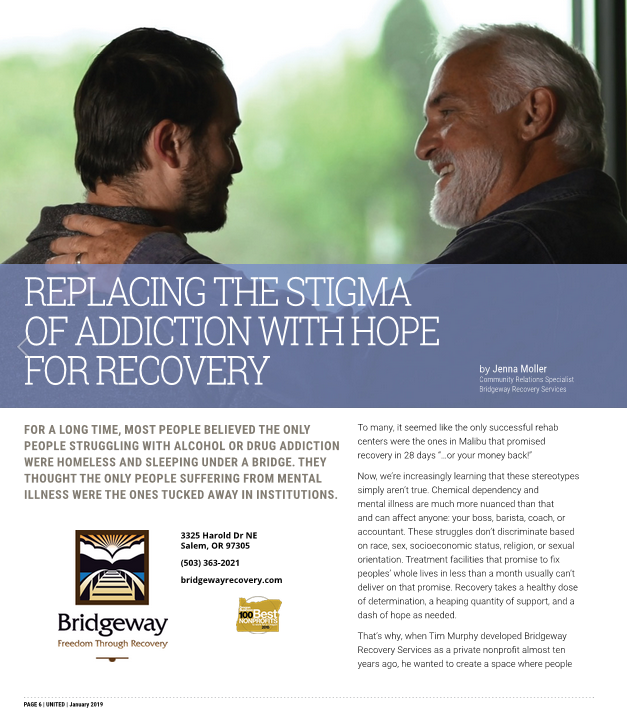
The City is seeking contributions in an effort to close the widening gap between the cost of operating a sobering center and the current financial commitments to cover that cost.  See, Moller, J. and Murphy T. "Replacing the Stigma of Addiction with Hope for Recovery." (January 2019, Salem Business Journal.) (special section United at 6.)

In November, Bridgeway CEO Tim Murphy's estimate for year-round, 24/7 operation was $638K/yr, and the gap was around $200K.  See "Sobering Center Sustainable?"  His most recent operating-cost estimate is about a million dollars.  Without additional commitments, that's a gap of about $.5M.

Not even urban renewal can close that kind of gap.  (See "Urban Renewal to the Rescue.")

The City's difficulty in pulling together the funding necessary for sobering center has contributed to delayed construction of Phase 2 renovations to the Mid Willamette Community Action Agency (MWVCAA)'s building, where the sobering center is to be located.  Phase 2 includes construction of a commercial kitchen, showers and laundry facilities for the homeless day shelter patrons, in addition to the sobering center.

Phase 1, completed last July, involved significant plumbing upgrades to accommodate the sobering center.  Sunk costs are not, however, a sound basis for business decisions, and whether to proceed with the sobering center build out should be "a business decision", should it not? 

The obvious question at this point is whether MWVCAA should proceed to construct Phase 2 without the sobering center, or with the sobering center, despite the gap in anticipated operating costs.   

Jan 2019 United piece on Bridgeway
The alternative is further delay in bringing much-needed hygiene facilities to CANDO's most vulnerable residents and increased construction costs, with no guarantee the gap will ever close.    

At the end of the United piece on Bridgeway, readers wanting to support the sobering center are asked to contact Courtney Knox Busch at City Hall.  Readers are told that

[s]ometimes, when people are struggling with addiction, they just need a roof over their head for one night before entering treatment. 

But how substantial a connection is there between sobering services and entering treatment?

We asked Tim Murphy about the idea that, sometimes, people struggling with addiction to the point that they've ended up living on the streets "just need a roof over their head for one night before entering treatment."

Interpreting the question as asking for "figures about admissions straight to detox", he said he would look.  We've spent some time looking, and, although Tim might be able to find something through his professional connections, we couldn't.

What we did find is that fear of being "dope sick" is a huge barrier to seeking treatment for addiction.  So, any delay between the decision point and treatment, and lack of transportation, shelter, and safety also are huge barriers.

Maybe "a roof over their head for one night" can prompt someone living on the streets to make a decision, but whether s/he's able to make it into detox and treatment as a result would seem to depend on the program.

Not much is known about Bridgeway's sobering center program.  MWVCAA doesn't provide any drug or alcohol treatment services.  Neither does The ARCHES Project.  As the City puts it, the sobering center program will only "connect individuals with treatment resources."    

"City of Salem Efforts to Reduce Homelessness"

On its website, the City touts the sobering center as an "effort to reduce homelessness".   But, given the lack of evidence that sobering services lead to treatment, the sobering center would seem to have about as much to do with reducing homelessness as the failed sit-lie ordinance had to do with pedestrian safety.

The other reason the City gives for supporting the sobering center is "to relieve some of the burden on our regional hospital and jail."  Assuming that's true, why aren't those entities willing to do more to close the gap on operating costs?  (Marion County is contributing $100-150K/yr, Salem Health is contributing $100K/yr for a limited time, and, contrary to what's in the United piece, there are no other commitments, including WVCH, the local CCO that's probably not going to be around much longer.)  Does their lack of contribution not suggest that the "burden" on those institutions isn't all that great?

It's been two years since Mayor Bennett announced his intent to open a sobering center in Salem.  Since that time, despite considerable time and effort, the project has not come together, but instead, has delayed construction of a much needed community resource -- hygiene facilities downtown.  Is this the best the City can do?

1/19/19 Update: the staff report on the sobering center for the Council Policy Agenda work session scheduled for 23 January 2019 states construction "could" delay opening until May 2019, and that the City of Salem's contribution is now $250K, up from the budgeted $200K.

Saturday, November 10, 2018

Sobering Center Sustainable?

By Sarah Owens and Michael Livingston


Touring future sobering space at 615 Commercial St NE, circa June 2018
The City's sobering center plans remained sketchy following Tuesday's presentation to the Public Safety Coordinating Council.  One thing was clear, however, the facility won't be opening before March 2019, probably later.

As discussed here last June, this  project is being "managed" by the City Manager's Office, and "led" by the Police Department. 

Construction of the space that will hold the sobering center has not yet begun, and it's not clear whether funding to cover the projected construction costs ($508,000+) has been secured.

MWVCAA, which owns the building at 615 Commercial Street NE, has accepted a construction bid of $1,395,000 to complete Phase 2 renovations, which now include the sobering center build out.  Originally, Phase 2 consisted of renovations to install showers, laundry, kitchen facilities and a sprinkler system, and the sobering center build out was to occur in Phase 3.  The decision to combine the two phases not only saves construction costs, it puts additional pressure on the City to move forward with the project, whether or not it's sustainable.  As of this writing, Phase 2 construction has not begun.

Also unclear is where the funds to operate the sobering program are going to come from.  The City projects annual operating costs of $638,000, but Tim Murphy, CEO of Bridgeway Recovery Services, which will operate the program, said he thought that might be too low, based on  conversations he had at the National Sobering Collaborative summit in San Diego.  Regardless, commitments from the City ($200K), Marion County ($150K) and Salem Health ($100K for a limited time) fall short of what's needed just for the first couple of years, by about $200,000.  

City Council 2018 Policy Agenda


We asked the City staff assigned to the project, Courtney Knox Busch, for a breakdown or more information about the operating costs.  She ignored the request, but did offer to come and talk to CANDO, presumably about the "one pager" she distributed at the PSCC meeting, the third published staff report on the sobering center project.

Courtney Knox Busch's one-pager
The first published staff report was issued about a year ago.  It stated that, "[a]s more details regarding specific roles, the site, and funding become available, staff will return to Council for consideration of budget, operational, lease and grant agreements."

The second staff report, issued in June to accompany a bare bones MOU with MWVCAA, stated that "to close the operating [funds] gap, the partners anticipate a grant from the local Coordinated Care Organization, Willamette Valley Community Health."
WVCH serves people covered under the Oregon Health Plan (Medicaid), which covers detoxification and treatment services, but not "sobering."  The anticipated WVCH grant was not mentioned at the PSCC meeting, or in the City's one-pager, but WVCH isn't going to be around after 2019, anyway.

Let's face it, even if we are very optimistic, and assume that they can secure an additional $200,000/yr to  operate the program, few donor agencies are willing to fund operations over the long term.  Short term, yes.  But not long term.  That's why Salem Health hasn't committed long term.  After all, it's law enforcement that stands to benefit, not Salem Hospital.  

And what about the City?  The City's 2018-2019 budget states that "there is not an offsetting revenue" for the sobering center, so it has to come out of working capital (General Fund).  But the City has an increasingly concerning "structural imbalance between the proposed cost of General Fund services and anticipated revenues."  In addition to the PERS rate escalations in FY 2020 and FY 2022, City Council just approved a collective bargaining agreement that will cost the City an additional $8M over the next three years.  The City's either going to have to cut services or raise revenue, or both, in pretty short order.  Under those circumstances, one has to ask whether or not the City's ongoing commitment of $200,000 is, you know, sustainable, especially when costs are only going to increase over the long term.

But might urban Renewal change the calculus?  See "Urban Renewal to the Rescue."

Friday, June 15, 2018

Sobering Thoughts

Revised: January 2019
 

By Sarah Owens and Michael Livingston


The City Council adopted the proposed 2018-2019 budget this week, with one minor modification, basically overriding  the Budget Committee and adding $50K to the transportation budget for Maple-Winter bikeway speed humps.

The new budget includes continued funding for HRAP and adds funding for the sobering center.  These are two of eight programs the City claims are "actively helping the homeless and working to reduce homelessness in Salem."  The other six are listed at left and on the City's website.

Mayor Peterson, bless her heart, could have offered up a similar list (less HRAP and the sobering center), but her politics got in the way.  She tended to view homelessness much the way she viewed addiction -- as moral failures to which a person should just say "no" and not the province of government except insofar as they threatened public safety.  Consequently, she did not claim credit for programs she might have, which gave the appearance the City "wasn't doing anything."

Mayor Bennett, ever the pragmatist, has no such qualms.  He also knows his constituents are very concerned about  homelessness, and his political legacy will depend in large part on his achievements in this area.  So, under Bennett, the City is both taking credit for its efforts in this area and attempting to do more, with programs like the sobering center and HRAP.

Although it is an extremely challenging program to run, HRAP is doing quite well, according to reports issued regularly by the Salem Housing Authority, who designed and runs the program.

The sobering center program, however, is something of a mystery, despite the budget commitment of $200K/year, beginning 2019.  Considering the sobering center wasn't funded in the 2017-2018 budget precisely because the City wasn't far enough along with the planning, this seems odd.

The last published staff report (issued about a year ago) stated, "As more details regarding specific roles, the site, and funding become available, staff will return to Council for consideration of budget, operational, lease and grant agreements."  Since then, few new details about the sobering center have been released, even to members of the Budget Committee.  Here's what we do know.

The latest budget says the project will be managed by the City Manager's Office (p. 202) and the Police Department will "lead the City's participation in this collaborative effort" (p. 239).

The Mayor's been heard to say that Bridgeway will operate the program (apparently having been selected without an RFP process), and it will be sited in the Mid Willamette Community Action Agency (MWVCAA)'s new building on Commercial Street (aka the ARCHES building), which is being "built out" for that purpose.  It's also been said that the legislature's committed funding of at least $300K.

The 2018-2019 budget doesn't specify what the $200K will pay for, other than "program costs", meaning operating costs, including rent. 


Book 1 of City's 2018-2019 Adopted Budget P. 239


Marion County's budget blurb indicates that the beds will not be for "alcohol-only sobering", as stated in the 2017 information report.

Marion Co. 2018-2019 Budget Committee Approved Budget


What will the sobering center try to do for drug- and alcohol-affected individuals?  The City says the sobering center will "connect individuals with treatment resources."  Marion County says it will "provide a path for addicted individuals to seek rehab services."  But how will the program do those things?  Will it be referral only?  Or will it be something more like Project Point?  What is being done to ensure treatment services will be readily available, so that there is not, as is currently the case, a long wait?  What measures will determine whether program methods are having the desired effect?  If the program's purpose is simply to "reduce the demand for needed emergency services and hospital beds" (Budget p. 4), do we know what the current demand is?  Or the target reduction? 
  
A sobering center is itself a "needed emergency service."  It's just a different kind of emergency service.  The assumption is that it's a less costly kind of emergency service, but is that really true from the City's perspective?

The City's 2018-2019 budget states that "there is not an offsetting revenue" for the sobering center, so it has to come out of working capital.  Salem Health, on the other hand, is paid to provide emergency services.  They also connect people with addiction problems to treatment.  How do we know it's going to be less costly overall to provide these services through a sobering center?  And how does it make sense for the City to take on its portion of the cost, whatever that is?

Overview National Sobering Collaborative
The National Sobering Collaborative is an organization formed couple of years ago to study sobering care as a national alternative model to current emergency department or police-based safety holding practices for intoxicated individuals.  It's preliminary survey of sobering facilities "suggests that sobering centers across the country are operating  without uniform or standardized practices, including triage protocols and outcome assessments."

Not one center studied billed insurance or individuals for sobering services, including billing of state-run Medicaid services.  The NSC considered that failure "surprising[,] given the potential healthcare savings these centers provide to Centers for Medicare and Medicaid Services (CMS) or private insurance companies."

At left is a portion of the NSC chart summarizing the survey responses.  Note that the San Francisco Sobering Center, with 11 beds and 4,450 encounters year, costs approximately $1M a year to run, and appears to sober the same folks roughly three times a year, with an average stay lasting between six and ten hours.

The 2017 information report suggests a Salem sobering center might encounter "as many as 20 a day" or "as many 300 a month."  Annualized, that's 3,600 to 7,000 a year, which is comparable to San Francisco's 4,450 (1,500 unique).  Why, then, does the City estimate it's only going to cost Salem only  $600K to $700K a year to run?  And how come Grants Pass is doing it for a lot less?   
     
Salem's sobering center was due to open in early 2019.  As of "early 2019", it's due to open in May or June.  Even though much of the community supports the idea of a sobering center, an idea is not a program.  HRAP is a program.  But, so far -- at least as far as the public is aware -- the sobering center is not much more than an idea with a lot of money behind it.

Last summer, the City Manager's Office had its hands fairly full with the water crisis.  There might not be enough "bandwidth" at City Hall to deal with that and constructing the new police station and developing the sobering center program in a transparent and inclusive manner.  There's also the question whether it still makes good financial and programmatic sense, assuming it ever did.

Sobering Ctr Design Drawing

There is a real danger that the City's efforts to deal with homelessness are fragmented, rather than comprehensive.  For instance, it is odd that the sobering center has hardly been mentioned during discussions of the Downtown Homeless Solutions Task Force (DHSTF) (fourth on the list at the top), which dissolved in August with a long list of recommendations (see here and here).

About 50 members of the public showed up for the DHSTF's hearing in June, with about 20 commenting.  Most of the comments, to the extent they touched on the proposed solutions, favored 4a (toilets) and 4d (showers and laundry) and opposed 4f (assess code), if that meant revisiting the sit-lie ordinance or something similar.  In the discussion that followed the comment period, no one even mentioned the sobering center or the ARCHES soon-to-open day shelter, or the new mobile shower/laundry program that United Way has been developing, suggesting they either didn't know about them, or didn't understand that those programs will directly impact the same areas they're concerned about.   If that's true, that should be very disturbing.

Piece meal will not get it.  The City simply must take a leadership role in developing a comprehensive approach to these problems.  During the Task Force meeting, Councilor Kaser indicated she felt that was not the City's responsibility.  The trouble is, everyone can say that, and when everyone says that, the responsibility devolves to...law enforcement.  In other words, the City.

The police are, of course, just one part of City government.  But if residents prefer approaches to homelessness that don't involve law enforcement (which is what law enforcement also prefers), then the City simply must develop a shared and comprehensive approach to these problems.  We don't need more lists; we need leadership.  The City doesn't need to do it all, but it does need to convene and communicate.  In other words, to lead. 

1/23/19 Update:  It was revealed at the Council Policy Agenda work session on January 23, 2019 that the City's commitment to sobering center operating costs had risen from $200K to $250K.

Friday, December 1, 2017

Let's Make a Sobering Deal

By Sarah Owens and Michael Livingston


Photo Courtesy HMNS
Free meals are served every evening on the east side of Marion Street, under the bridge, between the UGM Men's Mission, and the Mid Willamette Valley Community Action Agency (MWVCAA)'s new building at 615 Commercial Street NE.

The new MWVCAA building was acquired in June, 2017, with state funds ($487,000), on the condition that it be used as a day shelter for homeless and needy individuals.

But, as we all know, it isn't being used for that purpose, and can't be used for that purpose, until the building is renovated and okayed by the City, and no one seems to know when that will be.

State rules required the shelter to be opened and in use by June 30, 2017, but, due to poor planning, that didn't happen.  The Oregon Housing Department (OHCS) and the Housing Stability Council, which oversees the administration of state housing programs, don't seem to care.

So, for now, most of MWVCAA's 16,000 SF building lies empty or unused.

Which is too bad, because, ever since the SonRise Church lost its lease on the former Marion Car Rental and Park four or five years ago, the network of people that make up "Meals Under the Bridge", or MUBs, as they're called, have been hoping for another indoor location, so meals can be served and consumed in relative comfort.  Maybe even something with a commercial kitchen.

Last fall, 2016, when MWVCAA told the Salem Homeless Coalition they wanted to co-locate The ARCHES Project in a bigger space with other homeless services providers, the MUBs folks were supportive, hoping they'd be considered.  But that was then.

Now, almost six months post-purchase, the renovations that community was told would be completed by November have not even begun, MUBs are looking at another winter under the bridge, and MWVCAA is hoping for paying tenants to help cover their $10,000/mo mortgage payment.

Tenants like the City and County.  

Recall last February, 2017, when Mayor Bennett first announced his intention to open a sobering station in Salem, during his "State of the City" address.  Remember how MWVCAA, flush with its portion of $10M in statewide Emergency Housing Assistance (EHA) and State Homeless Assistance Program (SHAP) funds, started looking into buying, instead of leasing, a new space for The ARCHES Project, and the possibility of co-locating with the planned sobering station?  Was a sobering station a good fit with a homeless day shelter?  MWVCAA CEO Jon Reeves said sure, they'd both serve the same people.  (Reeves holds a graduate certificate in infant-toddler mental health and came to the executive directorship from the Head Start side of MWVCAA in 2015.)

But, sobering stations are expensive propositions that, in Oregon, can cost anywhere from $350,000 to $700,000 a year to operate.  The City would need partners.  Big partners, like Salem Health, WVCH (the local CCO) and Polk and Marion Counties.

According to sources, Salem Health was willing to put up some "seed money", but, not nearly enough.  Polk County and WVCH either weren't interested or weren't asked, and Marion County (i.e., Janet Carlson) wanted a deal.  According to sources, her support was contingent on the City supporting the implementation of the MWHITF Strategic Plan.

The MWHITF Strategic Plan was developed during the last year of former Mayor Anna Peterson's second term, and inherited by her successor, Mayor Chuck Bennett, who attended the last two meetings of the Task Force.  During the last one, he pledged on behalf of the city the generous sum of $40,000 toward Strategic Plan implementation.

He later thought the better of it.  During his "State of the City" address, he focused on his Homeless Rental Assistance Program, and failed to confirm his pledge of support for the Strategic Plan.  Commissioner Carlson left the event hall with a face like thunder, and promptly withdrew the County's support for the sobering station.

From that point, according to sources, negotiations were carried out by other, top level, City and County staff, and also the CEO of the Mid-Willamette Council of Governments (COG), Sean O'Day.  O'Day was once Salem's Deputy City Manager.

In May, 2017, City staff recommended not including a proposed $65,000 for the position in the budget, ranking it a 12 out of 13 on the General Fund "Wish List."

In June, 2017, as MWVCAA was scrambling to acquire their new building before the end of the fiscal year (when unspent EHA and SHAP funds would revert to the state), MWVCOG, at the request of Commissioner Carlson and Keizer Mayor Cathy Clark, was authorizing O'Day to negotiate an IGA, primarily between the City and Marion County, to hire a someone to coordinate implementation of the MWHITF Strategic Plan. 

In July, 2017, the City's Affordable Housing and Homelessness strategic plan work group considered the COG plan, but did not recommend supporting it.  By August, the plan was considered more dead than alive.

However, in September, 2017, City staff were seen touring MWVCAA's new building as a possible site for the sobering station. 

In October, COG authorized Day to execute the IGA he'd quietly negotiated over the summer, and MWVCAA forwarded architectural plans for their new building to the City that included the sobering station.

On November 27, 2017, the City Council approved without discussion the execution of the COG IGA, and payment of $45,000 toward a position that would now be called a "Homeless Initiative Program Coordinator."

The next morning, Commissioner Carlson e-blasted the job announcement to her lists.

Do these latest developments guaranteed the Mayor will get his sobering station, that MWVCAA will get its anchor tenant, and that Commissioner Carlson will have her Strategic Plan implemented?  Certainly it doesn't.  But, the probabilities have definitely shifted.  As more than one provider told us, "Janet always gets what she wants."

Maybe MUBs should speak with Commissioner Carlson about finding a place indoors, one with a commercial kitchen, perhaps, where people may be allowed to shelter briefly, instead of taking their meals outside, in the shadow of the Marion Street bridge, and MWVCAA's new $2.1M building.