Showing posts with label local media. Show all posts

Sunday, December 1, 2024

Why have homeless camps shifted to Lancaster Drive?

Outreach and Livability Services and friends, City of Salem, Oregon

"Lady wanted to know why homeless camps have shifted to Lancaster Drive. "

"Ever year, same thing.  Week afore Thanksgivin', it's what 'bout dem homeless, why's d'city jes lettin' 'em multiply under bridges.  It's lak nobuddy ever hearda winter er the river raisin. 

"I tole her d'poleece er downtown.  

~~~~~~~~~~~~~~ 

Get me the latest data on homeless per capita by ward, please.

Good question, but I'm afraid that calculation is not available at this time.

Well, get me the city-wide numbers, then.  I want the newly homeless year over year, last three years, compared to the total stably housed at least six months, all housing providers, by program, if you please. 

Also a good question, but also not available.

What about that regional group the City's supported the last four years?  The Homeless Alliance.  Doesn't somebody have their numbers?  

Good question.  No.  

~~~~~~~~~~~~~~   

Neighbors are scared, kids walking to school feel unsafe, and businesses are looking to relocate. I feel like Mayor-elect Hoy and I were the only ones raising this issue, but "[t]hey are now aware they have to do more and I'm hoping people will see the difference.  It will not go away completely, but they should see a difference [on Lancaster Drive] going forward."

                                                                                                    Jose Gonzalez, City Councilor, Ward 5

 ~~~~~~~~~~~~~~

“While it’s important to understand that the density of homeless persons on the east side of Salem has grown, few people have stopped to ask why.  The only person in the Statesman article that came close to addressing the “why” was the young homeless woman, who noted that “there was nowhere else to go.”  Salem, like every western city, has a deep and complex history of redlining race and poverty away from wealthier white populations with high property values. You need look no further than an overlay of current affordable housing projects in Salem for evidence that the practice continues. Some may argue that it’s best to “build within communities,” but mixed income and diverse communities are a HUD best practice.  It’s also true that the desire to keep the downtown free of the homeless and plans for future development are pushing the homeless population to the east side of town. Future development plans along Front Street in particular hope to drive the homeless out of Wallace Marine and the downtown to the east side of town, where poverty is concentrated compared to the rest of Salem.   There have been hushed, private meetings all summer saying the quiet part out loud: “for Salem to prosper the homeless have to go.”   These are all forms of structural racism, which concentrate poverty, reaffirm white privilege, protect and retain social and economic discrimination, and foster inequality.”

                                Jimmy Jones, Executive Director, Mid-Willamette Community Action Agency

Sunday, February 23, 2020

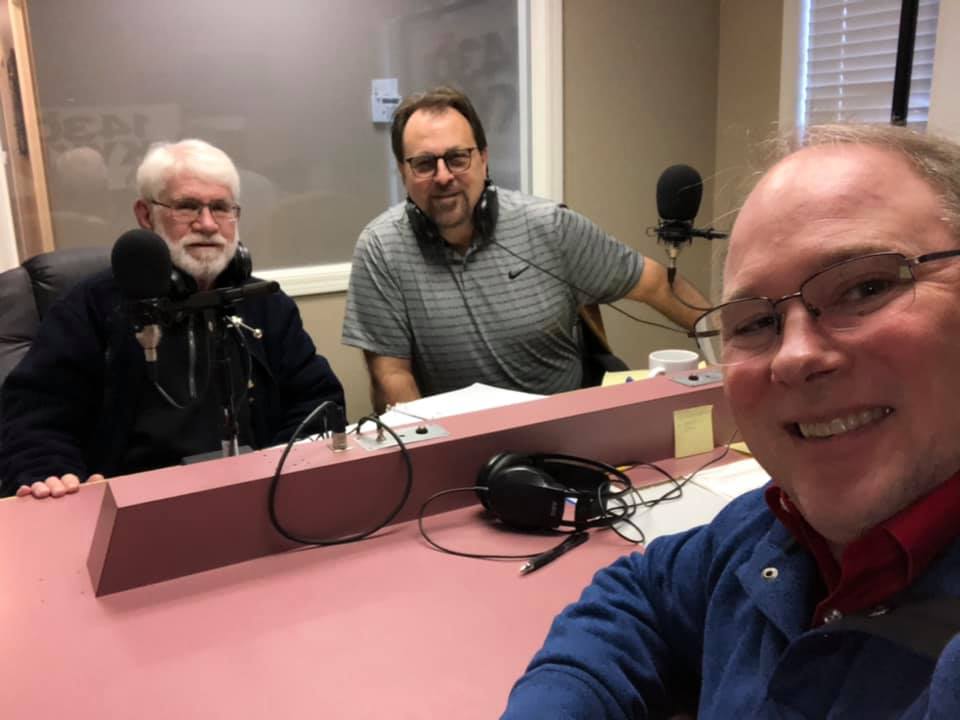
Mayor Bennett Pushes Sit-Lie on KYKN

Chuck, Brent, Dave
Mayor Bennett appeared recently on KYKN to talk about the state of the City (See "No More Allowing Homelessness!" (16 February 2020.) 

The correspondence below was sent on the dates indicated.  To date, there has been no reply.

We do understand that the Mayor is very busy and gets a great deal of mail.  The only reason for stating that there has been no reply to date is that people keep asking.
 
---------------------


From: SARAH OWENS
Sent: Saturday, February 15, 2020 2:30 PM
To: Chuck Bennett <cbennett@cityofsalem.net>
Cc: Michael Livingston
Subject: KYKN Interview

Dear Mayor Bennett,

Listened to your interview with Brent and Dave.  I'm trying to understand why it is you support sit-lie.  I understood your reason previously as being that Chief Moore had asked for it, and you simply wanted to give him what he needed.  But you now seem to be saying something more than that.  Maybe it's not a new message but different emphasis.

You told Brent and Dave that "if you don't have a sit-lie ordinance, you have no way to push people into those shelters."  You also told them sit-lie was needed in order "to get people to go take advantage of those [programs]."  But do you have any evidence that sit-lie ordinances "push people into shelters" or programs?  I've looked, and not been able to find any, anywhere.  I wondered if you had.  If you haven't, will you ask a true expert in the social work (not the City Manager or Police Chief) whether your belief has any scientific basis and take their advice?

I know you know that Council's been repeatedly advised by people like Jimmy Jones and Pamela Lyons-Nelson, as well as Chief Moore, that people have many and varied personal reasons for being on the streets.  You told Brent and Dave that "we can't meet the need for the folks down there [at Rite Aid, etc.] with the right kind of place for them to go", and that you "understand that a lot of this comes from trauma, and mental health issues, and serious addiction...and I don't disagree that that's that's the problem."  But if you understand that the City doesn't have the right kind of place for those folks to go, and that the reason they're on the streets is trauma, mental illness and serious addiction, why would you think a sit-lie ordinance would ever "push" them into shelters?  Or whatever other services you might have in mind?  It makes no sense.  

You also told Brent and Dave that, "We've had folks, and this is anecdotal, and I understand that, but I trust that people sharing the anecdote, they have gone down to the streets by Rite Aid and by Salem Center and offered 50 beds, and they've gotten 1, 2, 3, 5 takers.  People are just down there right now, seem completely unwilling to move into available space."  Was this someone from UGM?  A member of the public?  Who has 50 beds?

Finally, you told Brent and Dave about the assistant City Attorney being mugged "by a homeless person", and followed up by saying "There are behaviors beyond the pale, and we're seeing them down there now", heavily implying that the people outside Rite Aid, etc., are committing violent crimes.  But if that's true, existing laws allow police to arrest the perpetrators, do they not.  Is it fair to suggest sit-lie is needed to protect people from dangerous homeless people?  Do you not realize this adds to the considerable danger street homeless live with every day?  It's almost as if you don't consider the street homeless your constituents.  

Sorry, one last question.  Why aren't police enforcing the camping ban?  It's quite obvious there are structures on the sidewalks downtown.    

Sarah Owens

CANDO

--------------------------------------------------------------------------------------------------------------------------
From: SARAH OWENS <hlowens2@msn.com>
Sent: Tuesday, February 18, 2020 8:19 AM
To: Chuck Bennett <cbennett@cityofsalem.net>
Cc: Cara Kaser <CKASER@cityofsalem.net>; CanDo Board <candoboard@googlegroups.com>; Salem Homeless Coalition (not the "Homeless Coalition") <salem-homeless-coalition@googlegroups.com>; Michael Livingston <michaellivingston1@msn.com>
Subject: Fw: KYKN Interview

Mr. Mayor,

FYI, we have confirmed with other sources that your "50 beds" likely refers to UGM, only the offer was for a mat, not a bed, much less a living space (as the accommodation is only overnight and uncertain because it's overflow and first come, first served with sign ups in the late afternoon).  Plus, as you know very well, the Mission takes men only.  

While it might be true that the individuals outside Rite Aid and Salem Center have been contacted by local providers (UGM, SHA, MWVCAA and others) with offers of assistance, that fact doesn't justify sit-lie when, as you yourself have said "we can't meet the need for the folks down there with the right kind of place for them to go", and that you "understand that a lot of this comes from trauma, and mental health issues, and serious addiction...and I don't disagree that that's that's the problem."

For the reasons you cited, the situation outside Rite Aid and Salem Center is primarily a public health issue.  You might think it  makes political sense to adopt an enforcement strategy to deal with it, but such strategies always fail in the long term, and not necessarily because of lawsuits.  As with the camping ban -- which is being enforced very selectively -- you must understand that police are unlikely to enforce sit-lie to the extent needed to "clean the streets" downtown.

I believe you will find, if you succeed in passing sit-lie, that it will only inflame tensions and up the risk of a lawsuit.  It won't "clean the streets." It won't reduce the complaints or take the bull's eye off the City Manager, and it won't displace homelessness from its No. 1 position in the annual customer satisfaction survey.  It will however, very likely be the thing you will be remembered for most.  I doubt that's what you want.  

Sunday, January 19, 2020

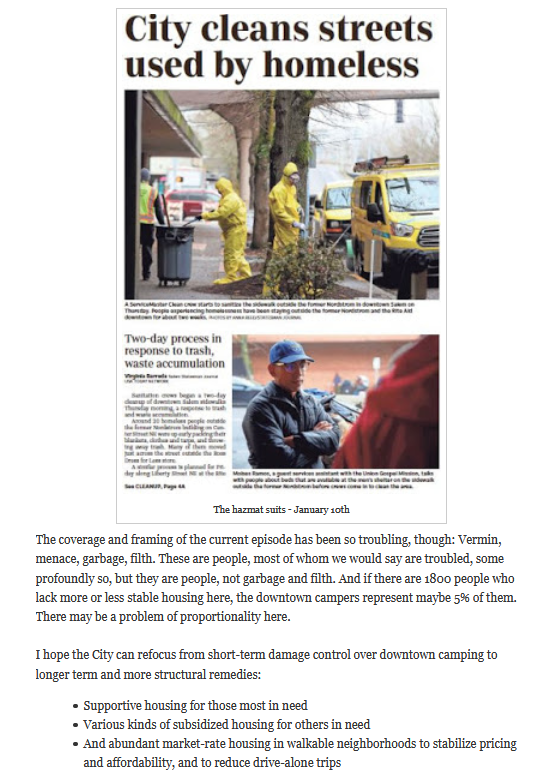
"A Problem of Proportionality"

Salem Breakfast on Bikes comments on the way some in the news media have covered recent events downtown, and what the City should do to recover from its self-inflicted wounds.

Excerpt from 1/18/20 Salem Breakfast on Bikes Post

Wednesday, January 30, 2019

KMUZ Politics Trumps Programming

By Sarah Owens


KMUZ Board President, Bill Smaldone
Bill Smaldone, the president of the board of Salem's community radio station, KMUZ (100.7 FM in Salem), "confirmed" recently that the Willamette Wake Up Tuesday team was not fired because of the absent mayor segment, which he referred to as the "encounter with the Mayor." 

Smaldone was speaking at the December 8 meeting of the Salem Chapter of the International Organization for a Participatory Society (IOPS), which he founded in 2012.

Willamette Wake Up Tuesday hosts Michael Livingston and Sara Cromwell, and yours truly are also members of the Salem IOPS Chapter, aka Socialist Friends of KMUZ.   The group donated on average about $400/year to KMUZ in the form of challenge grants.  Smaldone said that, as a result of the firing, he would not be attending any more meetings. 

No reason was given for firing the Willamette Wake Up Tuesday team, but it came just three days after the absent mayor segment aired.  It was reported here and in Salem Reporter.  See Brynelson, T. "Community radio hosts fired following interview with absent mayor."  (13 November 2018, Salem Reporter.) (quoting Ken Adams as saying the team were not "good team players" and “There’s been problems in the past. They haven’t been very communicative, and that was one of the reasons we (felt), in the past, that if we brought things up, they would not listen.”)

The absent mayor segment, the audio file of which is linked in a blog post by Livingston titled "The Radio Days", consisted of Livingston asking Mayor Chuck Bennett questions about the faltering sobering center project and the City's Homeless Rental Assistance Program, without the mayor present.   

Normally, Bennett would have been in the studio.  For more than a year, he had appeared on the first Tuesday of the month, but in October, his executive assistant emailed Livingston saying, 

Mayor Bennett determined that he will not be participating in tomorrow’s show. He suggested that you meet for coffee at some point in the near future to determine his future involvement. 

According to Salem Reporter, Mayor Bennett felt that the Tuesday team "had veered from its goal of talking about all city issues and instead focused on homelessness."  Salem Reporter quoted him as saying, “One of the biggest issues is homelessness. It’s not the only issue. And we seem to have gotten into a one-note discussion.”

During his appearances on the show in August and September, Bennett seemed to have no problem  fielding questions about the recommendations of the Downtown Homeless Solutions Task Force, which had had just completed six months' work on August 1.  He was also asked about the Corps of Engineers’ proposal to construct fish protection structures at Detroit Dam and the changes to the State Street Corridor Plan proposed by Councilor Kaser.

What Bennett didn't care for, apparently, was the CANDO Archive blog posts about the interviews, which he referred to during the September show as "transcripts", saying he needed to "have written notes in front me if you're going to be writing transcripts."  See "Mayor Mulls Dtown Hless Recs" and "City Homeless Role Unclear."

Despite repeated promises over several months to meet Livingston and me for coffee, Bennett did not follow through.  Then the email from his assistant, quoted above.  Livingston asked Bennett by email, "Chuck, Is that about the blog, or something else?", Bennett didn't respond.  That's when Livingston decided to ask his questions through the airwaves.

Melanie Zermer, Ken Adams, Pamela Kelly

Smaldone told the Salem IOPS Chapter that Ken Adams, who co-chairs the station's "Operations Team" with Pamela Kelly, did not have authority to speak for the station when he told Salem Reporter that the Tuesday team was "not communicative" and were "rarely 'good team players'."  Smaldone could not, however, explain the reason for the firing.  He suggested that the team might have been fired for not attending "all DJ meetings" and the perception that the team just did what it wanted to do.

When I reminded Smaldone that the Willamette Wake Up interim operating agreement adopted by the Program Review Committee in August of 2016 had made each day's team responsible for its own programming decisions and directed that, otherwise, everyone should "tend their own knitting" or go through the Executive Producer, Dave Hammock, he had no response.

Smaldone said he was not present when the board made its decision, but when it was explained to him, he agreed with it, based on his experience in the Salem United project, which he said Livingston and I had caused to fail five years ago.  See Bucklin, B. "Gardening in the Asphalt." (23 November 2013.) (Interview concerning the end of Salem United, which is referred to pseudonymously as the Nehalem Progressive Alliance.)  He admitted not having spoken to us about Salem United or "team player" perceptions, despite our being together at numerous Chapter meetings and other events over several years.  He also said he had not himself found us to be "unapproachable."

Salem United began in March 2013 and dissolved by a majority vote in November 2013.  See here. It was Smaldone who suggested that Cromwell, Livingston and I join Salem United.  Likewise, volunteering at KMUZ was his idea.  Both Smaldone and Cromwell stopped attending Salem United meetings weeks if not months before the group voted to dissolve.  Smaldone didn't say why he thought Livingston and I were uniquely responsible for Salem United's failure, or what it had to do with Willamette Wake Up.

"All DJ meetings" were held once or twice a year before pledge drives.  Livingston says he let Pam Kelly know when he couldn't attend and watched the video when one was available.  The show always aired pledge drive announcements and never received any complaints. 

Not since the fall of 2016 had anyone called a meeting of the Willamette Wake Up team.  As recounted in Livingston's "The Radio Days", the week before the firing, Melanie Zermer, who at some point succeeded Dave Hammock as Willamette Wake Up's Executive Producer, wrote the Tuesday team to say that "starting in January, Salem City Watch will be a sponsor of Tuesday WWU for 2019.  Thanks for the great programming you all provide."  The week before that, Adams had written to Livingston and Cromwell to thank them for "continued coverage of the Homeless Issue."  No complaints, no warnings, no hint of a problem with "the station." 


The decision to fire the Willamette Wake Up team was precipitous, without warning, and with no plan for how to fill the Tuesday slot, or to notify people lined up to appear on the Tuesday show.  Livingston wasn't even allowed to post the podcast of the excellent interview with Troy Gulstrom that also aired on November 6. 

In the days after the firing, Zermer responded to letters of concern from the community by saying "The KMUZ governing board reserves the right to terminate a show if it no longer serves the interest of the station."  Salem Reporter recently quoted her as saying, “I think it’s important that the community is able to report on itself, talk about itself,” she said. “I think it’s more genuine and gets more people engaged.”  See Brynelson, T. "Radio producer provides venue for community issues."  28 December 2018, Salem Reporter.)

Whatever it might mean for a community to "report on itself", it apparently doesn't include asking mildly tough questions of government officials.  If the replacement Willamette Wake Up Tuesday segment is any indication, it consists of hastily thrown together community events coverage and friendly chats with, as Adams put it, "people who come up and talk to her [Zermer] about things people need to be aware of."        

It's curious that "the station" can't just admit that the Willamette Wake Up Tuesday team was fired over the absent mayor segment because it didn't fit "the station's" milk toasty sensibilities as to what is appropriate for good community radio.  But, give "the station" credit for knowing the decision couldn't be justified to anyone outside the KMUZ cabal.

KMUZ: petty politics over quality programming.  Not my community radio.

Thursday, January 17, 2019

"It just didn't work out"

By Sarah Owens and Michael Livingston


Oregon Public Broadcasting ran a segment on "Homelessness in Salem" a couple of days ago, and the impression left by the conversation between Think Out Loud host Jeff Norcross and Jonathan Bach of the Statesman Journal is that Salem is just kind of bumbling along when it comes to dealing with homelessness.  

In his defense, Bach was just reporting what people, including City staff, have told him.

The City's press release stated that the crime and unsafe/unsanitary conditions under the Marion Street Bridge "confirm last year’s pilot effort to provide a single location for food distribution to the homeless was not successful." 
  
During the interview, Bach repeatedly conflated the camping ban with the ban on food distribution under the bridge and with distributing food in the area of Marion Square Park generally.

When Norcross asked Bach why people congregated under the bridge, Bach took the City's line by saying one of the draws may have been the volunteers serving food there under the City's pilot program.  He did so again when asked to explain the intent of the program (organize the area, contain people and trash, identify who was providing food) and the purpose of the ban (reevaluate the program).

When Norcross asked the same question everyone else is asking -- why did the City wait so long to clear the camp -- Bach couldn't say.  (The City hasn't said.)  Asked what went so wrong wrong with the City's program, Bach repeated what the Salem police had told him -- the unsafe/unsanitary conditions.  "It was done with the best of intentions, it just didn't work out", he said. 

"It just didn't work out" makes it sound as though the City uses a trial and error approach to homelessness.  Trial and error is appropriate for simple problems and games.  Not the best approach for dealing with people who feel their best option is to camp and eat under bridges.

Norcross told Bach, "This all sounds very familiar.  Other cities, especially on the west coast, are dealing with a growing homelessness problem", and asked, "Is it different in Salem, in some way?"

"It's hard to say", Bach replied.  "You can go to Bend, you can go to Portland, you can go to Salem, you can go to Eugene, it's a problem that a lot of cities are trying figure out how to deal with.  Salem has one approach, Portland and Multnomah County have a different approach", but he couldn't say what either was. 

So, after two years of covering homelessness in Salem, Bach cannot describe Salem's approach to homelessness.  Is that because he isn't paying attention?  Or might it be because Salem doesn't actually have what anyone would recognize as a plan?

Bach did, by the way, mention Salem's Homeless Rental Assistance Program.  He told Norcross that HRAP clients were ultimately supposed to become self-sufficient, which isn't quite accurate, although it is what the program's annual report says.    

Friday, December 8, 2017

Those Statesman Journal "Answers"

Revised: January 2019
 

By Sarah Owens and Michael Livingston


Statesman Journal's New Offices, Photo Courtesy SJ
Since moving out south to 340 Vista Avenue last May, the Statesman Journal's perspective on Salem's homeless residents has altered somewhat. 

While in CANDO, at 280 Church Street, staff took their latte breaks at the Ike Box, along with their homeless neighbors, looked out their windows at the transit mall, and could walk downtown anywhere they needed to go.  And anywhere downtown they went, there were CANDO's homeless residents, also.

There are few homeless out in the Vista neighborhood, however, or at the French Press, in the Roth's parking lot (not counting the panhandlers on the corner), or in the Candalaria neighborhood, to the west.   

Judging by its most recent article, "Your Questions about Salem, Oregon's Homeless Crisis, Answered", the new perspective hasn't improved its reporting on the subject.

For this latest article, the SJ asked readers to "guide our reporting by sending in questions they have" about Salem's homeless through a note on their FB page.  SJ claims the questions they chose to answer were the "most frequently asked", but they were clearly cherry-picked from among those posted on its FB note.

Questions Answered

"What are the demographics of homeless people in Salem?", "Why, all of a sudden, has Salem's homeless population swelled?", "What barriers do they face on the path to not being homeless anymore?"  "What's being done in other parts of town [than the central area and] What about warming shelters?"  "What type of outreach are officials doing for the homeless rental assistance program?"  "Are there shelters where the homeless can have pets with them?"  "Are there homeless shelters in Salem that are non-religious?"  "What shelter options exist for homeless teens?"  

Questions Not Answered
 
These questions, which were not answered, were also posted to the SJ's FB note:  "How does the City's plan to invest $45K in a "Homeless Program Coordinator" at the Council of Governments [COG] fit with the City's recently adopted Strategic Plan goals and strategies for Affordable Housing, Social Services and Homelessness [AHSSH]? Is the City counting on the COG position to implement the City's AHSSH goals and strategies? If not, why create the additional layers of oversight? Aren't the Policy and Steering Committee and the Coordinator going to be duplicating existing efforts?"  "How about answering the same questions for this area that the Seattle Times is working to answer for the Seattle area in its Project Homeless initiative?"  "Is SJ willing to 'pull back the curtain on the response system and see how well it serves the distinct populations of homeless'?"  "Do the homeless really want help? If so, what kind? How many are elderly? How many are teen? How many shelter beds are available in Marion-Polk counties? How many are needed?  Why don't you talk homeless people? What are their stories? What kind of help do they need?"  "Are there plans to create other shelter options like tiny houses, etc?" "What are the timelines on the projects underway, like the day-use center? What can citizens do to help those in need?" "What is Salem doing/going to do to help provide more comprehensive mental health care to these individuals?" "How...are [city officials] coordinating the different pieces in this plan re: banning loitering on sidewalks before a day Center or rental assistance program are up and running wouldn't be very effective."  "How can existing supports be augmented to address homelessness and issues related to homelessness instead of creating new infrastructure?" "What can be done so that the shelters are more comfortable for people? Can we look into coed shelters? Can we look into ways to help the homeless who have pets? What about a daytime shelter?" "How many choose the homeless life style, living on the streets, in cars and in our parks? If they refuse help, then what?" "Is anyone doing anything to address the root causes of homelessness?" "How are city zoning laws effecting housing prices, and is there anything to be done to lower prices so housing is more attainable?" "Are the homeless [in Salem] transients looking for handouts or have they lived in Salem, and actually need help?"

"A Variety of Experts"

The SJ article claims they "reached out to a variety of experts" to answer the eight cherry-picked questions.  Those "experts" were Dan Clem, former Salem city councilor and Union Gospel Mission (UGM) Director since May of this year, Stephen Goins with Northwest Human Services (NWHS), Jimmy Jones with the Mid Willamette Valley Community Action Agency (MWVCAA), and TJ Putman, Salem Interfaith Hospitality Network Director.

Dr. Jones, who was quoted in five of the eight answers, holds a doctorate in European History, and joined MWVCAA in July 2016 as a coordinated entry specialist.  In March, 2017, he was promoted to Director of its Community Resources Program, and became the driving force behind The Golden ARCHES Project.  He probably would not consider himself an "expert." 

Mssrs. Clem and Putman also probably would not consider themselves experts.  They answered the questions about the role of religion and pets in shelters.  Stephen Goins, who might actually deserve to be called an "expert", being a qualified mental health practitioner who for several years has managed HOST and HOAP for NWHS as Director of Transitional Programs, was asked about barriers to recovery.

The Answers 

 Bowl of Apples, Photo Courtesy HGTV
Answering, "Why, all of a sudden, has Salem's homeless population swelled?" (and without pausing to examine the question's premise), the SJ quotes Dr. Jones, who "likens the noticeable uptick to a bowl of apples on a table. If there were one apple in the bowl, you might walk by and not notice it. But as you put more apples in the bowl, they'll start to spill over.  'Eventually, you're going to have a whole table full of apples, overflowing everywhere else,' he said. 'And then, all of the [sic] sudden, you're going to notice that.'"  

Really?  The homeless are like a bowl of apples on a table?  

Dr. Jones is also "quoted" as saying that Salem's unsheltered homeless population grew from about 200 in 2014, to about 500 in 2017.  When we asked Dr. Jones how he arrived at the 2014 estimate, he demurred.  "We [he and the SJ] talked for 30 minutes, and I don't remember the context of it all...[the number was] something akin to the street count in the PIT in 2014."  (The MWVCAA's 2014 Point in Time Count report indicates 202 unsheltered individuals were surveyed in Marion and Polk Counties that year.)  When we asked why he would accept the 2014 PITC figure, but not the 2017 PITC figure of 295, he admitted he thought the 2014 count was wrong, but didn't want to venture a guess as to the true number.  

So, the SJ article wrongly suggests, based on Dr. Jones's unexamined opinion, that Salem's homeless population has been growing by 100 more apples a year.  It also seems to suggest that those apples are "overflowing everywhere" because the bowl's not big enough.  Or something.  

SJ Photo: A Sack Lunch at ARCHES
If you don't find the SJ's answer satisfying, try this:  the perceived "uptick", which was noted primarily in CANDO's central area, was partly due to the decision by the then UGM management, in the summer of 2016, to close the locker program, "because of the difficulty preventing the lockers from being used to store drugs", and the day room, so as to encourage long-term guests to get out and seek work.  (UGM re-opened its day room ~June 2017, but not the locker program.)  

This change in policy meant men who had previously been able to move about the city without all their belongings in tow (i.e., without necessarily appearing to be homeless), were no longer able to do so.  Others, some in wheelchairs and unable to work, who previously had remained in the day room, were forced outside the building, where they just waited until they were allowed back in.  The fact that UGM is located prominently next to the Center Street Bridge just added to their visibility.

Other factors include the closing of the ARCHES day shelter on Madison Street back in June, and The Salvation Army's decision to cut back on its programs for the homeless in August, and the ARCHES inability, since June, despite its being a requirement of the state funding ARCHES  received for the purchase of the building, to open a day shelter at its new Commercial Street location.  That failure has meant, among other things, that the sack lunches ARCHES distributes every M-F must now be eaten outside, in the weather -- a fact the SJ article depicted but failed to appreciate as contributing to the perceived "uptick" in the downtown homeless population it was attempting unsuccessfully to explain.

Note: the SJ also failed to report that, last July, CANDO sent a recommendation to the City Council
which was backed by the Salem Police Department and Stephen Goins, to pilot a locker program to replace the one lost in 2016, with no response.  MWVCAA has indicated in grant applications and reports that it intends to institute a locker program in its new building, but, so far, nothing's been done.
  
So, aside from the apple thing, the article offers little that was not already published here, on social media, and through Dr. Jones's speaking engagements at Rotary Clubs and such like over the past year.  (See links above under Questions Answered.)  One newsbit:  according to Dr. Jones, "Once our day center is done, we plan on using it as a nighttime warming center with a bit higher trigger, maybe 32 degrees."  

For MWVCAA to use their new building as a shelter for people experiencing homelessness would be a  nice change of pace.  But, bear in mind that when anyone from MWVCAA says "plan", what they usually mean is "hope", or "thought about."  It doesn't mean they're actually doing anything to make it happen, though you wouldn't know that from the uncritical accounts published by the Statesman Journal.

Friday, August 25, 2017

Salem Weekly Fact Check

Revised: January 2019


By Sarah Owens and Michael Livingston


Salem Weekly
Salem Weekly yesterday published a rehash of a story it published August 3rd about The ARCHES Project moving to 615 Commercial Street NE with the addition of an unsourced detail that appears to be an attempt to answer the main question raised in this recent blog, which is whether the state approved the use of state funds to acquire the property. 

In the rehash, Salem Weekly and author Delana Beaton assert that the Oregon Housing and Community Services Department approved the use of $.5M in state funds to purchase the  building in February of 2017.  We asked Delana where she got that information, and whether she had been provided any supporting documentation.  She did not respond.

If Salem Weekly's assertion were true, it would means that the Mid Willamette Community Action Agency (MWVCAA) sought approval from the state before getting approval from its board of directors.  That would be contrary to ORS 458.505(4)(c), which requires Community Action Agency boards to approve "all contracts, grant applications and budgets and operational policies of the agency."

A little research would have taken Salem Weekly to MWVCAA records, which show that Executive Director Jon Reeves did not seek board approval to use state funds for a down payment until March of this year.  The building he was wanting permission to buy at that time was not 615 Commercial Street, and there was no mention of needing, much less having received, state approval of the purchase, which is telling because the state required both an application and a detailed project proposal for approval.  Reeves did not even decide to buy 615 Commercial Street until June 2017, so OHCS couldn't have approved the purchase in February.  

As for the rest of the article, the Salem Weekly may well be correct that The ARCHES Project is serving more sack lunches and assessing more clients in its new location, and they may well have organized a 3-day cooling center (offsite at 770 Commercial St.), but it was not "in the midst of major renovation work", which hasn't yet begun.    

Thursday, June 1, 2017

MWHITF: Carlson Denies Wrongdoing

Revised: December 2018

By Sarah Owens and Michael Livingston


[Material originally posted under the titles, "Janet Carlson: Fact Check" (18 March 2017) and "Salem Weekly: Fact Check" (26 May 2017).]

For over a year, the Tuesday Willamette Wake Up team, then consisting of yours truly, Sara Cromwell and Sarah Rohrs, covered the Mid-Willamette Valley Homeless Initiative Task Force for KMUZ, 100.7 FM in Salem.  We also reported on the Task Force here in the CANDO Archive.   

However, it wasn't until January of 2017 that any of our reporting came to the attention of Marion County Commissioner Carlson, who took particular issue with the Willamette Wake Up report that aired January 17 (podcast here).  Melanie Zermer and Bill Smaldone (President of KMUZ's Board of Directors and member of the Salem Weekly Editorial Board) both reviewed the podcast, and concluded "the research was thorough and makes a compelling argument for public concern."  John Gear, legal counsel to the Board, also reviewed the podcast and approved the quality of the reporting as a "scoop."

About ten days after the report aired, the County asked KMUZ to "either remove the podcast from further distribution, or allow the county, and other task force conveners if they wish, the opportunity to respond in a follow up interview." 

KMUZ's President responded to the request saying that, of course, there would be an opportunity for a response.  Willamette Wake Up's Tuesday team arranged an interview date but had to cancel because of a power outage at the station.  The County did not follow through on the offer to reschedule.  The last communication from the County was a February 20 email saying they would "touch base with Michael next week", which they never did.        

On March 16, Salem Weekly ran a cover story about the January 17 Willamette Wake Up report.  The story said the County's PR person "looks forward for Commissioner Carlson and her having the opportunity to 'correct factually inaccurate information, and answer questions by the show hosts regarding the task force.'"  However, the County never attempted to reschedule an interview.     

The same day the Salem Weekly published its story, "Gator" Gaynor interviewed Commissioner Carlson on his show, Gator's Radio Experience, on KYKN, 1430 AM in Keizer.

The show has since been canceled, and the show's podcasts are no longer available.  However, three things about her interview are worth noting.

First, Carlson told "Gator" that she still wanted to do the interview with the Tuesday Willamette Wake Up team, she "just hasn't had the opportunity."  The show aired Tuesdays from 8 to 9, and the team was willing to schedule as far out as necessary to accommodate the Commissioner's schedule.  

The other two noteworthy bits were her comments about Polk County Commissioner Jennifer Wheeler's reasons for leaving the Task Force and her failure to respond directly to the report's very specific charges --  for example, the charge that she withheld Wheeler's October 18 memo from the Task Force and the public and that she was dishonest in telling the Task Force that Heidi Mackay and Sheriff Garton had not resigned.   

When asked during the interview, "from your mouth, what happened with Jennifer Wheeler?", Carlson responded:

Jennifer had some personal things going on in her life at that time, and she stepped away from the Task Force, uh, she, there was some confusion in how the letter was written, and so, when, when we got the letter, Anna, Cathy and myself, from Karen [sic], we needed to check in to find out whether it meant that Jennifer was stepping down, or whether Polk County was stepping away.  And that took us a little while to, uh, Anna talked to Mike Ainsworth, I talked to Craig Pope, uh, we also talked with our legal counsel, they had not rescinded their charter, so we thought it would be best to clarify at the next meeting, that while Jennifer had resigned, that Polk County was still at the table.  So it was the consensus of the co-chairs to come up with a statement, uh, to say that the four jurisdictions were still moving forward.  When I talked with Craig, they were really not interested in trying to, you know, the other two commissioners had a lot of commitments, didn't want to step in, and only three meetings left at that point, so, uh, that was where we went.  I sent you an email, I hope you got that, from Jennifer where, uh, she basically did not condone the, you know, kind of the blogs and the commentary that was going on about the Task Force and Polk County. 

After hearing the interview with "Gator", we asked Commissioner Wheeler whether she in fact "stepped away" from participating further on the Task Force because she "had some personal things going on in her life at that time."  This was her response, received March 23, 2017.


In closing the interview with "Gator", Carlson said,

The other point that we want to make is that in some of that innuendo or insinuations or speculations, there's a lot of discussion about transparency and whether we're being transparent or trying to mislead and all of that, you know everything was done appropriately under public meetings laws, you know, when a question came up, I contacted our county attorney, she sent me a statement, I sent that statement out, and I sent that statement to you [the interviewers], that, you know, what we were doing was within the bounds of the public meeting law.  I'm the one in Marion County that actually started the training in public meetings law.  It's a big deal to me, so it's interesting that somehow I'm getting tagged with the idea that I'm doing something inappropriate.   

On May 25, 2017, Salem Weekly ran yet another story about the January 17 Willamette Wake Up report.  In it, Carlson maintains that, contrary to the report, she was not a friend of Karen Ray, but a former colleague whose work she admired.  Carlson told Weekly she did her doctoral dissertation on one of Ray's books.  The report referred to Ray as "her friend, they had worked together in past years."

The Weekly incorrectly characterized the report as saying, "Ray's hiring...to do work a qualified volunteer could have done was contrary to the directive to co-chairs that they limit themselves to administrative actions."  What the Willamette Wake Up report actually said was,

Carlson was unable to persuade Co-Chair Polk County Commissioner Jennifer Wheeler of the need to go out of state, or to pay $20,000 for services that Wheeler suspected very well were available in the community, and probably for free.
and,

The County Counsel for Marion County, in responding to our request to attend and cover these co-chair meetings said they [the co-chairs] don't have any authority to make any substantive decisions, their authority is to schedule meetings...put items on the agenda, sort of ministerial, not to make any substantive decisions. 

Carlson admitted to the Weekly that Wheeler had left "over her unhappiness with the hiring of Ray, but Carlson adds that the departure was also due also to personal matters unrelated to the task force."  Wheeler has, as noted above, denied this.  

Carlson told the Weekly she rejected the report's suggestion that "she misled assembled task force members at the November 7, 2016 meeting...where she stated that several Polk County members 'just couldn’t be here.' It is not accurate, she maintains, to say that she made that statement 'knowing' that Polk County had actually departed."

Carlson's exact words to the Task Force at the November meeting were, "If I could clarify.  Jennifer resigned.  Steve Bobb sent in his resignation recently.  Heidi Mackay has not resigned.  Sheriff Garton has not resigned.  They just couldn't be here tonight."  The report did not allege Carlson's comments were made, "'knowing' that Polk County had actually departed", but that she made them after she had received and replied to, that very morning, an email from Heidi Mackay.  Mackay's email stated:

As already established by Commissioner Wheeler's letter dated October 18, 2016, Polk County is declining to participate in further meetings of the homeless task force.  Accordingly, as one of Polk County's appointed task force members, I also decline to participate in ongoing task force business. 

The Weekly stated that, "In fact, Carlson's documentation shows Polk County had not left the task force on November 7, and never did."  We haven't seen Carlson's "documentation", but the issue raised by the Willamette Wake Up Tuesday team was not whether Polk County "left" (i.e., whether its Task Force Charter remained intact), but why Carlson misrepresented the situation to the Task Force and the public.  The fact of Wheeler's memo is undisputed.  The fact that Carlson withheld it from the larger Task Force is undisputed.  The fact that Carlson received and replied to Heidi Mackay's email  prior to the meeting is undisputed. And, the fact that she told the Task Force that Jennifer Wheeler and Steve Bobb had resigned but Heidi Mackay and Sheriff Garton had "not resigned, "[t]hey just couldn't be here tonight," is undisputed

The Weekly had no basis for saying that, "The January 17 program...was part of an ongoing conflict between [the show's] co-host Michael Livingston and his wife, Sarah Owens, -- and the task force."  This is an ad hominem, circular argument that seeks to imply, but does not state, that the January report was somehow biased, and therefore lacking in credibility, because of critical CANDO Archive posts and emails linking to them that were sent to the Task Force once a week.  The claim of "ongoing conflict" was not raised in Carlson's interview with Gator Gaynor on KYKN in January, or anywhere else we know of, and it is not true.  Moreover, Carlson told her co-chairs in an email obtained through public records requests that "I don't read Sarah Owens' emails."              

Saturday, February 4, 2017

Salem's Homeless Chronic

From the National Alliance to End Homelessness
The latest issue of the Salem Weekly has an op-ed piece titled, "Addressing our Homelessness Crisis." 

It asserts that homelessness "has reached near epidemic proportions in many cities of the U.S."  It doesn't say which cities, though, so it's not clear who "our" refers to.

To say homelessness has reached epidemic proportions suggests there's been a rapid and uncontrollable increase in the number of people experiencing homelessness; that there's a "crisis" occurring in many U.S. cities.  Maybe, but the Weekly didn't make the case.   


"The number of people who are homeless...continues to decrease."
Salem, for example, does not have a homeless "crisis" so much as it has a homeless "chronic."  What do we mean by that?  Two things.

One, Salem's approach to homelessness, like its approach to so many things, has been habitual, long-lasting, and patterned over a long period of time to conform to outdated norms.  Specifically, the City has, year after year, let religious institutions such as UGM, The Salvation Army, and others provide its residents emergency shelter, with little if any support from the City, while continuing to fund, year in and year out, the same favored social service programs, without regard for whether those programs are, in fact, effective in addressing community needs.

Two, the City has, as a result of its habitual, long-lasting and patterned approach to homelessness, neglected the most vulnerable, the so-called "chronically homeless", the "service resistant", the "hard-to-house", those who supposedly "don't want to be helped."  As a consequence, and as the Weekly observed, Salem has something like twice the national average of chronically homeless.  That's why the downtown is the way it is, and it's only going to get worse if the City doesn't change its approach to the problem.

Everyone can agree with the Weekly's observation that resources "need to be used in the most effective possible manner", but it is hard to know what to make of the statement that, "Providing a place to live or sleep may meet immediate basic needs, and that may be a needed first step." (Emphasis added.) 

Research has shown that providing housing first is the needed first step.  So, wake up Salem Weekly.  Wake up City of Salem.  This is not a new idea.  What's needed is permanent supportive housing, not sanctioned camping and car-camping programs.  A resource center would be nice, but it won't begin to address the needs of Salem's most vulnerable - the chronically homeless.

Salem's homeless problem is not widespread and uncontrollable, meaning it's not of "epidemic proportions."  It's chronic; built in; systematized.  It's the result of 1) capitalism, and 2) long-term neglect, and while we can't do anything about 1), we can do something about 2).  Other communities have made inroads, but only after they gave up habitual, long-lasting and patterned approaches to the problem, and followed the research.  C'mon Salem Weekly, help us out.  Don't follow habitual thought patterns.  Do your research.     

Sunday, January 31, 2016

Homeless for the Holidays

The ARCHES Project on Madison Street NE, 2016

 Revised: December 2018

By Sarah Owens and Michael Livingston


In 2009, the Salem Weekly published a piece by called "Homeless for the Holidays" (Salem Weekly, 31 October 2009) that set out to "paint a picture of homelessness", but found in the end that "no single brush, color or canvas" could do the subject justice.  In 2016, we updated the article after paring it down to a listicle.  Here is this year's update.

2016:  The $79M NASA Moon mission did, in fact, locate water on the moon in 2010. 
2018:  NASA's next flagship Mars mission, the Mars 2020 rover is projected to cost >$2B.  The Pentagon estimated deploying troops to the southwest border per order of President Trump would cost $72M.

2016:  Mattel's "homeless" doll, Gwen Thompson, which retailed for $95 in 2009, can still be purchased on eBay -- for $190 (she's no longer advertised as a homeless doll).
2018:  The doll is still available on eBay for between $120 and $200.


2016 eBay listing for Gwen Thompson doll


2015:  Visits to The ARCHES Project day center on Madison Street totaled 2,290 in the third quarter, down from 2,945 in the third quarter of 2009.
2018:  Visits to The ARCHES Project day center on Commercial Street NE totaled 5,385 between  opening day (July 25) and October 16.  Visits in October alone totaled 2,851 (daily average 124). 

2016:  The ARCHES Project on Madison Street had no shower or laundry facilities for clients.
2018:  The ARCHES Project moved to Commercial Street NE in June 2017, and still has no shower or laundry facilities for clients.

2016:  Shelters still "specialized."
2018:  Unchanged.

2016:  Sleeping in public was still cited, but less often.
2018:  Impossible to know for sure, but changes in the law suggest sleeping is not being cited.

2016:  Homelessness was still a merry-go-round. 
2018:  Largely unchanged, despite claims for MWVCAA's "Coordinated Entry Program."

2016:  Discriminating against those with felony convictions was still allowed, but a new "reentry" program was helping a few be more successful.
2018:  Unchanged, except that Salem Housing Authority has lowered some criminal history barriers

2016:  Thanks to the initiative of five women, there were a few public toilets open 24/7 downtown. 
2018:  The "Arta Potties" initiative folded in January 2018.  See full story, "Toilets and Panhandling", here.

2015:  The homeless student count was down to 491 from 879 (2009).  
2018:  The homeless student count rose above 1,100.

2016:  The wait lists for government housing in the rural areas around Salem were unfrozen. 
2018:  Unchanged.

2016:  There are still 1,000 housing vouchers for rural areas around Salem, and a long wait list.  
2018:  Unchanged.

2016:  The Salem Housing Authority still had about 3,600 housing vouchers, and a long wait list.
2018:  Unchanged, except the list is frozen.

2016:  Demand for emergency food boxes from Marion-Polk Food Share had been rising steadily. 
2018:  Each month, MPFS serves >9,000 families (40,000 individuals) through its partner network.

2016:  Salvation Army was still turning people away each night. 
2018:  Salvation Army eliminated its transitional housing program, greatly restricted its meal service, and raised requirements for admission to the emergency overnight shelter, such that there are often empty beds.

2016:  UGM still sheltered an average of 200 men each night.   
2018:  Unchanged.

2016:  Mid-Willamette CAA was keeping wait lists again. 
2018:  Unchanged, except they're now calling them "interest lists."

2016:  The $10.5 million set aside by Housing Opportunity Bill to build affordable homes for low-income residents, not necessarily homeless, between 2009-2011 had little, if any, effect on Salem's housing market.
2018The Legislature increased the document recording fee for affordable housing from $20 to $60, which is expected to raise $90M/biennium, and allocated $5M for emergency shelter, a portion of which came to MWVCAA to support area warming shelters. 

2016:  Lack of housing remains the main complaint. 
2018:  Unchanged.

2016:  The enforcement of vagrancy laws has been greatly relaxed. 
2018:  Salem tried unsuccessfully to pass a "sit-lie" ordinance, but repealed its vagrancy law (SRC 95.560).